I would like to know what’s the influence of first generation immigration in these charts, because the states are kind of shit at reporting that.
My kids speak Spanish. They can read in both Spanish and English, but they learned Spanish first, so it took them a while to catch up in English. Many of their classmates come from Spanish speaking families, English is their second language, and they have a bit more of trouble. The issue here is that state level standardized testing doesn’t seem to care about Spanish at all, so you may find a bunch of very smart kids who score below average just because they speak more than one language, which is frankly insane.
Something like 22% of the US speaks something other than English at home. I wonder how this plays a role. I have no data beyond this, but it’s just something I’ve wondered about.
My kids district is a diverse one, I think white is just barely the majority, and it’s a real smattering of all sorts otherwise. There are a lot of kids who come from parents who clearly speak no English. And so when test results come out, they don’t look great for the school, but it’s kinda like no shit, we have kids learning English for the first time, of course they won’t test well.
So for this reason, I see how my kids are doing, I read with them, I do math with them, and if things seem good then they seem good, and I’m not personally going to stress over test score trends schoolwide, and certainly not statewide or nationally.


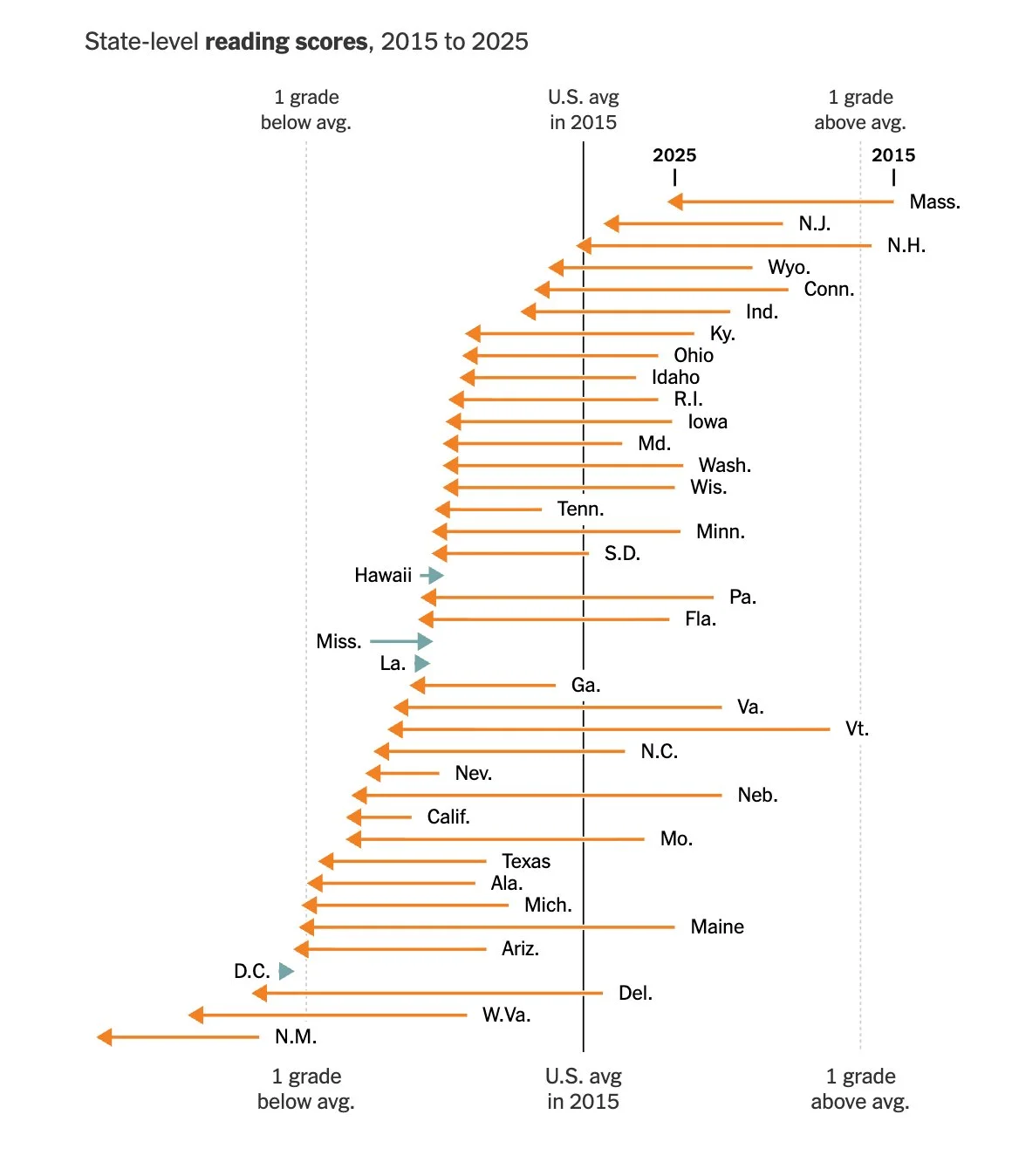
I would like to know what’s the influence of first generation immigration in these charts, because the states are kind of shit at reporting that.
My kids speak Spanish. They can read in both Spanish and English, but they learned Spanish first, so it took them a while to catch up in English. Many of their classmates come from Spanish speaking families, English is their second language, and they have a bit more of trouble. The issue here is that state level standardized testing doesn’t seem to care about Spanish at all, so you may find a bunch of very smart kids who score below average just because they speak more than one language, which is frankly insane.
Something like 22% of the US speaks something other than English at home. I wonder how this plays a role. I have no data beyond this, but it’s just something I’ve wondered about.
My kids district is a diverse one, I think white is just barely the majority, and it’s a real smattering of all sorts otherwise. There are a lot of kids who come from parents who clearly speak no English. And so when test results come out, they don’t look great for the school, but it’s kinda like no shit, we have kids learning English for the first time, of course they won’t test well.
So for this reason, I see how my kids are doing, I read with them, I do math with them, and if things seem good then they seem good, and I’m not personally going to stress over test score trends schoolwide, and certainly not statewide or nationally.
It would be interesting to see how multiple language statistics have changed. With any luck, maybe the numbers have increased.