

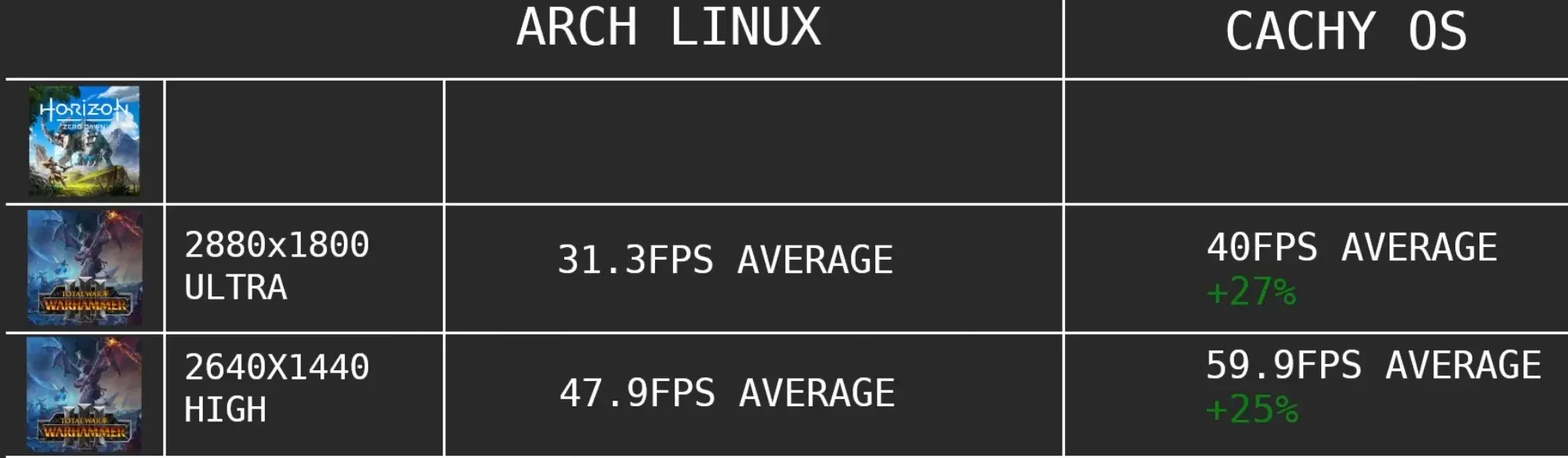
Small sample set aside, the performance differences here are much bigger than I’ve seen in previous linux comparisons. Something has to be off right? Curious if anyone is able to reproduce these results.
Small sample set aside, the performance differences here are much bigger than I’ve seen in previous linux comparisons. Something has to be off right? Curious if anyone is able to reproduce these results.
It’s just a matter of learning Linux before dealing with the Arch way of doing things, at the end of the day. As there are guides and shit, but it’s a task that someone should only undertake if they feel ready…Prepared with snacks, the Arch Wiki, and good curse words in case of failure. Personally as a graphical install king, I think vanilla Arch is just TOO barebones, but archinstall is just right. Shame it needs internet to install. However, there is nothing inherently wrong with the Arch way, as long as it is recommended to the right people, there is simply no issues with it. As it is for people that are ready for the next step, a fully minimal system that is set-up in the way they like. However, perhaps Gentoo would be better for maximal precision, as there are a lot of ways to shape the system and the applications you install to suit user purposes on Gentoo. Not that I would know how at the moment, perhaps when I have plenty of time to learn.
I honestly wanted to point out the whole FreeBSD thing in case someone took it at face value. As yah know, sometimes sarcasm doesn’t translate well for people (note that I laughed with a ROFL myself thinking your being silly not serious).
I think FreeBSD is actually great, I’m looking for a reason to install it on anything just to have it around.
And Gentoo too. I’m currently on a MacBook Pro (2014, Intel era) with Arch Linux. Weirdly, the hardware support is great, and it feels like even better than macOS. For some reason, some other MacBooks I have are much worse with some things Linux. Eg sleep and battery life estimation. But apart from that, they’re better than macOS, as they’re long obsolete.
I want to have Gentoo somewhere, and I’m just not sure where to start. It surely have to be a separate machine to not hurry with the install and setting it up. (However, I expect that most if not all my user configs would just work, assuming the same software stack.) But that machine is expected to be powerful too!
At this point, I think of getting a MacBook Air M1, perhaps the next year. Or maybe even years, depending on real life events, that’s rather a cool toy to me at this point than a real need. But ideally, I’d like to have it when being obsolete (not supported with macOS updates) and Neo having at least two or better three generations. Which would make its price to value very attractive. I thought of having Gentoo there, since Arch is not supported, and I’m not a big fan of Arch Arm project.
I would like to use Gentoo so much, I thought of actually getting a used somewhat broken MacBook Air (I’ve seen one with partially broken screen for like a bit over €100), and use it as a test machine. Then, just buy another one, in a better shape when it would enter its obsolete state, which would inevitably happen at some sooner rather than later point.
I expect it would be just perfect for Gentoo. FreeBSD, I have no idea. Thought of getting a tiny PC just for it, without any purpose in mind. Perhaps I’d find one along the way. I’ve researched briefly, and there are either Mac minis of 2014 with a very nice idle energy consumption and price locally (about €100 or even less). Or some N100 Chinese similar computer, but I have no idea about the hardware support.
There are some security issues and poor defaults with FreeBSD, these issues are ultimately what made me swerve left for the time being until these issues are resolved by the FreeBSD security team and devs. It makes me sad, because in my opinion FreeBSD is holistically developed as a unit, so it flows together! It feels coherent and sane, unlike Linux distros which are a disparate parts that are fused into a singular thing. In a way that is pretty fucking metal that all these separate projects are fused into working Linux distros which for the most part are stable…Kinda like a multicellular organism.
Yeah, honestly, it does sound like you have a good idea of where to start at least in terms of either learning Gentoo or FreeBSD. Purchasing recent/old but capable hardware that won’t put your current hardware at risk of getting borked due to experimentation, is for the best (as long as it won’t hurt the old pocketbook). I wouldn’t choose anything Apple because that hardware can be particularly annoying when it comes to driver support and the like, but if you want to live on the wild side. It’s your life and you can have all that smoke, because I can’t imagine the troubleshooting is going to be much fun.
For my part, I plan on learning about Gentoo in a sane timeframe because there is literally no hurry, my spare laptop is recent enough that compiling won’t take long and it will be supported by Gentoo. I love the idea of being able to set specific compiler flags within the package manager that automatically compile programs based on those user designated flags. I’ve wanted to test the viability of stripping systemd out of my life for a while now, openrc (which Gentoo uses as an init service) seems pretty cool and simple. The Gentoo Handbook is okay in terms of describing the process of installing Gentoo…So I hope after reading it several times, I will find the courage to actually install it on my spare laptop. ROFL As right now, it has Solus on it and that is a usability dream.
Oh wow, Solus is something I have never heard of. Or even if I did, I don’t remember. I gave it a quick glance, I it’s a Linux distro, so nothing too niche, right? Why did you pick it? I’d really love to find some blogs where people write on their daily experience with some things Linux. (I’m trying to start one, we’ll see how it goes.)
MacBook Air M1, it should mostly work with Asahi Linux project. The hardware is really impressive. I thought of getting a modern ThinkPad instead, but it’s just an ugly heavy moist machine in comparison. From a laptop, I don’t need a tank. I have that tank in my primary desktop computer. A laptop is more of a lightweight toy to me. So that was my thinking behind the MacBook Air M1 running Gentoo idea. I expect it to be very well supported as it’s probably the best value you can get (assuming used, and assuming 10/10 repeatability is not a concern).
I have a used Microsoft Surface RT3 (they would become Go line with the next model) running Arch Linux. I don’t even consider that device to sport Gentoo. I’m not well versed with Gentoo, but I remember you can actually compile from another machine, so theoretically I can use Gentoo even on a Raspberry Pi (well, that Surface I mentioned isn’t really far from my Raspberry Pi 2B). But to get there, I need to learn all those things :) It’s more like a chicken and egg problem now. I have a somewhat powerful PC (if we can call a quad core Intel i7 that), which I could use as a Gentoo compile machine. But it runs Arch and it’s my primary machine, so migrating it to Gentoo would not be very easy.
Theoretically, an M1 Air is even more powerful than that. So, a perfect storm. All that is theoretical at this point though :)
Solus is something that I chose because the sane defaults are good at install. You can use Secure Boot if you want with the Linux Distro and you only need to enroll in MOK once at install, never worry about it again. It is a rolling release with weekly sync updates that are often fairly fast, depending on your internet speeds. The most I ever had to wait is 4 minutes for eopkg to download and install the updates, a simple reboot and I am into the latest Solus Linux version. Talking about eopkg, I like their custom package manager, it’s fast tells you everything you need to know, and doesn’t waste my time. Solus repos have quite a bit of software in them, you can also use Distrobox/Shelf, AppImage, Flatpak to shore up any deficiencies. It’s a general purpose distro that is a perfect daily driver. That will make it very difficult for me to test Gentoo on bare metal because I love Solus. Still, there is a lot of time for me to read and learn beforehand.
It seems like you have everything just about figured out for your plans, so that is good. I knew about Asahi Linux project…I have an aversion to Apple hardware because of my personal bias. I’d honestly want a Thinkpad or another kind of Windows Laptop to wipe clean of Windows. As while you like sleek and light laptops, I don’t mind a laptop with a bit of heft (love a good 17 inch screen laptop) I like having roomy keyboards and screens. Mostly to account for my shitty eyes being borked from birth LMAO, and my big hands. I find anything less than a 15 inch screen device to be cramped and it hurts my hands over time.
As for Gentoo compiling on another device, yep you can indeed do that. You just have to be sure to compile with the correct hardware in mind! It will be hard given your core desktop is running Arch and you don’t want to disturb the force at the moment by installing a distro you haven’t any practical experience with on it. That would be a trial by fire way of learning (I often do because as apparently my brain loves the adversity and frustration a lot).
Given that you’ve used Arch for years and have entire workflows attached to Arch, I would just get something relatively powerful and cheap to test Gentoo on, so you don’t have to compile the distro on another device. If you are testing, there is nothing wrong with keeping the compiling contained to the device in question. You’ll get the full experience and not sacrifice anything (since it would be easy to install another distro you’d like on the thing).
That way if anything goes wrong, you can do some reading on how to fix it on the other device, to troubleshoot. Whatever you decide, you naturally have all the time in the world to decide! Good luck on that.
Thanks! A great read it was! Do you have / plans to have a blog by the way? You write quite well and interesting to read.
See you around, have a great day.
Uh, I don’t blog regularly…Might do someday. Personally, the quality of my writing isn’t that great. I occasionally think before I type (got that goose on the loose energy). LMAO If I do end up writing more, I will put the blog link in my profile.
Blogging been a great help for me recently. In many aspects. I haven’t deployed mine yet, but it’s not far from it. I’d really recommend, especially if you learn something new. To each their own, but it looks like that’s the only proper way for me to learn.
It depends on the subject, often times I tend to learn better by simply doing or thinking through the process before actively attempting what I thought about. I am a weird mix of practical and book learner, I often just blog about daily life stuff or whatever has my immediate attention. A blog for me is like my current hyperfixation identifier. ROFL
For internal stuff, I tend to keep system documentation of all the changes that I made (directories, etc), the reason why I did it, how I did it, what steps did I have alter in order to complete the change. That also really helps because years down the line, this helps build my understanding of my personal system.