

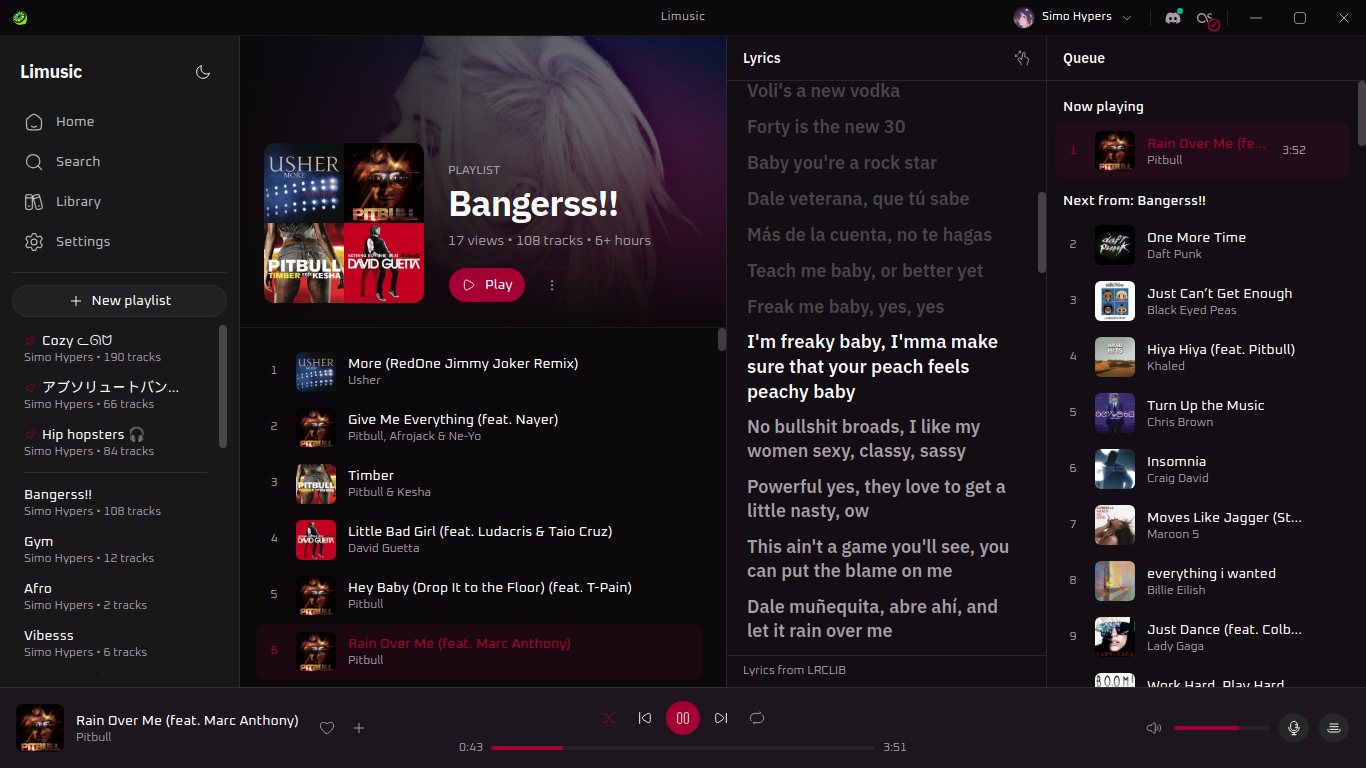
My music setup was a pinned browser tab for years. It worked, technically. It also ate RAM doing nothing, my media keys only worked when that tab happened to be focused, and I killed the music at least once a week by closing the wrong window. There’s no official YouTube Music desktop app on Linux, and most of what exists is the same web player in an Electron shell.
So I built my own. It’s called Limusic. Rust and Tauri, no bundled Chromium, audio goes through libmpv.
You sign in with your actual YouTube Music account, so your playlists, likes and subscriptions are just there, and liking a song or adding it to a playlist syncs back like you’d expect.
The part I actually care about is that it’s not bare bones:
- Proper MPRIS, so media keys and your now playing widget just work
- System tray, closing the window doesn’t kill the song, plus play/pause and skip from the tray
- Discord Rich Presence with album art and a live progress bar
- Last.fm scrobbling, connect once and forget about it
- Synced lyrics in a side panel, click a line to jump there
- Listen Together, synced rooms so you and a friend hear the same thing at the same time
- 8 themes, including Catppuccin, because obviously
- Gapless playback, volume normalization, shuffle, repeat, autoplay radio
- Your queue survives a restart
Free and open source, GPL. AppImage (self updating) or an rpm for Fedora, which is what I daily drive. No Flatpak or AUR yet, both are on the list. There’s a Windows build too, and no macOS one yet.
Would really love for people to try it, and I’d genuinely like to hear what everyone thinks. ❤️
Site: https://simohypers.github.io/limusic/ Downloads: https://github.com/SimoHypers/limusic/releases/latest
Not affiliated with Google or YouTube, just a thing I made because I wanted it
I’d like to add my perspective.
I’m not very anti-AI, I use a locally run model to help me write code (especially boring stuff).
For me it’s mostly about “is it worth the time to package this thing in Nixpkgs, add it to my config, and get used to how it works?”
And for vibecoded projects, even if they work now, the answer is “probably not”; more specifically it’s “let’s look if it’s alive in a year, if I’m still interested”.
As such, I really appreciate when people add a disclaimer so that I don’t have to go look at the code only to be disappointed - I also appreciated it back in the day when someone said “this is my first real project” or something, for similar reasons.
And secondly it’s a question of trust. If the author doesn’t disclose such basic things about the way the project has been developed, and in fact avoids answering when asked directly, what other potential problems could there be semi-hidden in the codebase?