One of my Polish colleagues, who otherwise speaks pretty perfect English, seems to choose he/she/it at random when putting sentences together. Which is fine for objects, but misleading for people. “I saw a friend yesterday and she said such-and-such” for a male friend, and so on.
Slavic languages notoriously have gender for every object. In russian “friend” have two variants, one for male gender, one for female. Same at least with Ukrainian and Serbian. So when I translate sentence to English (which only have one word for “friend”) I subconsciously use default word + she/he to empathize gender.
It’s annoying habit, cause when I say or refer to “user” for example, I always assume it’s “he/him”.
Depends on the exact word. For example, person is grammatically female, even if the actual person isn’t. Or, a lot of times you can make a different form, but you don’t strictly need to.
It’s actually somewhat of an ongoing debate in places WRT professions: declaring whatever the current word is to be gender neutral, or having mandatory versions for both male and female (German /inen approach).
I think it’s the case with most Slavic languages. My wife’s native tongue is Serbian, and knowinf when and how to use articles was one the hardest parts of learning English for her.
Most (if not all) Slavic-family languages do not. Neither do Japanese nor Korean. Some languages have a partial system (i.e. no a/an but the to show definiteness). Some languages have both but do it differently (Scandanavian languages suffix the definite article on nouns, but the indefinite precedes the noun like in English). Languages are messy and neat.


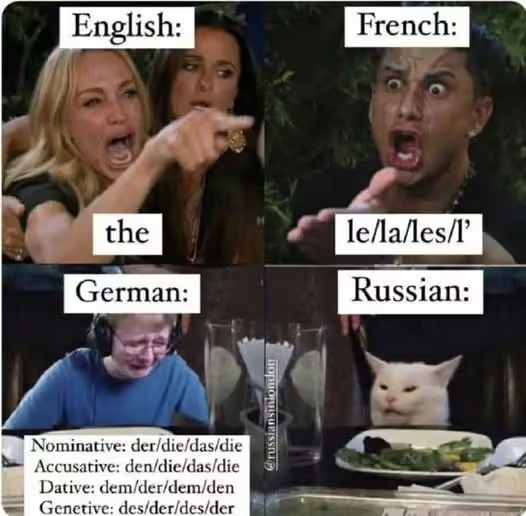
Russian doesn’t have definite/indefinite articles?
it doesn’t really use article at all.
it’s highly cased, the cases and inflection do all the work.
That doesn’t sound more simple.
English has strict word order and all these stupid helper words, how is that simpler?
By being the devil we know, I guess? 🤷🏻
Lol. English is the opposite of simple.
Ok, it is relatively simple to learn for the indogerman family. And looks like, for chinese/korean/japanese as well.
The case are quite complicated, yes. But not having articles is way simpler. And I can’t say it ever caused confusion growing up.
And they aren’t clear when to use them either, it’s kinda cute when they look at you questioningly if they did correctly after formulating a sentence.
Neither does Polish. I know at least one polaka who confuses the/a(n) 15% of the time.
One of my Polish colleagues, who otherwise speaks pretty perfect English, seems to choose he/she/it at random when putting sentences together. Which is fine for objects, but misleading for people. “I saw a friend yesterday and she said such-and-such” for a male friend, and so on.
Slavic languages notoriously have gender for every object. In russian “friend” have two variants, one for male gender, one for female. Same at least with Ukrainian and Serbian. So when I translate sentence to English (which only have one word for “friend”) I subconsciously use default word + she/he to empathize gender.
It’s annoying habit, cause when I say or refer to “user” for example, I always assume it’s “he/him”.
Guess same for your colleagues.
…which sounds surprising to me, because AFAIK Polish also has separate he/she words (on/ona).
I assume he’s aligning the pronouns to the gender of the noun, rather than the person. “Susie is a great worker, he’s very efficient” kind of stuff.
I’d be surprised if there weren’t a female “worker” in Polish, “workeress” as it were, same for any other such nouns.
Depends on the exact word. For example, person is grammatically female, even if the actual person isn’t. Or, a lot of times you can make a different form, but you don’t strictly need to.
It’s actually somewhat of an ongoing debate in places WRT professions: declaring whatever the current word is to be gender neutral, or having mandatory versions for both male and female (German /inen approach).
I think it’s the case with most Slavic languages. My wife’s native tongue is Serbian, and knowinf when and how to use articles was one the hardest parts of learning English for her.
Most (if not all) Slavic-family languages do not. Neither do Japanese nor Korean. Some languages have a partial system (i.e. no a/an but the to show definiteness). Some languages have both but do it differently (Scandanavian languages suffix the definite article on nouns, but the indefinite precedes the noun like in English). Languages are messy and neat.