It’s just a coincidence that the same words are homonyms in English and German in this case: “Warehouses” = “Warenhäuser”, “There were houses” = “Dort waren Häuser”.
You don’t even have to translate to colloquial German as the other comment suggests, a word-by-word translation works here.
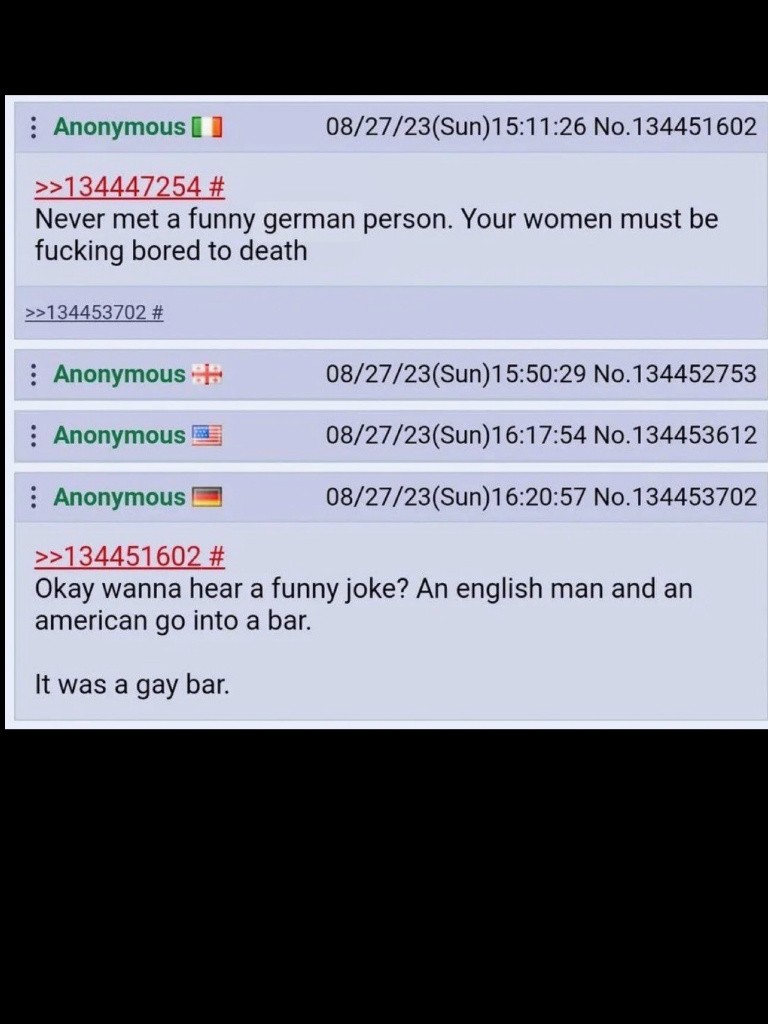
It’s just a coincidence that the same words are homonyms in English and German in this case: “Warehouses” = “Warenhäuser”, “There were houses” = “Dort waren Häuser”. You don’t even have to translate to colloquial German as the other comment suggests, a word-by-word translation works here.
You might like this (to be read aloud in French):
Un petit d’un petit
S’étonne aux Halles
Un petit d’un petit
Ah! degrés te fallent
Indolent qui ne sort cesse
Indolent qui ne se mène
Qu’importe un petit d’un petit
Tout Gai de Reguennes.
Tap for spoiler
https://en.wikipedia.org/wiki/Mots_d'Heures:_Gousses,_Rames:_The_d'Antin_Manuscript
Wow ok that’s clever
This. I asked myself this and that and was amazed the joke worked in both languages.
I mean to be fair, English and German are in the same language family.
So are English and French. And English and Frysian. English is a moshpit of languages.
More a happy coincidence that it lines up.
Dutch is wild to hear or see because it feels like alternate universe English.