

- cross-posted to:
- technology@lemmy.ml
- cross-posted to:
- technology@lemmy.ml
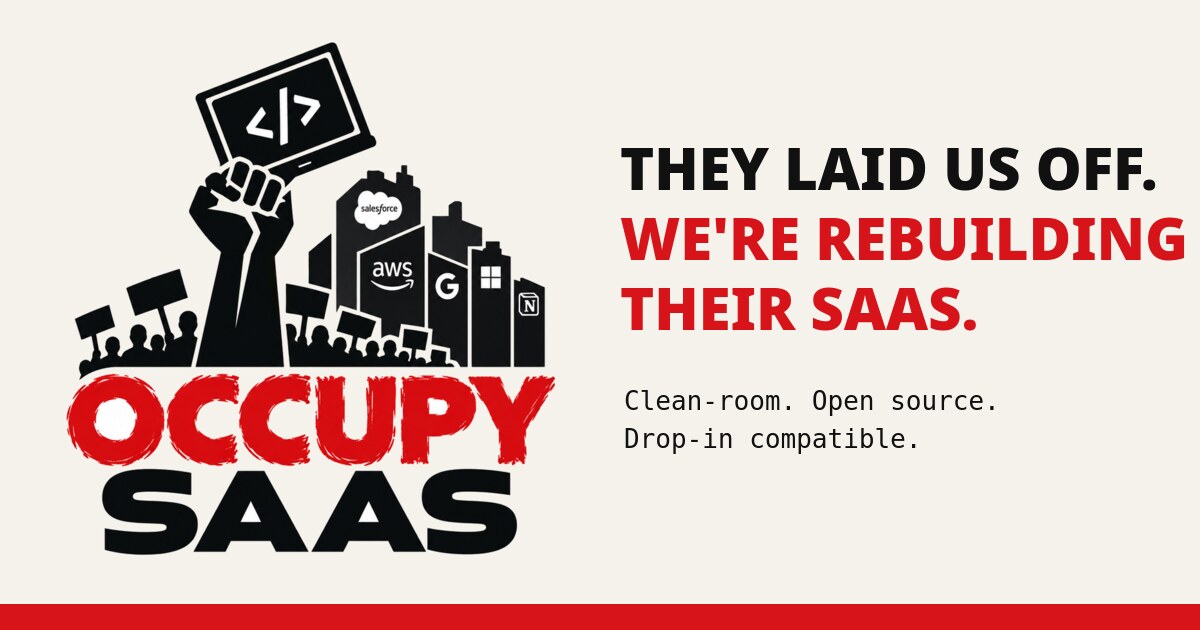
OccupySaaS is protest movement written in code.
Story is simple. Many engineers got laid off in tech. But the SaaS platforms they built keep growing and keep charging per seat. So the same industry rent our own work back to us. This project is answer to that. Laid off engineers use AI and public documentation to rebuild those platforms as free open source drop-in replacements. One seat at a time.
Method is clean room. Public docs only, open standards, public SDK behaviour. No leaked code, no decompile, no confidential info from former employer. AI help with build, humans write spec and review every change. Compatible is proven by running vendors own public SDKs against the server. If your existing code dont work unchanged, it is not done.
Two early releases: ZeroAuthy ( Auth0 compatible identity server) and SalesCompel( Salesforce compatible CRM)
They are early, not production ready yet. But the goal is the point.
I have creative cloud that work pays for. It’s awful, I hate it, I hate the launcher, I hate having to kick off my laptop so I can work on my desktop, I hate the whole sign in experience, and I hate how slow everything is. Most of all, I hate that I have to use windows for it.
Calling artcraft slop that doesn’t work is just coping with refusing to accept that AI could be used to make something good. I don’t open Photoshop anymore, photocraft launches in 1 second, I don’t have to boot windows for it, it opens all my PSDs, and while I’m not the most advanced Photoshop user, it works well for everything I’ve tried.
Film craft works well too, I had missed results with ultra key and it’s missing features, but it mostly works.
Pdfcraft replaced Acrobat, it can sign, it can stamp, it can do pretty much everything most people need already.
I use LLMs for coding every day at work and also use local LLMs at home. From my experience, LLMs can be used to create a better end product than humans alone if the proper discipline is followed.
However, my impression is that ArtCraft is a bunch of vibe coded slop where the goal is to reproduce several apps as quickly as possible by letting the LLM go wild. In that case, you usually end up with something that seems to work in many respects, but eventually collapses under its own weight.
We will see whether ArtCraft ever gets out of alpha and shapes up to be solid, but as someone who has been a software engineer over 20 years, hastily creating a mountain of code and then expecting to come back and fix all the problems later never works. It’s always better to work incrementally and add one feature at a time while building in quality every step of the way.
What I expect is that they will continue adding features and trying to fix the problems, play an extended game of whack-a-mole, then eventually get frustrated and abandon the project.
I detest companies like Adobe and I’d be delighted to have my skepticism be proven wrong and see them end up with replacements for the whole suite that work well and are on solid ground legally. I’d also feel better about this if they were using local models, since spending a fortune in tokens to support a company like Anthropic is certainly not on higher moral ground than supporting Adobe with subscription fees.
I hear you, and I agree with the sentiment.
Checkout their GitHub, they are completing pull requests from many people (no doubt using their own AI) that incrementally add features and fix bugs. They maintain architecture plan and docs so it’s maintainable, with future phases planned out. It’s not purely “make Photoshop” slop, there’s a bit of planning.
I don’t know if they’re competent engineers who review the plans and docs for potential issues or hallucinations, I haven’t investigated it deeply, but it’s not lowest hanging fruit slop.
In all fairness, I haven’t investigated it thoroughly myself, and my skepticism mainly comes from the proposed timeframe. I’d be less skeptical if they said they were going to focus only on, say, Photoshop and spend a few months reproducing a small subset of its features without decompiling the code while creating a public audit trail of their clean room process that a lawyer helped them create.