
You must log in or # to comment.
Citation needed
And the severity increases with per axle weight
Well, no, we don’t know that & that’s prob false, it’s just all plastics.
Tire microplastics just get circulated faster bcs they get grinned to a fine powder as part of their initial use (& that float gets flushed away with water). And the stat is stated for water or air.
Which is a problem, I’m just saying that we are producing a much larger scale of this problem that we can currently detect (and detecting microplastics is still in it’s infancy even in lab conditions).
But sooner or later all petroleum based (non-biodegradable) plastics get to be microplastics, we just won’t be around to see it.
Microplastics are the sedimentary boundary that will mark the current extinction event in rocks.
You can weigh new tires and compare them to weights of replaced tires. That would give you the low end estimate environmental tire microplastics deposited based on tire sales. I can’t imagine its not a massive number.
By mass or volume?
…and ~35% come from the clothes we wear. No clothes, no cars, sign me up.
I mean we could just go to cotton or other organic materials for clothing
Yeah but where’s the fun in that?
I’ve avoided synthetic fabrics for years. People used to think I was just being a woowoo anti-science luddite hippy (this was back before microplastics were a well-known phenomenon). But the fact is I just didn’t like the texture of synthetics.
Here are some examples of natural fiber, all of which are lovely:
- Linen - made from flax; lightweight, airy, dries quickly. Great for summer.
- Bamboo - made from bamboo. Feels like a dream. Softer than cotton, lighter than linen, smooth as silk. Sustainable. Not even crazy expensive.
- Micromodal - made from beech trees. Similar to bamboo, but even softer.
- Rayon - made from cellulose. Often used in blends to impart softness and elasticity. Many different kinds. Bamboo and micromodal might technically be kinds of rayon. Also known as viscose.
Non-vegan:
- Sheep’s wool - Many varieties. Soft, warm, comfortable even when wet. Great for winter (and hiking socks!). Can be felted due to the properties of the fiber. Comes in a range of qualities, but low quality wool can be itchy.
- Alpaca - Like wool, but softer, sturdier, and warmer. More expensive than wool.
- Kashmere - made from a species of goat fiber. Very very soft. Also expensive.
- Mohair - Different kind of goat wool. Haven’t tried this one personally so I can’t describe it.
- Angora - Made from rabbit wool! Also haven’t tried this one, but supposedly it’s very soft.
- Yak - Suuuper warm. Durable. Not as expensive as you might think.
- Silk - Soft, smooth, shiny. Also non-conductive and low-friction! Tends to be expensive, though.
And of course, cotton is versatile and has a wide range of qualities (depends on growing region, thread count, and processing methods. Pima and Egyptian cotton are supposed to be the highest quality, but are also more expensive. Organic cotton is best for the environment).
Here are just some examples of fabrics you can make with cotton:
- Jersey knit
- Terry cloth
- Flannel
- Denim
- Satin
- Muslin
Be sure to check the tags though: many “cotton blends” contain polyester, and often they label something “flannel” when it’s just polyester with a plaid print (real flannel is a type of fabric, not the pattern on the cloth. If you can’t see the individual threads that make up the pattern, it’s not real flannel, just a print).
Final note: most fibers can be either knit or woven, with textures depending accordingly. There are sooo many different kinds of wovens, each with its own unique pattern. Could write a whole textbook just on different kinds of weave.
You missed hemp. I’ve only the one shirt and haven’t worn it much yet but it seems similar to linen. I’ll find out as it gets warmer.
lol I was memeing but this is good info. Which is your preferred fabric for undies? I live in a hot climate so cotton and wool are not preferred…
Bamboo and micromodal make good underwear. I haven’t tried them in the summer yet so I don’t know how they hold up in heat and humidity.
Linen can be good for underwear. It’s very breathable, but sometimes it takes a few washes before it feels soft. Also, it doesn’t have any natural elasticity, so it needs an elastic waistband to stay up. Sometimes it has a drawstring, but I prefer the waistband personally. It’s also loose and flowy, so if you wear tight clothes and don’t want it bunching underneath, linen isn’t a good choice for underwear. If you wear loose, flowy clothes anyway, linen is a great choice.
If you’re willing to put out the expense, silk undies sound kinda awesome. Never tried that myself though so I’m not sure how breathable it is.
Personally, I love linen in general for hot weather. You can wear long sleeves to keep the sun off, and its so airy that you don’t even feel hot under your clothes. Especially if it’s a light color. It also dries quickly, so it’s not like cotton where once you sweat you’ll be wet all day. Spend thirty minutes in the shade on a breezy day, and your linen clothes will already be dry
Everyone thinks nudity is great until they remember how the average person actually looks
Or how much the sun will fuck you up
Maybe just a loin cloth then.
Or the lack of sun
This one is real
lol seeing ugly people doesn’t hurt you.
it hurts my soul
That’s why I buy clothes made with polyester! No plastic here! In fact I don’t think I’ve ever seen clothes with “plastic” as a material before…
Polyester is plastic.
Or are you being sarcastic? (I hate that this rhymes, it was totally unintentional…)
Not even NO clothes and tires, just clothes and tires that aren’t made of plastic
It’s much easier to switch to clothes not made of plastic then it is to replace what we make tires out of.
Easier than either to just stop making them.
cough train
I mean, yes. But that’s a different discussion.
Switch back to natural rubber?

Mandating that everyone in the public can no longer buy the huge variety of clothing styles that can only be achieved with synthetics would cause a giant uproar of opposition and would be almost impossible to get passed into law.
So would anything that makes world better.
Sure, but a gradually increasing tax on the production any plastic containing fabrics would help naturally phase it out.
Iirc viscose, polyether etc., right?
I think some viscose can be plant-based. I could be wrong but I think they can make viscose from bamboo.
Yeah, it constantly degrades, we wash it directly into the water, and you can’t find clothes that are plastics-free.
Id like you to see you try that outside tropical climates.
You wouldn’t see much, unfortunately…

Source? Heard this before and not surprised, but I’d like something concrete that I can point to.
It seems to be even higher, several studies suggest it’s closer to 50%:
https://pubs.acs.org/doi/10.1021/acs.est.3c05002
Three different studies predicted emitted tire wear proportions (TWP and TRWP) of total emitted MP [microplastic] loads in the environment (both aquatic and terrestrial) for around 45%. (6,7,52) These calculations were mainly based on global, annual production data and matched the TWP proportions of around 40% in this study. However, since C-PVC was excluded here, a comparison of the percentages is not trivial.
Thanks!
That’s why I don’t use tires. Raw dog the road.
There are some people who do that. Just driving on the steel rims of their cars. But they usually take it a step further, driving on roads that are also made of steel.
Trains…?
No, Trams
I thought car tyres were made of rubber.
On average ~25% of that rubber is synthetic, i.e. pertroleum/plastic based.
According to this page it’s about that 25% of the whole tyre, where more than half the tyre is not rubber/synthetic rubber but other stuff.
So there is more synthetic rubber than natural rubber. But the mind-blowing thing for me here is that I kind of assumed the whole tyre was synthetic, but they are only 25% plastic and still are the biggest source of mocroplastic.
But the other stuff is nasty. Total of petrochemicals in a tyre is above 60%. That fabric, carbon black, oils, elastometers, textiles, antioxidantes and additives are all based on petroleum too
Rubber literally grows on tress, and we’re like no, plastic please.
Rubber is less resistant than the plastics mix we use now.
We didn’t invest much into developing rubber into a better for for tires. The switch was due to cost & hegemony.
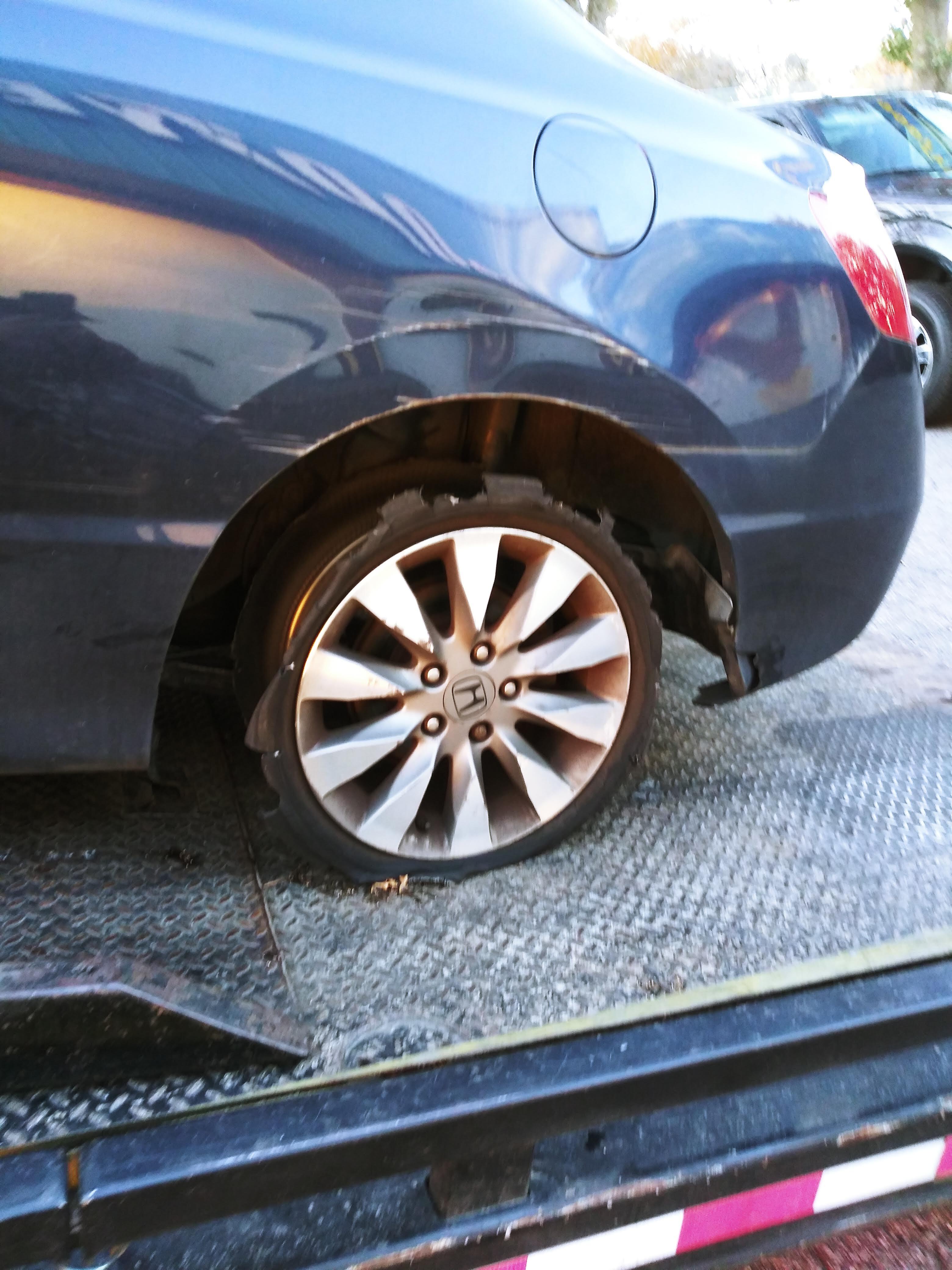
There are actual safety concerns with tires. Modern ones are much, much less prone to blowing out on the highway.
It still can happen though. Ask me how I know.