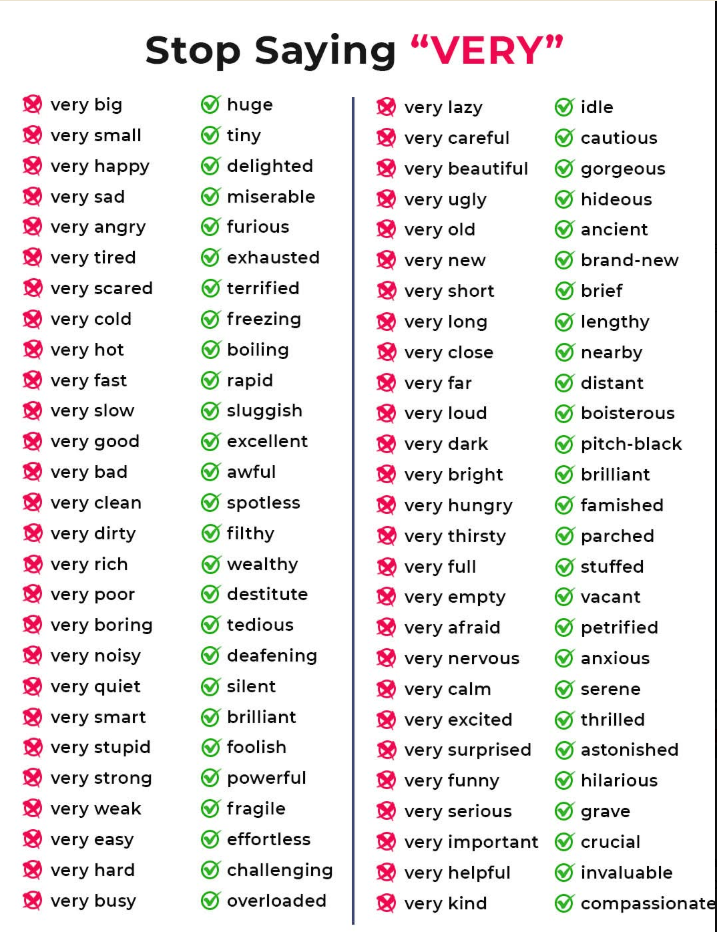
Hear me out: doubleplusgood
I don’t know if this is a very good idea
Very is overused but has its uses. I think it’s a good rule of thumb to avoid using it too much if you want greater impact, although eliminating it entirely would be a loss overall. What gives greater impact is the nuance that comes with having different words with similar meanings. Having a high impact word or phrase necessarily means having something lower impact to contrast against.
Also, the intensification with very isn’t quite the same as using the listed intensified words. Challenging is intensified hard as opposed to easy but not to soft. In human terms boiling is very hot and opposed to freezing, but what does that make the sun? It’s not a liquid turning into a gas.
Oh, and are people still against using literally to mean intensified figuratively?
What’s the alternative to very figurative?
No.
Legit criticism! But hear me out. Who remembers all those different words anyway?
Instead of NOT using “very”, I say we ONLY use “very”.
It’s a very idea!
That’s so aladeen of you

The veryist of ideas. Bigley very
A very idea from a very mind! You’re very.
No, I like that language is composable. I think it’s very convenient. It also allows me to say stuff in a way that’s easier to grasp for folks who might not understand English that well. Very dumb suggestion.
Reads comment. Looks up list. Ah, he means it’s a foolish suggestion. Splendid.
Use all the words in the right columns but preceded with “fuckin’” every time. Like a real gentleperson.
idle does equate to very lazy
this was shit when it was on reddit
This is extra plus good
Very lazy = idle?
No? Or is my english bad?
Indolent.
Kinda, kinda not. To me, idle means “not doing anything at the moment”, e.g. “standing idly by”, which is definitely different than “very lazy”.
Yeah. Same.
It’s an older use, to the point that I’ve never heard it used. Merriam marks that definition as “old-fashioned” (which is a bit odd, because I thought they only used the archaic or obsolete terms).
The lazy sense is probably what’s meant from the old bible quote about “idle hands” related to the devil.
Fair enough while I have opinions.
But it makes me wonder if OP actually used idle for very lazy or if they never actually read their own post.
It’s the second one
I prefer “double plus”
Strength and power are different measurements though
Can I interest you in strongful?
deleted by creator
Very -> Verraily
Veraiously?
You can put ‘very’ before every suggested alternative. What then?
Some of them feel better than others. Very boiling is kinda weird.
Very powerful works imo.
I teach foreign language students and they often write about how their food was “very delicious”, and it always sounds so jarring to me. There are a lot of really strong words that native speakers tend to not use very with.
eg:
very difficult task / very monumental task
very good cooking / very superb cooking
very happy man / very elated manFor some reason intensifiers like so and such don’t have those restrictions:
The task was very/so monumental.
It was very/such superb cooking.
He was very/so elated.Bring ‘fucking’ into it and even native speakers say how fucking delicious the food was.
It’s funny how it suddenly appears to work with “fucking” but “very” is weird.
When very then?
Most of the alternatives feel odd with a very. Eg: very powerful, sure I get your message but it sounds awkward