While you aren’t wrong about them being good to use in Ag, the scenario where you can do both is more limited.
You can’t drive a combine harvester under panels, to harvest the crop you just protected for instance, unless you place and design your panels carefully. It’s ok for pasture in that sheep and the like can get in and chow down and it provides shade though.
For a parking lot, it’s easier, as shown, but also fuck cars, they’re their own environmental disaster
They are using them on closed tailings facilities (mining) to add additional land use or gain benefit where there wasn’t really a good land use to begin with.
I think urban settings are where panels will ultimately shine, as you can concentrate them without taking up other land uses - it’s just an add on and doesn’t detract from existing or future uses like using them in an ag field would.
40% of US cornfields are used for energy today. If these fields were turned into solar farms with natural meadows under them, not only would we actually recover more energy per acre than corn ethanol, but we would start restoring the American prairie that has been nearly erased from the continent.
It uses far less materials to build arrays in a field than over a parking lot. The panels don’t need to be mounted as high. There doesn’t need to be as much safety margin and protection of the panels because people won’t be underneath them.
The bigger problem is getting the power from solar farms to where it is needed, but this is also not as big a problem as anti-electrification lobby wants you to believe.
Technology connections did the math out on this. He found that acre for acre, even assuming very poor fuel mileage for an electric car, the same land used to produce electricity instead of corn for fuel would be about 70x more efficient.
He also found that if we used only ethanol corn fields for solar panels and no other land, we would produce 7x the current total power demand of the United States.


While you aren’t wrong about them being good to use in Ag, the scenario where you can do both is more limited.
You can’t drive a combine harvester under panels, to harvest the crop you just protected for instance, unless you place and design your panels carefully. It’s ok for pasture in that sheep and the like can get in and chow down and it provides shade though.
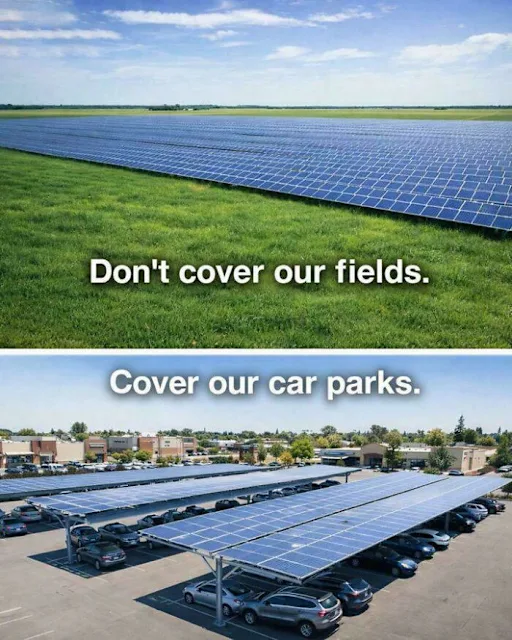
For a parking lot, it’s easier, as shown, but also fuck cars, they’re their own environmental disaster
They are using them on closed tailings facilities (mining) to add additional land use or gain benefit where there wasn’t really a good land use to begin with.
I think urban settings are where panels will ultimately shine, as you can concentrate them without taking up other land uses - it’s just an add on and doesn’t detract from existing or future uses like using them in an ag field would.
40% of US cornfields are used for energy today. If these fields were turned into solar farms with natural meadows under them, not only would we actually recover more energy per acre than corn ethanol, but we would start restoring the American prairie that has been nearly erased from the continent.
It uses far less materials to build arrays in a field than over a parking lot. The panels don’t need to be mounted as high. There doesn’t need to be as much safety margin and protection of the panels because people won’t be underneath them.
The bigger problem is getting the power from solar farms to where it is needed, but this is also not as big a problem as anti-electrification lobby wants you to believe.
Technology connections did the math out on this. He found that acre for acre, even assuming very poor fuel mileage for an electric car, the same land used to produce electricity instead of corn for fuel would be about 70x more efficient.
He also found that if we used only ethanol corn fields for solar panels and no other land, we would produce 7x the current total power demand of the United States.