
You must log in or # to comment.
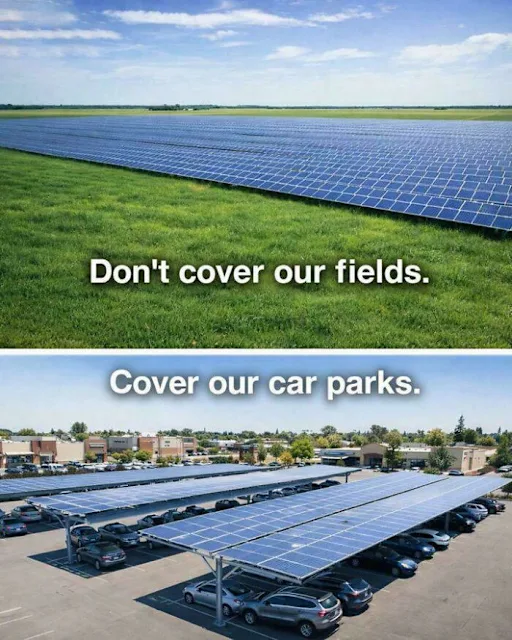
Stop sharing this bullshit. It is a stupendously simplistic view that is propagated by those wanting to get in the way of cheap renewables.
Yes, it makes sense in some cases to cover parking lots, but it increases the price and complexity manifolds and the areas needed in open land are next to nothing compared to the area being used to grow energy crops today.
The meme should be “stop covering our land with fertilized, pesticide covered corn and rapeseed that go into combustion engines, cover it with solar instead”
Because it’s not necessarily correct. There’s so many fields dedicated to growing energy plants that covering just a part of those would be sufficient to electrify the entire transport sector. That’s just fields for plants for Biofuels etc., not a single beautiful picturesque meadow, not a single field that grows food.
Of course covering car parks is a good idea too, but it’s more expensive, and it’s a climate change denier’s strawman that covering fields would supposedly endanger our food supply or ruin our landscapes.
Two things have lead to that first picture though.
-
We’ve been underpaying farmers for a long time. Everyone buys from supermarkets, and supermarkets will pay farmers a meagre amount for produce. Cheap imports are further hammering the farmer. Hard to compete in northern Europe with slavery conditions in southern Spain.
-
We’ve been overpaying for solar too. Locking it to the rate of fossil fuel energy means it’s well worth covering a field in solar panels and reaping the rewards.
Both of these should change, but since nobody has any money, it’s a hard sell to make people want to pay more for farm produce, especially when you don’t know who is soaking that extra money up. Capitalism says it’s going to be the supermarket owners taking the lion’s share.
-
Also warehouses. Also houses. Also literally any structure that already exists that isn’t nature. If it is an energy consuming building, it should have solar panels on it. Parking lots count because cars are energy consuming devices.
If any of the billionaires actually cared about the planet or the human race, they would just dump money at a huge loss into making solar panels cost pennies.
I want solar panel Venetian blinds on my windows. The entire exterior of my car should be solar panels. Every roof everywhere should be solar panels.
I want the to see so much money poured into it that for $35 I could get a t-shirt with a USBC port that charges my fucking phone when I’m out in the sun.
But that doesnt make money. I guess the lives of a few hundred assholes is more important than making some super awesome shit that benefits everybody.
I fucking hate this time line.
It’s called Agrovoltaics and it works pretty damn good,if you do it right.
The pairing can also offer some synergies. Solar panels can help moderate ground temperatures, provide shelter for livestock and help plants retain moisture.[6] For farmers the ability to produce electricity can help diversify their income stream.
Solar panels block light, which means that dual use systems involve trade-offs between crop yield, crop quality, and energy production.[7] Some crops/livestock benefit from the increased shade, obviating the trade-off,[8] such as green leafy vegetables, and spices such as turmeric and ginger, whereas staple crops such as wheat, rice, soybeans or pulses require more sun.[9] Agrivoltaics has also been used at scale in arid and semi-arid regions to stabilize soils, reduce dust storm intensity, increase vegetation cover, provide forage for livestock, and curb desertification, notably in northern China.[10][11]
The picture in the op doesn’t look like agrivoltaics though. Compared to the agrivoltaics examples of the wiki article, the panels in the op are more densely placed, placed flatter, and placed closer to the ground. Nothing is getting harvested there, the most they could do is keep rabbits under them. From what I’ve seen in person, the non agri kind with panels over monoculture grass fields is much more common than agrivoltaics with cultivated fields.
In the US it makes sense. Much of our corn is grown for ethanol so ot can be used for fuel. Replace that with solar and we reduce our reliance on a monocrop and end up with far far more power.
They also use lots of irrigation from aquifers in the Great Plains, so they’ll need less irrigation and the shading will help a tiny bit with replenishing the aquifer.
In northern Europe these solar fields make no sense at all to me though. When I see something like the fields below in my temperate marine climate, then I can’t help but think of the forest that could have been there.
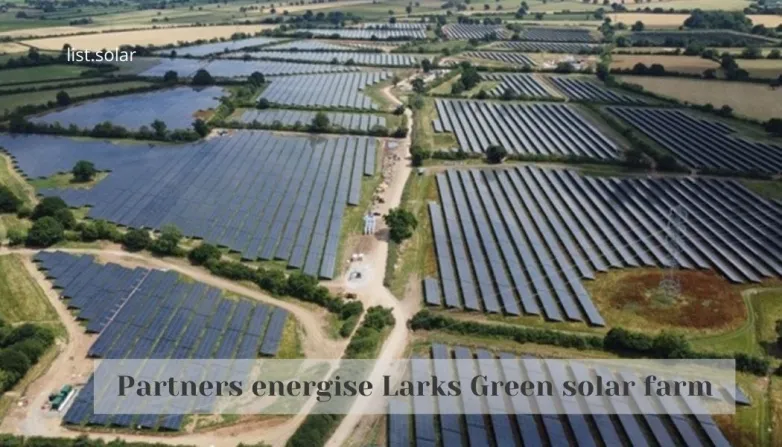
Turning it back into a forest will never happen when the land owner needs to pay taxes on the land and thus need to make income of the land. These solar fields are usual on private property. Not public land. Either they put windmills and solar on the fields or they raise cattle or grow crops. Which one is better for the environment overall?
If you destroy existing forest to make a farm, maybe. But if it’s an empty field and you want to do something with it, making it into a forest makes little sense. It’s complicated, very expensive, and doesn’t do much. Just let natural forests do their things, allow them to expand if you want more forests, don’t make one from scratch.
How many times is this gonna get posted? It gets dunked on every time too…
I’m convinced this is astroturfing in the same vein as the “Just stop oil” protesters that do all that trolly shit. The goal is for you to view green technologies negatively by association, and to feel like the science and decision-making behind them is suspect.
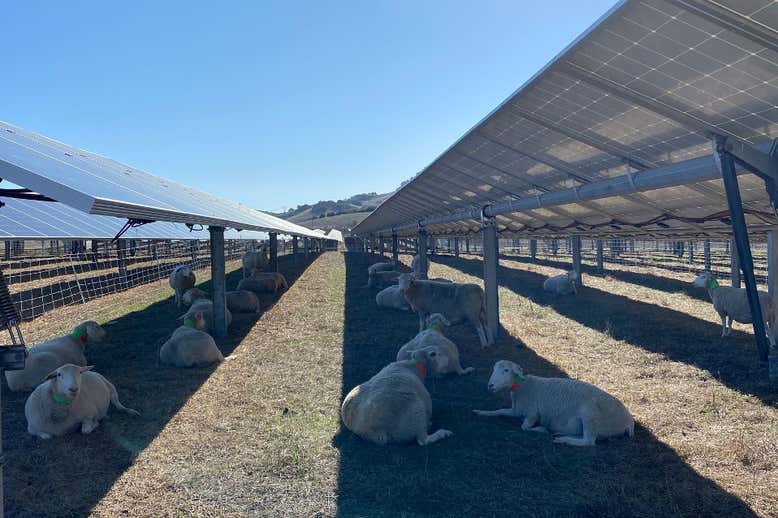
I don’t know. Sheep like to park below panels too.
Yeah I was gonna say:
First of all, we probably should not encourage more parking lots.
Secondly, in the words of that kid in A League Of Their Own who gives Gena Davis a ride who hits on her and then she makes a snide remark about smacking him around instead: “Can’t we do both?”
Woolly engineers hard at work.
"Noooo don’t replace a tiny part of my monoculture industrial croplands used mostly to feed cattle with the cleanest and cheapest form of energy nooo*
Not only to feed cattle, also to make ethanol to be used as fuel 🤦♂️
Um, they do? Half the retail stores in my area have solar panels in the parking lot.
Lucky. The only solar panels in my local retail parking lots are the ones powering the ALPRs they installed there.
Here’s the largest solar farm in California. It covers sand. Also, solar panels don’t block 100% of the light getting to the ground, so different species of plants and animals can live and thrive under them. The land under solar panels is not lost to natural use. Life will adapt.
That said, solar panels over car parks is also a good idea. Both things can be true.
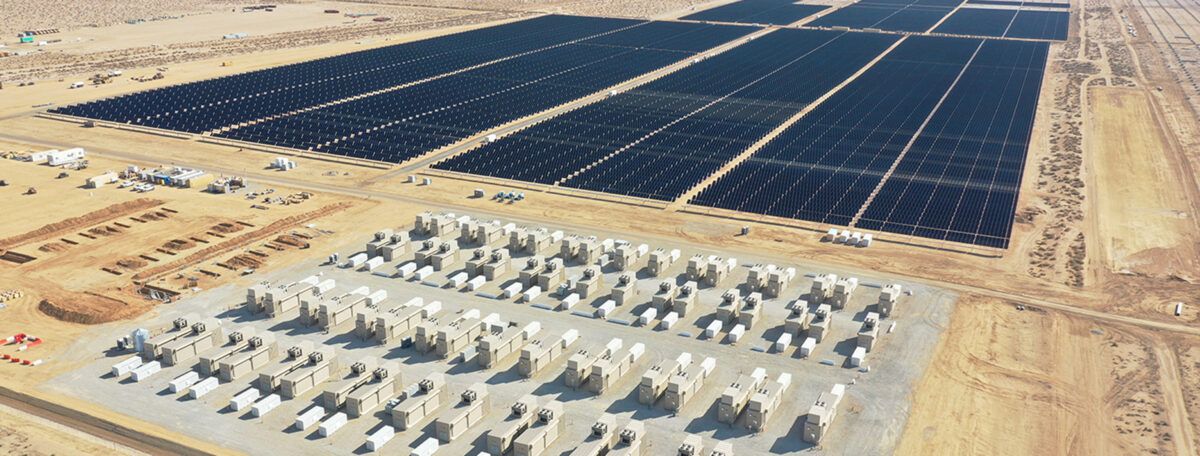
Also a solar park like this is a lot cheaper and thus they can sell the energy for much cheaper. Solar over car parks requires a more complex structure to hold the panels since they are higher up and therefore catch more wind and the structure needs to span a larger gap. So a car or two can park between the pillars. This increases the cost.
Life will adapt
Life will recover:
https://www.ecoportal.net/en/foxes-use-solar-farm-as-natural-habitat/20424/
That article has all the hallmarks of AI-generated slop.
Sweet rig.
Which make/model of mixing deck is that?
;)
It can be really good to cover the fields!
Reduce evaporation, expand the range of plants that can grow and provide subsidies for hard pressed farmers
Protecting food and water resources are going to get increasingly important over the next few decades
Yes. Both, not either or. Where is that shitty competition thinking coming from?
It’s the way the typical American thinks
'Muricans have a habit of seeing things as zero-sum, because that’s what their shitty system relies on
A lot of it comes from conservative AstroTurf.
And, unfortunately, a lot of it comes from farmers and other people living in rural areas, who see fields of crops being turned into solar farms and think “these panels are ugly, these panels are industrial, these panels are taking up fertile farmland” and see it as just one more way the government is exploiting rural areas for the benefit of the cities.
They’re wrong, of course, but rural America has been abandoned and neglected and made the dumping ground for all sorts of polluting industries for so long I can’t blame them for thinking that way.
The cynic in me suspects it’s an attempt to sow division within pro-solar panel groups. Get them arguing amongst themselves over where to put them, rather than uniting to push for more panels.
Yeah I really hate this post, and how often it seems to surface on lemmy. Agrivoltaics is good for energy and for the plants*!
*Some exclusions apply. Not all plants grow better with the added shade.
In Switzerland, there was a vote on a petition requiring new houses to include solar panels. Conservatives opposed it, arguing that construction costs were already too high without such regulations. Instead, those same people want to build massive solar farms on untouched natural landscapes. To me, the reason is obvious: energy companies want to maintain control over a centralized power infrastructure. This way, they can keep charging us high electricity prices while pocketing subsidies for infrastructure projects.
Ding ding ding that is correct!
no, it’s one thing to allow solar panels on houses, but a completely other thing to require them. i’m against the requirement as well. there’s absolutely no sane reason for that besides making people uncomfortable if they don’t want them. if they want them, they can already get them.
A lot of the big building companies, in Europe, treat solar panels as a premium option and so charge a larger profit margin on them. Installing solar, while constructing the house is a LOT cheaper and easier than retrofitting them later.
The panels have gotten cheap enough that it’s no longer a real cost burden, Vs the cost of the house.
Put them everywhere. I don’t care where they go. I want my son and daughter to have a planet to enjoy and raise a family in.
Every single time this gets posted: Both is good.
Farmers are the biggest welfare queens in this country. They all bitch and moan about needing subsidies and everything but they all have crop insurance.
Generally speaking these are the large companies doing this while pretending to be small farmers.
Farmer A through F are family members. They each have their “own” farm, just inside the limit to make it a small farm. Farmer A also has a “small” farm with Farmer B, and C, and D, and E, and F, each qualifying as a “small” farm. Do the same with the rest of the mixes.
The reality is that these “small” farms are really one 400 acre farm run by the same people, worked by the same people (migrants being taken advantage of with illegally low wages).
The actually small farms do benefit from a lot of the programs, and that can be a really good thing. Its unfortunate though that there are enough loopholes that large scale corporate farming finds ways to abuse the system by cosplaying as “small farm” owners.
While you aren’t wrong about them being good to use in Ag, the scenario where you can do both is more limited.
You can’t drive a combine harvester under panels, to harvest the crop you just protected for instance, unless you place and design your panels carefully. It’s ok for pasture in that sheep and the like can get in and chow down and it provides shade though.
For a parking lot, it’s easier, as shown, but also fuck cars, they’re their own environmental disaster
They are using them on closed tailings facilities (mining) to add additional land use or gain benefit where there wasn’t really a good land use to begin with.
I think urban settings are where panels will ultimately shine, as you can concentrate them without taking up other land uses - it’s just an add on and doesn’t detract from existing or future uses like using them in an ag field would.
40% of US cornfields are used for energy today. If these fields were turned into solar farms with natural meadows under them, not only would we actually recover more energy per acre than corn ethanol, but we would start restoring the American prairie that has been nearly erased from the continent.
It uses far less materials to build arrays in a field than over a parking lot. The panels don’t need to be mounted as high. There doesn’t need to be as much safety margin and protection of the panels because people won’t be underneath them.
The bigger problem is getting the power from solar farms to where it is needed, but this is also not as big a problem as anti-electrification lobby wants you to believe.
Technology connections did the math out on this. He found that acre for acre, even assuming very poor fuel mileage for an electric car, the same land used to produce electricity instead of corn for fuel would be about 70x more efficient.
He also found that if we used only ethanol corn fields for solar panels and no other land, we would produce 7x the current total power demand of the United States.
This is emotionally resonant but it’s actually sometimes better to cover fields. The right thing is not always intuitive.
Yup, like, what is it replacing? If it’s food that goes directly to humans, let’s not do that. If it’s corn for ethanol, that has little worth. Covering it with solar panels isn’t terrible by any means.
I feel like people still haven’t internalized just how much of our fields go to corn for ethanol
Actually, with climate change in the back of the mind, covering fields with solar panels (not 100%, only partially) will reduce heat damage and water usage in the height of summer, and also protect the ground during cold spells of winter. So it is not that stupid after all.
That covering car parks with solar is a good idea is completely independent of this.
Plants need direct light to grow… most need full sun. Personally all the solar farms I’ve seen just “grow” grass and everything is kept trimmed down to not cast shade on the panels. Putting the panels up higher would still cast any plants grown in deep shade. I think putting them in places deep shade is needed/wanted on the ground makes sense and because cities tend to be hotter due to paving using solar panels to cast shade would help lower the temps in cities, lowering power usage on things like AC. I think integrating solar into urban landscapes is the future
Plants need direct light to grow… most need full sun
Except for all the plants that evolved and thrive in the low light beneath tree foliage. Evolution is not so picky as a pretty houseplant.
They need direct and indirect light, and agro-panels have a coverage of about 50%. Not enough for high-end farming, but more than enough for grass and similar to grow for grazing. Or some herbs that need shadow to grow properly. Those panels are usually placed on land that can’t be used for high-performance farming, anyway.
Plant butterfly bushes and other pollenator attractants / nectar sources.
One can always do this. Quite some of those plants love shadow and half-shadow environments. And, as i stated in my original post, don’t ignore the climate change. Many plants growing in a given location for ages will have difficulties in the future because of the more extreme weather.
You can either change the plants you are growing (like people in the south of my country who replace wineyards with olive orchards), or you can help historically local plants to survive, and solar panels is actually one way to do this.
Crazy thought: put solar panels over A/Cs and tie it into the panel.
Plants need direct light to grow… most need full sun.
That’s only true, if the solar panels are not properly adjusted to this use case.
The solution for that is https://en.wikipedia.org/wiki/Agrivoltaics#Spectrally_selective_modulesPlants need direct light to grow… most need full sun.
The humble Monotropa uniflora:
How about we don’t cover our fields with car parks?
Too radical for Americans
With a pink hotel, a boutique, and a swinging hot spot?
public transport makes sense above a certain population density. many rural areas just don’t have that.
By and large we don’t. 53% percent of the surface area of the US is farmland. 28% of it is protected federal lands of some stripe or another — national forests and national parks, BLM land, etc. Everything else, all the remaining cities and suburbs and coal burning power plants, freeways, stroads with no bike lanes, Walmarts, and strip malls are all packed into the remainder. Most of that is along the coasts. The US is absolutely full of wide, huge, horizon-to-horizon, enormous expanses with nothing in them.
It’s just that our populated areas, largely along the costs, are utter hellholes.
The raw numbers are very misleading. First, although only (!) 53% of U.S. has been ecologically devastated by farming, the 28% of “protected” federal land is often leased for cattle rangeland, clear-cut by logging companies, or what environmentalists derisively call, “rocks and ice.”
The small remainder has been carved up by roads. It would be one thing if all of the pavement were one, contiguous blob in the middle of the New Mexico desert, but it is laced across the landscape from coast to coast. The effect on wildlife has been profound, from direct impact to roadkill numbers, to fragmention of ecosystems, to pollution from tailpipe emissions and road surface runoff.
It’s not about the space that cars physically occupy (though that is a major issue in cities), but rather the almost-apocalyptic effect they have had on the natural world. We would be better off if we didn’t build all of the parking lots on farmland (or anywhere).
This is ridiculously untrue and confuses too much of what matters for food
I just drove through New Mexico hundreds upon hundreds of miles of nothingness
Saw a documentation a few days ago. It was about a berry Farmer who put solarpanels above his berries to shield them from direct sunlight. Works great! And He could replace all his transporters with EVs. :)
I’ve seen plenty of different types of solar panels, some specifically for agriculture use that have small gaps between the solar cells to allow for more sun to reach plants.
I’m not sure how that affects solar panel output/longevity but it can’t be too much of a hit.