I’m leftist but I am the first to admit that Stalin wasn’t a good leader at all. For heaven’s sake, his own guards were scared of him. In fact, he died because he instilled so much fear into them. Personally, I’m more of a collectivist who doesn’t believe in authoritarianism.
im presuming that you’re presenting yourself i good faith and you sound like me not long ago; i want to share something that’s been helpful in dispelling the inception like nature of sources from the western that likely gave you this conclusion:
For heaven’s sake, his own guards were scared of him. In fact, he died because he instilled so much fear into them. Personally, I’m more of a collectivist who doesn’t believe in authoritarianism.
(i know that you’re getting this from a western source because you used the word authoritarian).
the freedom of information act, passed in the 1960s, forces the us government to release files – like they released the epstein files – where the cia, fbi, state dept, etc. admit in writing that they make shit up.
you have to wait at least 25 years after the event, but you can already read some files – just like people are reading the epstein files rn – of shit they made up about north korea being “authoritarian.” (you can even see how they chose that word). but the key part is that they admit to lying to us about north korea’s authoritarianism.
so if your source calls north korea authoritarian, know the us government invented that in the 1950s, was forced by law to admit the lie to the public in the 1970s and that any source still pushing this narrative can’t be trusted.
you’re never going to be a leftist if you don’t question your own sources.
This isn’t really true. Stalin was often described as a quiet listener in collective meetings, and was widely beloved. He developed a cult of personality against his own wishes, due to leading the country successfully during its most chaotic and desparate periods. This happens to all leaders in such situations, FDR was almost revered as a god in the US. Stalin turned down awards like the Hero of the Soviet Union, and refused to change Marxism-Leninism to Marxism-Leninism-Stalinism, essentially equating his own contributions (particularly on the national question and linguistics) to an extremely minor aspect compared to Marx and Lenin.
Khrushchev, in trying to cement his position, tried to attack each part of Stalin’s legacy. His staunch dedication to preparing for World War II, his careful contemplation of the National question as one of the foremost theorists on it within the realm of Marxism, and as someone who detested undue praise. Khrushchev flipped each of these on their heads without base (such as suggesting Stalin planned front line battles on a globe), and instead of killing the cult of personality, turned it into a negative cult of personality and created a total nihilism for the prospects of building socialism. I highly recommend Domenico Losurdo’s How to Cast a God into Hell: The Khrushchev Report.
As Weng Weiguang wrote, The Evaluation of Stalin is Essentially an Ideological Struggle. Repudiating Stalin is less about the historical figure and more about what was accomplished during his service. Demonizing Stalin demonizes the soviet union during its major industrialization, and therefore demonizes the most critical era for socialism in advancing on what came before.
In clearing Stalin’s name, we clear the record of socialism historically, proving it can, did, and does work definitively. This isn’t wasted effort, but is absolutely critical, especially as the demonized visage of Stalin is used as a club to beat Marxists and anti-imperialists in general (even non-Marxists!).
Ah yes, I always forget how the purges were just a big whoopsie doopsie misunderstanding and uncle Joe was actually a stoic, quiet voiced totally not good friend to that big bad Hitler guy.
Molotov-ribbentrop pact is a fact of history. Not to mention during the war, Stalin himself authorized German u-boats to utilize naval bases around Murmansk to hide between raids against the British. Tell me how Stalin was actually playing 4D chess by allowing Hitler into Soviet naval bases.
The communists were never allies with the Nazis. A non-aggression pact is not an alliance. The communists spent the decade prior trying to form an anti-Nazi coalition force, such as the Anglo-French-Soviet Alliance which was pitched by the communists and rejected by the British and French. The communists hated the Nazis from the beginning, as the Nazi party rose to prominence by killing communists and labor organizers, cemented bourgeois rule, and was violently racist and imperialist, while the communists opposed all of that.
When the many talks of alliances with the west all fell short, the Soviets reluctantly agreed to sign a non-agression pact, in order to delay the coming war that everyone knew was happening soon. Throughout the last decade, Britain, France, and other western countries had formed pacts with Nazi Germany, such as the Four-Power Pact, the German-French-Non-Agression Pact, and more. Molotov-Ribbentrop was unique among the non-agression pacts with Nazi Germany in that it was right on the eve of war, and was the first between the USSR and Nazi Germany. It was a last resort, when the west was content from the beginning with working alongside Hitler.
Harry Truman, in 1941 in front of the Senate, stated:
If we see that Germany is winning we ought to help Russia, and if Russia is winning we ought to help Germany, and that way let them kill as many as possible, although I don’t want to see Hitler victorious under any circumstances.
Not only that, but it was the Soviet Union that was responsible for 4/5ths of total Nazi deaths, and winning the war against the Nazis. The Soviet Union did not agree to invade Poland with the Nazis, it was about spheres of influence and red lines the Nazis should not cross in Poland. When the USSR went into Poland, it stayed mostly to areas Poland had invaded and annexed a few decades prior. Should the Soviets have let Poland get entirely taken over by the Nazis, standing idle? The West made it clear that they were never going to help anyone against the Nazis until it was their turn to be targeted.
Churchill did not take the Nazis as a serious threat, and was horrified when FDR and Stalin made a joke about executing Nazis. Churchill starved millions to death in India in preventable ways, and had this to say about it:
I hate Indians. They are a beastly people with a beastly religion. The famine was their own fault for breeding like rabbits.
Meanwhile, the soviet famine in the 1930s was the last major famine outside of wartime in the USSR, because collectivized farming achieved food security in a region where famine was common. As a consequence, life expectancy doubled:
The Nazis and soviets were never allies. A non-aggression pact is not an alliance, and the non-aggression pact between the soviets and the Nazis was unique among the other non-aggression pacts in that it was on the eve of war. The soviets knew war was coming, and so bought more time to prepare.
This is ignoring the secret protocol in which the USSR and Nazi Germany carved up eastern Europe into spheres of influence: https://avalon.law.yale.edu/20th_century/addsepro.asp And yes it does mention carving up Poland, it describes what the border should be if Poland is invaded (wink wink) and then declares that leaving a Polish rump state or not will be decided later. It also in no uncertain terms states that the Soviets can take Bessarabia.
It is the only non-aggression pact with such a protocol. The western powers did not sign such a deal with the Nazis in which third-parties are carved up.
Negotiations between the west and the USSR broke down for several reasons, notably:
Deep mutual mistrust, in part due to the mass terror and the purges in the USSR, and notably France failing to make good on an earlier promise for a military agreement. Both sides believed the other might abuse a pact to draw them into war with Germany.
Disagreement over the Baltics; the USSR believed Hitler would attack through those states, but the west did not want to commit to security guarantees to states that did not want them (Estonia and Latvia rejected them, fearing it would incense the Germans).
Once the west finally yielded on guaranteeing the Baltics, the USSR refused to do the same for the Netherlands, Luxembourg and Switzerland.
The USSR demanded that in case of war, the Red Army would be given free passage through Poland and Romania. The west told the USSR that they’d have to negotiate that with those countries themselves, and they could not unilaterally allow it without having either country agree.
There was disagreement over what would constitute “indirect aggression”, eg what the Nazis did to anschluss Austria.
The USSR kept hammering on immediate, unconditional action in case of war with Germany. The west wanted consultations first, as they were worried the USSR would do something in the Baltics to trigger war with Germany, drawing the west in for a cause they might not support.
The west had little motivation to push for a pact, as it had already provided security guarantees to Poland and Romania. The only other land access route was through Memel into Lithuania, but Lithuania had ceded Memel and signed a non-aggression pact with the Germans, so the west did not think an attack over the Baltics was as likely as the Soviets believed it was.
Ultimately the security guarantee on Poland brought the west into war with Germany. The USSR, despite hammering on immediate action against Germany during negotiations before, instead opted for the annexation of the Baltics, Bessarabia and eastern Poland, and an attack on Finland. It took nearly two years for the USSR to begin fighting the Nazis, and only because the Nazis invaded them first.
The Soviet Union did not agree to invade Poland with the Nazis, it was about spheres of influence and red lines the Nazis should not cross in Poland. Spheres of influence were not agreements to jointly work together. When the USSR went into Poland, it stayed mostly to areas Poland had invaded and annexed a few decades prior. Should the Soviets have let Poland get entirely taken over by the Nazis, standing idle? The West made it clear that they were never going to help anyone against the Nazis until it was their turn to be targeted.
Further, you’re ignoring the Munich Agreement, where Czechoslovakia was given to the Nazis by the west. Not only was the west on good terms with the Nazis, signing many non-aggression pacts, they fostered healthy relationships. Finally, the Soviets were reasonably highly suspicious that Britain and Germany would ally. This was not unfounded, both were friendly enough until the outbreak of war. The Soviets desperately needed to make sure that the British and Germans would not ally, which reasonably would have happened had the Soviet Union taken unilateral action against the Nazis, rather than waiting to be attacked first.
Stalin was said to have “obsessed over quantitative and qualitative” improvements in arms in the years leading up to World War II, and had soldiers stationed on high alert, preparing for a German attack. Despite the insistence of many Generals to muster forces on the German border, it was Stalin’s insistence that forces not be so concentrated that prevented the Nazis from totally routing the Red Army, enabling the greatest counteroffensive in history.
Hitler himself was quite honest at times, to himself at least:
How can such a primitive people manage such technical achievements in such a short time!
…
The fact that Stalin has raised the Russian standard of living is unquestionable. People don’t go hungry [at the moment when Operation Barbarossa was launched]. In general, it’s necessary to recognize that they have built factories of similar importance to Hermann Goering Reichswerke where two years ago nothing but unknown villages existed. We come across railway lines that aren’t even marked on our maps.
The Soviets expected and planned for it, they were never allies with the Nazis.
The purges were a popularly supported response to genuine threats and infiltration. They were not a misunderstanding, but they did exceed initial expectations, which is why they were stopped. As for Hitler (and the rest of the fascist movement), the Soviets (Stalin included) absolutely despised him. That’s why the Soviets spent the 1930s ramping up industrial production as quickly as they could, and trying to form an anti-fascist coalition with the west (which the British and French tanked).
Stalin was said to have “obsessed over quantitative and qualitative” improvements in arms in the years leading up to World War II, and had soldiers stationed on high alert, preparing for a German attack. Despite the insistence of many Generals to muster forces on the German border, it was Stalin’s insistence that forces not be so concentrated that prevented the Nazis from totally routing the Red Army, enabling the greatest counteroffensive in history.
Hitler himself was quite honest at times, to himself at least:
How can such a primitive people manage such technical achievements in such a short time!
…
The fact that Stalin has raised the Russian standard of living is unquestionable. People don’t go hungry [at the moment when Operation Barbarossa was launched]. In general, it’s necessary to recognize that they have built factories of similar importance to Hermann Goering Reichswerke where two years ago nothing but unknown villages existed. We come across railway lines that aren’t even marked on our maps.
Statesian journalist and activist Anna Louise Strong actually met and spoke with Stalin, writing down her impressions:
My first impression of him was vaguely disappointing. A stocky figure in a simple suit of khaki color, direct, unassuming, whose first concern was to know whether I understood Russian sufficiently to take part in discussion. Not very imposing for so great a man, I thought. Then we sat down rather casually, and Stalin was not even at the head of the table; Voroshilov was. Stalin took a place where he could see all our faces and started the talk by a pointed question to the man against whom I had complained. After that Stalin seemed to become a sort of background, against which other people’s comments went on. The brilliant wit of Kaganovich, the cheerful chuckle of Voroshilov, the characteristics of the lesser people called to consult, all suddenly stood out. I began to understand them all and like them; I even began to understand the editor against whom I had complained. Suddenly I myself was talking and getting my facts out faster and more clearly than I ever did in my life. People seemed to agree with me. Everything got to the point very fast and smoothly, with Stalin saying less than anyone.
Afterward in thinking it over I realized how Stalin’s genius for listening helped each of us express ourselves and understand the others. I recalled his trick of repeating a word of mine either with questioning intonation or a slight emphasis, which suddenly made me feel I had either not quite seen the point or perhaps had overstated it, and so drove me to make it plainer. I recalled how he had done this to others also. Then I understood that his listening has been a dynamic force.
This listening habit dates back to the early days of his revolutionary career. “I remember him very well from the early days of our Party,” said a veteran Bolshevik to me. “A quiet youth who sat at the edge of the committee, saying almost nothing, but listening very much. Toward the end he would make a few comments, sometimes merely as questions. Gradually we came to see that he always summed up best our joint thinking.” The description will be recognized by anyone who ever met Stalin. In any group he is usually last to express his opinion. He does not want to block the full expression of others, as he might easily do by speaking first. Besides this, he is always learning by listening.
I highly recommended the book Stalin: History and Critique of a Black Legend by legendary communist Domenico Losurdo. Losurdo’s unique method in the book is to use near-exclusively western, anti-communist sources, including Goebbels, Hitler, the New York Times, and so forth to examine not just Stalin, but to explain why Stalin is both so hated and yet so loved. It’s a critique of the legend surrounding Stalin.
Excerpt from Stalin - the History and Critique of a Black Legend by Domenico Losurdo
Impressive demonstrations of grief accompanied Stalin’s passing. In his death throes, “millions of people crowded the center of Moscow to pay their last respects” to the dying leader. On March 5th, 1953, “millions of citizens cried over his loss as if they were mourning for a loved one."1 The same reaction took place in the most remote corners of this enormous country, for example, in a “small village” that, as soon as it learned of what had happened, fell into spontaneous and collective mourning.2 The generalized consternation went beyond the borders of the USSR: “Many cried as they passed through the streets of Budapest and Prague."3
Thousands of kilometers away from the socialist camp, in Israel the sorrowful reaction was also widespread: “All members of MAPAM, without exception, cried”, and this was a party in which “all the veteran leaders” and “nearly all the ex-combatants” belonged to. The suffering was mixed with fear. “The sun has set” was the title of Al Hamishmar, the newspaper of the Kibbutz movement. For a certain amount of time, such sentiments were shared by leading figures of the state and military apparatus: “Ninety officers who had participated in the 1948 war, the great war of Jewish independence, joined a clandestine armed organization that was pro-Soviet and revolutionary. Of these, eleven later became generals and one became a government minister, and are now honored as the founding fathers of Israel."4
In the West, it’s not just leaders and members of communist parties with ties to the Soviet Union who pay homage to the deceased leader. One historian (Isaac Deutscher) who was a fierce admirer of Trotsky, wrote an obituary full of acknowledgements:
After three decades, the face of the Soviet Union has been completely transformed. What’s essential to Stalinism’s historical actions is this: it found a Russia that worked the land with wooden plows and left it as the owner of the atomic bomb. It elevated Russia to the rank of the second industrial power in the world, and it’s not merely a question of material progress and organization. A similar result could not have been achieved without a great cultural revolution in which an entire country has been sent to school to receive an extensive education.
In summary, despite conditioned and in part disfigured by the Asiatic and despotic legacy of Tsarist Russia, in Stalin’s USSR “the socialist ideal has an innate and solid integrity.”
In this historical evaluation there was no longer a place for Trotsky’s harsh accusations directed at the deceased leader. What sense was there in condemning Stalin as a traitor to the ideals of world revolution and as the capitulationist theorist of socialism in one country, at a time in which the new social order had expanded in Europe and in Asia and had broken “its national shell”?5 Ridiculed by Trotsky as a “small provincial man thrust into great world events, as if by a joke of history”,6 in 1950 Stalin had become, in the opinion of an illustrious philosopher (Alexandre Kojève), the incarnation of the Hegelian spirit of the world and called upon to unify and lead humanity, resorting to energetic methods, in practice combining wisdom and tyranny.7
Outside communist circles, or the communist aligned left, despite the escalating Cold War and the continued hot war in Korea, Stalin’s death brought out largely “respectful” or “balanced” obituaries in the West. At that time, “he was still considered a relatively benign dictator and even a statesman, and in the popular consciousness the affectionate memory of “uncle Joe” persisted, the great war-time leader that had guided his people to victory over Hitler and had helped save Europe from Nazi barbarity."8 The ideas, impressions and emotions of the years of the Grand Alliance hadn’t yet vanished, when―Deutscher recalled in 1948―statesmen and foreign generals were won over by the exceptional competence with which Stalin managed all the details of his war machine."9
Included among the figures “won over” was the man who, in his time, supported military intervention against the country that emerged out of the October Revolution, namely Winston Churchill, who with regards to Stalin had repeatedly expressed himself in these terms: “I like that man."10 On the occasion of the Tehran Conference in November, 1943, the British statesman had praised his Soviet counterpart as “Stalin the Great”: he was a worthy heir to Peter the Great; having saved his country, preparing it to defeat the invaders.11 Certain aspects had also fascinated Averell Harriman, the American ambassador to Moscow between 1943 and 1946, who always positively painted the Soviet leader with regard to military matters: “He appears to me better informed than Roosevelt and more realistic than Hitler, to a certain degree he’s the most efficient war leader.“12 In 1944 Alcide De Gasperi had expressed himself in almost emphatic terms, having celebrated “the historic, secular and immense merit of the armies organized by the genius, Joseph Stalin.” The recognition from the eminent Italian politician isn’t merely limited to the military sphere:
When I see Hitler and Mussolini persecute men for their race, and invent that terrible anti-Jewish legislation that we’re familiar with, and when I see how the Russians, made up of 160 different races, seek their fusion, overcoming the existing differences between Asia and Europe, this attempt, this effort toward the unification of human society, let me just say that this is the work of a Christian, this is eminently universalistic in the Catholic sense.13
No less powerful or uncommon was the prestige that Stalin had enjoyed, and continued enjoying, among the great intellectuals. Harold J. Laski, a prestigious supporter of the British Labour Party, speaking in the fall of 1945 with Norberto Bobbio, had declared himself an “admirer of the Soviet Union” and its leader, describing him as someone who is “very wise."14 In that same year, Hannah Arendt wrote that the country led by Stalin distinguished itself for the “completely new and successful way of facing and solving national conflicts, of organizing different peoples on the basis of national equality”; it was a type of model, it was something “that every political and national movement should pay attention to."15
For his part, writing just before and soon after the end of World War II, Benedetto Croce recognized Stalin’s merit in having promoted freedom not only at the international level, thanks to the contribution given to the struggle against Nazi-fascism, but also in his own country. Indeed, who led the USSR was “a man gifted with political genius”, who carried out an important and positive historical role overall; with respect to pre-revolutionary Russia, “Sovietism has been an advance for freedom, just as, “in relation to the feudal regime”, the absolute monarchy was also “an advance for freedom and resulted in the greater advances that followed." The liberal philosopher’s doubts were focused on the future of the Soviet Union; however, these same doubts, by contrast, further highlighted the greatness of Stalin: he had taken the place of Lenin, in such a way that a genius had been followed by another, but what sort of successors would be given to the USSR by “Providence”?16
You understand so little you would likely have to unlearn effectively everything you “know” to even approach 0 understanding.
I’m also finding it a little bit suspicious that Chinese people–whom are propping up the USSR–are replying to me.
Fuck you first of all you massively racist fucking loser. You don’t get to be suspicious whitey.
For the record, China is still capitalist,
Maybe, if you have no fucking idea what capitalism, socialism or communism actually mean.
Hell, are Chinese people even legally allowed to use Lemmy?
Not understanding the firewall award.
Actual Gulag survivors have told stories about how horrific it was to be in those camps, too.
Gulag archipelago reader award. (A book so terribly it’s been disavowed by everyone involved bar the main author)
Chinese cruelty toward the Uyghurs?
Depends do you mean the real issues that occured during the crackdown on ETIM or the Zenz/US state department fantasy.
Or the children working in factories and producing carcinogenic products for Shein for next to no money?
Views stuck decades in the past award.
What about the Tianamen square massacre?
Categorically not a massacre but a clash between violent rioters and the military acting as riot police at the time, also funnily enough none of the violence was actually in the square.
greenwash
I don’t think you know what this word means
The West is pretty evil, but let’s not greenwash the USSR or China.
“My country is evil and constantly lies but I also believe everything they say about their ideological enemies”
I do think China has done some good, but it also doesn’t cancel out the sketchiness. I do agree that we could learn from China, but there’s also a damn good reason why their phones are banned in multiple countries. There’s also a good reason why people are urging people to stop buying from fast fashion websites, which are mostly Chinese.
Please do explain to me how selling carcinogenic products worldwide (from sketchy AF factories) isn’t capitalist. Explain it like I’m 5 years old, I do insist. With the way the world is going, I’m even going to use GrapheneOS for extra privacy.
Considering that China is known for its heavy censorship and is in good cahoots with Russia, it isn’t racist to be suspicious. I’d be just as suspicious of a person from the USA defending Israel, so it’s not like I’m not like I’m going after race. Not to mention, at least 250 people died during the Tianamen square incident. Some even estimate that thousands died, but it was at least 250 people.
I quite literally do not celebrate Canada day because it’s built on top of the blood of colonialism. I am also largely not a fan of Christians and have very little patience for a lot of them.
I do agree that we could learn from China, but there’s also a damn good reason why their phones are banned in multiple countries.
Yes, because the US started a trade war with them because they can’t compete (in EVs also), and a few of their vassal states followed suit.
Considering that China is known for its heavy censorship and is in good cahoots with Russia
Sources on this? The PRC only blocks western surveillance platforms because they’re incredibly dangerous to let them loose in your country. They’re one of the few countries not naive enough to let facebook and google take over their social media landscape.
Plus, China has billionaires. Any truly non-capitalistic country wouldn’t have ~~ billionaires~~ oligarchs. Nor would they have factory workers working for 75 hours per week.
I would define a transition from capitalism to socialism as
Merchants & lawyers out of power
and engineers (laborers) & academics into power,
which is what China has.
The US isn’t failing true capitalism while still secretly being feudalistic,
just because land lords and TV evangelists exist,
while George Bush Jr, eldest son of George Bush Senior, became leader of the land in 2000.
China just had a capitalistic phase due to Deng’s reforms,
just like the US had a socialist phase due to Roosevelt’s reforms.
Both of those did not last, because ultimately those in power are
socialist for China (engineers & academics)
and capitalist for the US (merchants & lawyers).
The capitalist phase is already waning under Xi,
just like the socialist phase did under Nixon did for the US.
Considering that China is known for its heavy censorship and is in good cahoots with Russia, it isn’t racist to be suspicious.
Lol. Do you really use such language with your own nation?
If not, you are selective and that begs the question as to why
and what pattern would emerge out of what you are selective to.
I highly doubt you ever said something along the lines of
“The EU/UK is in good cahoots with the US”,
despite the fact that EU NATO chief Rutte openly called Trump “daddy”.
I don’t see Putin doing that with Xi. Putin is not even running
a socialist country.
And Putin talks about a multipolar world in which Russia is one of those poles.
To be honest, I am growing quite tired of the USA. I do not like the USA or what it stands for; Donald Trump is merely proof of what I’ve been saying about the country all along. I do think that countries that are buddy-buddy with the USA are frustrating as hell. As a Canadian, I’ve been done with their BS for so long that it’s not even funny.
I actually criticise the country so much that I can genuinely say I’m a certified hater. Plus, I also believe that patriotism for being Canadian or American is celebration of colonialism; we should deconstruct these countries instead of maintaining status quo. People got genocided just so cranky old white people can cry about immigrants from India and eat hotdogs and burgers on Canada day.
I don’t think you’ll find anyone disagreeing with you here, Canada and the US Empire are both genocidal settler-colonies and imperialist powers. The US Empire is just the global hegemon (though this is dying away), Canada is complicit because it benefits.
And what sucks even more is that I’m sadly very disabled and can’t protest in public like everyone else can. In a nutshell, I developed a severe condition after a traumatic event and it’s so bad that I can’t even work at a job. I already had autism and ADHD and can’t drive a car as a result, but this newer condition makes everything 10 times worse.
From the time I was 7 or 8 years old, I always wanted to grow up and help the world. I always wanted to be somebody important like Greta Thunberg (even before I heard of her). I’ve always cared about animals and the damage that is being done to the environment worldwide. In fact, every time I enter a car, I think about the fossil fuel gas contributing to the decline of the environment.
Every single day, I think about how capitalism and carelessness are ruining the world. In the last 13 or 14 years, I don’t know if a single day has ever passed by where I wasn’t thinking about the injustices of this planet.
Given that you think the US and Canada are only as bad as Russia, you’re certainly no hater of them; if anything, you have a rosey picture of them. Further supported by the fact you think 250 people dying in clashes 40 years ago even registered in comparison to the millions killed by the West since.
the easiest first step in ensuring that the usa and it’s ilk change their tune is to stop repeating the propaganda the usa already admitted to manufacturing thanks to the freedom of information act.
i’m referring to stuff like this:
I do think China has done some good, but it also doesn’t cancel out the sketchiness. I do agree that we could learn from China, but there’s also a damn good reason why their phones are banned in multiple countries.
Not to mention, at least 250 people died during the Tianamen square incident. Some even estimate that thousands died, but it was at least 250 people.
Plus, China has billionaires. Any truly non-capitalistic country wouldn’t have billionaires. Nor would they have factory workers working for 75 hours per week.
if you’re to repeat their propaganda, you should atleast be getting paid for it.
My honest stance is that Russia and the US are just as bad as one another. Anyone who defends either of these two countries is suspect to me. I do think the fact that other Eastern European countries flinch at Russia is highly indicative that something clearly went wrong in the Soviet Union. However, I dislike that the CIA got involved in the dissolution of the USSR.
Being constantly spied on is one of my biggest fears, so I’m obviously making moves to slowly degoogle my life. My next step is buying a Google Pixel, which sounds insane until you realise that you can install GrapheneOS on it (the most private operating system for phones). Thankfully, Motorola is soon teaming up with GrapheneOS and GOS is maintaining its position as a non-profit organisation. This pairing is simply meant to ensure that the OS is available on more than just Google phones.
I even plan to get rid of Facebook, Instagram, and Reddit. I already got rid of Twitter and TikTok and am switching over to Bluesky, Mastodon, Lemmy, Matrix.org, Pixelfed, and Loops (by Pixelfed). I also prefer Linux over anything mainstream like Windows or MacOS. Because I won’t be able to afford a Pixel for a few months, I’m slowly getting prepared by downloading APK downloaders. Stock Android is getting locked down and I’m preparing for it.
I wrote a more direct reply to this, but I have come to realise that in this situation it would most likely be unproductive. You appear to be a very new leftist of some description: you seem to like the idea of socialism or communism, but you do not yet seem to have a firm grasp of what they actually entail. So instead of arguing point by point, I am going to explain what socialism is, why China has been socialist since 1949, and then add some book and article recommendations so you can begin studying the question more seriously on your own.
To start, we have to define a term that is commonly used but rarely properly understood: the state. Many people use “the state” and “the government” interchangeably, but this is not accurate. The state is specifically the organised force by which class antagonisms are mediated through the rule of one class over others. The government, on the other hand, broadly refers to the administration, coordination, planning, record-keeping, infrastructure management, public decision-making, and the organisation of social production required by advanced societies. This distinction will be important later.
Next, it is important to define socialism. Socialism is the transitionary period between capitalism and communism. It still contains many contradictions inherited from capitalism: classes, class struggle, uneven development, commodity production, wages, bureaucracy, ideological struggle, and often limited market mechanisms. Socialism is not “when everything is already communist.” It is the period in which the proletariat holds political power and uses that power to transform society, develop the productive forces, suppress reaction, and gradually overcome the material basis of class society.
This stands in contrast to communism, where class society has been abolished as a meaningful social reality. Communism is classless because there are no longer opposed classes standing in antagonistic relation to one another (as only a single class, the proletariat, remain after the other classes have been proletarianised during the socialist period). It is stateless because, once class antagonisms have disappeared, the state as an instrument of class rule no longer has a function and withers away. This of course does not mean that organisation, administration, planning, or collective decision-making (the government) disappear. It means that the coercive state as an instrument of class domination disappears.
At this point you might ask: if contradictions remain under socialism, how is it different from capitalism? That is a reasonable question. The answer rests on one primary and one secondary characteristic.
The primary question is: which class commands the state? Under socialism, the proletariat commands the state through the people’s democratic dictatorship, also called the dictatorship of the proletariat. Under capitalism, the bourgeoisie commands the state, which communists refer to as the dictatorship of capital (even if they have a liberal democratic cascade).
The secondary question is: which mode of ownership holds primacy, public ownership or private ownership? This is secondary because public ownership under the dictatorship of capital functions as state capitalism, while public ownership under the dictatorship of the proletariat is part of socialist construction. Ownership forms matter, but they cannot be separated from the class character of political power.
Now, with this groundwork laid, we can finally look properly at the Chinese situation.
China has been socialist since October 1, 1949, because the old landlord-bureaucrat-comprador state was destroyed and replaced by a people’s democratic dictatorship led by the working class through the Communist Party. The Communist Party of China has more than 100 million members as of the end of 2024 (slightly over 1/14 people). The commanding heights of the economy were brought under public ownership and workers state direction. The new state was built to suppress reaction, defend sovereignty, develop the productive forces, and transform society.
In China, the bourgeoisie still exists, but it does not rule as a class. Capitalists can own firms in non-commanding sectors, make profits, and accumulate wealth within limits, because developing the productive forces still serves necessary social goals at China’s current stage of development. But they do not command the state, the army, the land system, the central banking system, or the strategic direction of the economy. They do not stand above the people or above the people’s organised political instrument, the Communist Party, as a sovereign power.
When capital conflicts with the long-term interests of socialist construction, it is disciplined, subordinated, investigated, broken up, fined, or otherwise brought to heel. Jack Ma and Ant Group is a useful example: its $37 billion IPO was suspended in 2020 and Jack Ma was made step away from public life as he attempted to put his profit before the benefits of the people by pushing for loosening banking regulations so he could provide micro loans. Foreign capitalists spent years crying about this as it showed the truth capital holds no power in China.
To put it briefly: China is socialist because the proletarian-led state holds political power, commands the strategic economy, subordinates capital to national and social development, suppresses reactionary threats, and continues the long transition out of capitalism under conditions of imperialist encirclement, uneven development, and a still-existing world capitalist system.
It would also be remiss not to mention that much of what you “know” about China has been manufactured through a mix of exaggeration, selective framing, omission, and outright lies. For example, you have likely heard about “996” as if it represents Chinese labour law or the normal working life of the whole country. In reality, 996 was an issue in ~40 of the large tech firms around the 2019 tech boom and was quickly ruled illegal which it now has been for half a decade.
For a proper explanation on how this kind of ideological manufacture happens, I would recommend reading Michael Parenti’s Inventing Reality.
But for my recommendations more directly related to the topic at hand I would recommend:
Engels: The Principles of Communism
Marx and Engels: The Communist Manifesto
Engels: Socialism: Utopian and Scientific
Marx: Wage Labour and Capital
Marx: Value, Price and Profit
Marx: Critique of the Gotha Programme
Lenin: The State and Revolution
Lenin: The Proletarian Revolution and the Renegade Kautsky
Lenin: Left-Wing Communism: An Infantile Disorder
Lenin: Imperialism, the Highest Stage of Capitalism
Stalin: Foundations of Leninism
Stalin: Economic Problems of Socialism in the USSR
Mao Zedong: On Practice
Mao Zedong: On Contradiction
Mao Zedong: On the Correct Handling of Contradictions Among the People
Mao Zedong: On New Democracy
Mao Zedong: Report on an Investigation of the Peasant Movement in Hunan
Mao Zedong: On Protracted War
Deng Xiaoping: Build Socialism with Chinese Characteristics
Deng Xiaoping: We Must Follow Our Own Road in Economic Development
Xi Jinping: Uphold and Develop Socialism with Chinese Characteristics
Xi Jinping: The Governance of China
Roland Boer: Socialism with Chinese Characteristics
Rong Zhaozi: Productivity, Public Capital, and Socialism with Chinese Characteristics
Carlos Martinez: The East Is Still Red: Chinese Socialism in the 21st Century
Roderic Day: China Has Billionaires
Michael Parenti: Blackshirts and Reds
Michael Parenti: Inventing Reality
Walter Rodney: How Europe Underdeveloped Africa
Kwame Nkrumah: Neo-Colonialism: The Last Stage of Imperialism
Vijay Prashad: Washington Bullets
J. Sakai: Settlers: The Mythology of the White Proletariat
I understand having such a long list dumped on you is likely off-putting however that’s the unfortunate truth of being a real socialist/communist, constant reading, education and investigation is a must. If you have any specific questions on any of them I can try help you if need be.
Excellent write-up I’d like to point to one thing though
China has been socialist since October 1, 1949, because the old landlord-bureaucrat-comprador state was destroyed and replaced by a people’s democratic dictatorship led by the working class through the Communist Party.
This doesn’t mean anything to a westerner. What westerners hear is “The communist party officials presume/claim to speak in the interest of the working class with no direct input from them”. Since this is what almost every party in the west has done since parliaments became a thing. The ones that didn’t aren’t included in textbooks. And since you’re speaking positively of such a party you must be “shilling” for them. I know adding the “how” of how workers shape and influence the state would make your comment even longer, but as it is to most it’s just an unbelievable, meaningless phrase.
Yeah I 100% agree but also felt that it was long enough that it was 50/50 they’d actually read past the first few lines anyway so I could clarify in any follow-ups if they did and if they didn’t then it was fine as is anyway.
Selling products is not capitalism by itself. Capitalism is a system where private ownership is the principal aspect, and capitalists control the state. Socialism, on the other hand, is a system where public ownership is principal, and the working classes control the state. The backbone and commanding heights of China’s economy are publicly owned, and the working classes control the state, ergo it is socialist.
Billionaires exist because private property exists, and private property exists because it speeds up development and integrates China with the global economy. This is a tradeoff used to build up the productive forces as quickly as possible, so that the social surplus can be redirected to developing underdeveloped regions, and because developed industry is easier to publicly own and plan. As these private firms grow, they are more tightly controlled and/or folded into the public sector.
Average working hours in China are 46 hours per week, not 75.
On Authority is a pointed response to the thought-terminating pejorative of “authoritarian.” If you haven’t read it, you should! It’s short and important =)
You want a change in society? You don’t care that fascists don’t want that change? Then you’re an authoritarian. Everything after that is a matter of degree.
I care about the fact that leaders have a huge say in everything in our lives. I do not wish for a system where I must cater to the whims of whomever is in charge.
If you’re willing to do something about that wish, then you’re an authoritarian too.
And FWIW, casting it in personal terms makes that wish tautological. No one wishes for a system where they have to cater to the whims of someone else. I’m sure you meant to say “no one has to cater to anyone else’s whims,” and that’s all well and good. Still authoritarian if you’re willing to see anything at all done to overcome the desires of the powerful to maintain the status quo (and in case it’s not obvious, that’s a good thing to be authoritarian about).
The USSR brought dramatic democratization to society. First-hand accounts from Statesian journalist Anna Louise Strong in her book This Soviet World describe soviet elections and factory councils in action. Statesian Pat Sloan even wrote Soviet Democracy to describe in detail the system the soviets had built for curious Statesians to read about.
Y’all are so quick to suck up to sketchy leaders when you could be hoping for someone more classy like Thomas Sankara.
It’s so obvious that the only standard western “leftists” have for who was a “classy” leftist and who was an evil authoritarian is whether they were martyred or not. You’re clearly just readapting Christianity here in order to say the only good leftist is a dead leftist
Try looking at it from our side. Day in, day out we get bombarded with disinformation (intentionally or not), and have had these same arguments day in, day out. I don’t think it’s particularly surprising when some communists become jaded and snappy over time, even if I think it’s counter-productive. The point on Sankara is apt, Sankara was just as good a person as many other demonized socialist leaders, but was not as heavily targeted due to Burkina Faso’s socialist project getting strangled in the crib, rather than flourishing and thus getting demonized.
Sankara is just as “tankie” as Stalin, Castro, Mao, Huey P. Newton, etc. The difference is that he was killed before Burkina Faso really had a chance to develop socialism, and as such his name hasn’t been dragged through the mud. Regarding Stalin, there are several books I can recommend, but I’ll pick just one. Stalin: The History and Critique of a Black Legend by Domenico Losurdo.
Also not sure what you mean by saying you don’t “believe in class society.” What does this mean? Do you deny the existence of wage laborers and capitalists, or do you deny that classes have similar interests and philosophies that come more naturally based on how we live?
Either way, we all love Sankara. Just because we disagree with bourgeois historiography on socialist leaders does not mean we don’t also appreciate the ones that bourgeois historiography has largely left alone.
You don’t think classes exist? Or you think it’s possible to abolish classes at the press of a button without any transitionary phase? Either way this is idiotic.
more classy like Thomas Sankara.
Leader who believes the things I believe (Marxism Leninism) but was assassinated before the consolidation of the workers state began. You should probably investigate subjects before you speak on them.
have several articles I can cite, but I’ll use this one because it jumps straight to the point.
This site won’t load but from dealing with them previously I vaguely remember them as a liberal nonsense publisher however if you can provide an archive link or equivalent I can give my proper views on this article in particular.
According to the journalist Sennen Andriamirado, who wrote two early books on Sankara, the Burkinabè leader believed that “Stalin killed Leninism by stifling the soviets and making all-powerful the Cheka [secret police], the military,” and other repressive bodies.
Hmm, I wonder if protecting the socialist leadership was a factor in this. Too bad he got assassinated, proving that using state power to oppose the reactionary forces is critically important in a nascent socialist state.
Uhhh… no? Historically speaking, there were societies that took care of everyone. Plus, the desire for egalitarianism has existed for quite a long time. Just because I don’t agree with some historical white leader, doesn’t mean that I only like leftists who got killed.
Not sure if this is a joke because if you exclude China from the data, world poverty has actually gotten worse in the last 40 years. They are singlehandedly dragging that world average upwards.

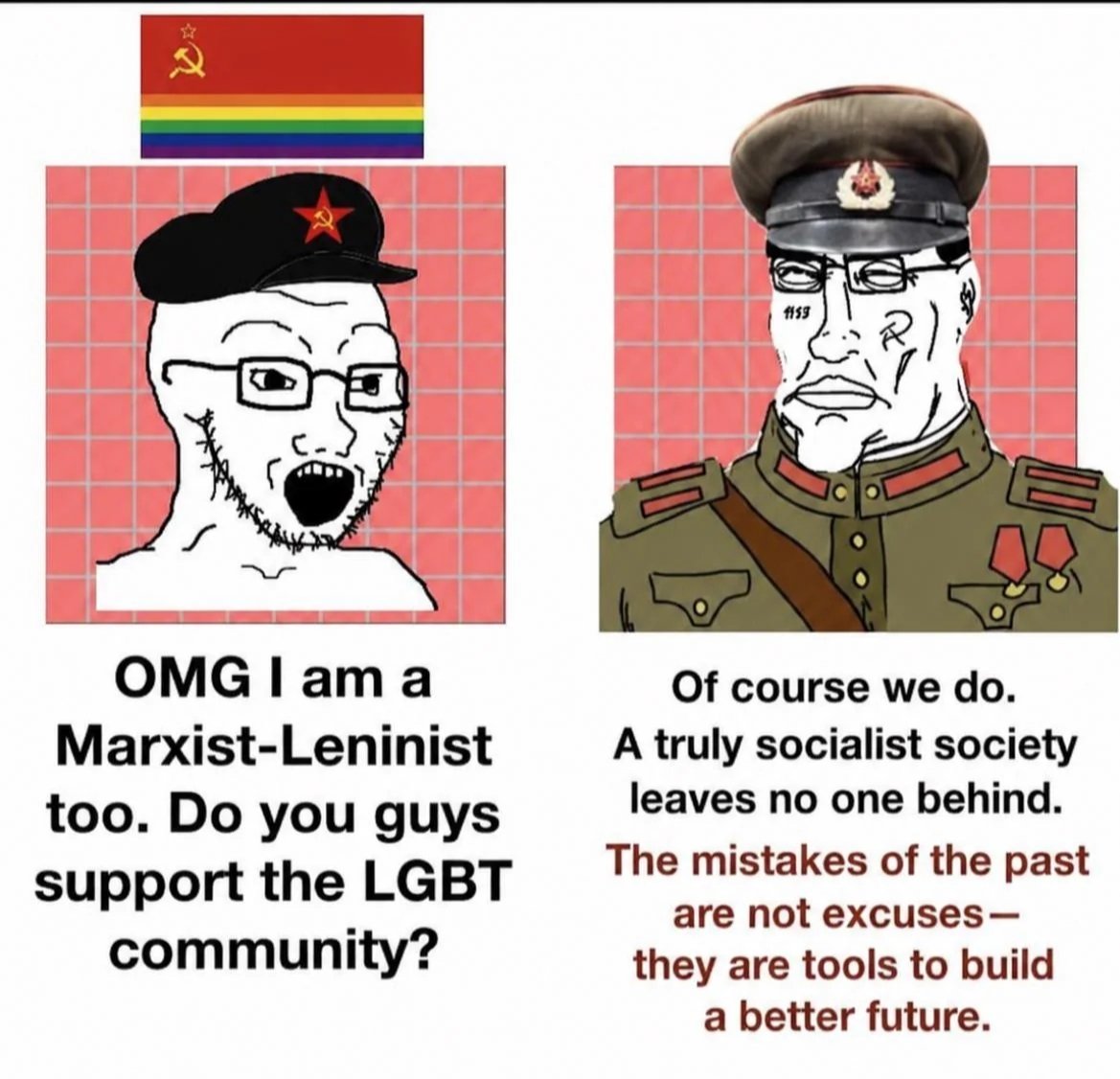
I’m leftist but I am the first to admit that Stalin wasn’t a good leader at all. For heaven’s sake, his own guards were scared of him. In fact, he died because he instilled so much fear into them. Personally, I’m more of a collectivist who doesn’t believe in authoritarianism.
im presuming that you’re presenting yourself i good faith and you sound like me not long ago; i want to share something that’s been helpful in dispelling the inception like nature of sources from the western that likely gave you this conclusion:
(i know that you’re getting this from a western source because you used the word authoritarian).
the freedom of information act, passed in the 1960s, forces the us government to release files – like they released the epstein files – where the cia, fbi, state dept, etc. admit in writing that they make shit up.
you have to wait at least 25 years after the event, but you can already read some files – just like people are reading the epstein files rn – of shit they made up about north korea being “authoritarian.” (you can even see how they chose that word). but the key part is that they admit to lying to us about north korea’s authoritarianism.
so if your source calls north korea authoritarian, know the us government invented that in the 1950s, was forced by law to admit the lie to the public in the 1970s and that any source still pushing this narrative can’t be trusted.
you’re never going to be a leftist if you don’t question your own sources.
No you are a liberal who’s trying to hijack the label.
This isn’t really true. Stalin was often described as a quiet listener in collective meetings, and was widely beloved. He developed a cult of personality against his own wishes, due to leading the country successfully during its most chaotic and desparate periods. This happens to all leaders in such situations, FDR was almost revered as a god in the US. Stalin turned down awards like the Hero of the Soviet Union, and refused to change Marxism-Leninism to Marxism-Leninism-Stalinism, essentially equating his own contributions (particularly on the national question and linguistics) to an extremely minor aspect compared to Marx and Lenin.
Khrushchev, in trying to cement his position, tried to attack each part of Stalin’s legacy. His staunch dedication to preparing for World War II, his careful contemplation of the National question as one of the foremost theorists on it within the realm of Marxism, and as someone who detested undue praise. Khrushchev flipped each of these on their heads without base (such as suggesting Stalin planned front line battles on a globe), and instead of killing the cult of personality, turned it into a negative cult of personality and created a total nihilism for the prospects of building socialism. I highly recommend Domenico Losurdo’s How to Cast a God into Hell: The Khrushchev Report.
As Weng Weiguang wrote, The Evaluation of Stalin is Essentially an Ideological Struggle. Repudiating Stalin is less about the historical figure and more about what was accomplished during his service. Demonizing Stalin demonizes the soviet union during its major industrialization, and therefore demonizes the most critical era for socialism in advancing on what came before.
In clearing Stalin’s name, we clear the record of socialism historically, proving it can, did, and does work definitively. This isn’t wasted effort, but is absolutely critical, especially as the demonized visage of Stalin is used as a club to beat Marxists and anti-imperialists in general (even non-Marxists!).
Ah yes, I always forget how the purges were just a big whoopsie doopsie misunderstanding and uncle Joe was actually a stoic, quiet voiced totally not good friend to that big bad Hitler guy.
Thanks for reminding me.
Twelve year old who just discovered sarcasm
Removed by mod
This is a children’s cartoon-ass story that falls apart at the slightest investigation. 80% of dead nazis died on the eastern front.
Molotov-ribbentrop pact is a fact of history. Not to mention during the war, Stalin himself authorized German u-boats to utilize naval bases around Murmansk to hide between raids against the British. Tell me how Stalin was actually playing 4D chess by allowing Hitler into Soviet naval bases.
People who believe that fascists, whose aim and total reason of being was to combat communism would be partners with them.
That is just embarrassing
The communists were never allies with the Nazis. A non-aggression pact is not an alliance. The communists spent the decade prior trying to form an anti-Nazi coalition force, such as the Anglo-French-Soviet Alliance which was pitched by the communists and rejected by the British and French. The communists hated the Nazis from the beginning, as the Nazi party rose to prominence by killing communists and labor organizers, cemented bourgeois rule, and was violently racist and imperialist, while the communists opposed all of that.
When the many talks of alliances with the west all fell short, the Soviets reluctantly agreed to sign a non-agression pact, in order to delay the coming war that everyone knew was happening soon. Throughout the last decade, Britain, France, and other western countries had formed pacts with Nazi Germany, such as the Four-Power Pact, the German-French-Non-Agression Pact, and more. Molotov-Ribbentrop was unique among the non-agression pacts with Nazi Germany in that it was right on the eve of war, and was the first between the USSR and Nazi Germany. It was a last resort, when the west was content from the beginning with working alongside Hitler.
Harry Truman, in 1941 in front of the Senate, stated:
Not only that, but it was the Soviet Union that was responsible for 4/5ths of total Nazi deaths, and winning the war against the Nazis. The Soviet Union did not agree to invade Poland with the Nazis, it was about spheres of influence and red lines the Nazis should not cross in Poland. When the USSR went into Poland, it stayed mostly to areas Poland had invaded and annexed a few decades prior. Should the Soviets have let Poland get entirely taken over by the Nazis, standing idle? The West made it clear that they were never going to help anyone against the Nazis until it was their turn to be targeted.
Churchill did not take the Nazis as a serious threat, and was horrified when FDR and Stalin made a joke about executing Nazis. Churchill starved millions to death in India in preventable ways, and had this to say about it:
Meanwhile, the soviet famine in the 1930s was the last major famine outside of wartime in the USSR, because collectivized farming achieved food security in a region where famine was common. As a consequence, life expectancy doubled:
The Nazis and soviets were never allies. A non-aggression pact is not an alliance, and the non-aggression pact between the soviets and the Nazis was unique among the other non-aggression pacts in that it was on the eve of war. The soviets knew war was coming, and so bought more time to prepare.
This is ignoring the secret protocol in which the USSR and Nazi Germany carved up eastern Europe into spheres of influence: https://avalon.law.yale.edu/20th_century/addsepro.asp And yes it does mention carving up Poland, it describes what the border should be if Poland is invaded (wink wink) and then declares that leaving a Polish rump state or not will be decided later. It also in no uncertain terms states that the Soviets can take Bessarabia.
It is the only non-aggression pact with such a protocol. The western powers did not sign such a deal with the Nazis in which third-parties are carved up.
Negotiations between the west and the USSR broke down for several reasons, notably:
Ultimately the security guarantee on Poland brought the west into war with Germany. The USSR, despite hammering on immediate action against Germany during negotiations before, instead opted for the annexation of the Baltics, Bessarabia and eastern Poland, and an attack on Finland. It took nearly two years for the USSR to begin fighting the Nazis, and only because the Nazis invaded them first.
No notes on Churchill being a dickhead though.
Poland makes sense, but why Romania?
The Soviet Union did not agree to invade Poland with the Nazis, it was about spheres of influence and red lines the Nazis should not cross in Poland. Spheres of influence were not agreements to jointly work together. When the USSR went into Poland, it stayed mostly to areas Poland had invaded and annexed a few decades prior. Should the Soviets have let Poland get entirely taken over by the Nazis, standing idle? The West made it clear that they were never going to help anyone against the Nazis until it was their turn to be targeted.
Further, you’re ignoring the Munich Agreement, where Czechoslovakia was given to the Nazis by the west. Not only was the west on good terms with the Nazis, signing many non-aggression pacts, they fostered healthy relationships. Finally, the Soviets were reasonably highly suspicious that Britain and Germany would ally. This was not unfounded, both were friendly enough until the outbreak of war. The Soviets desperately needed to make sure that the British and Germans would not ally, which reasonably would have happened had the Soviet Union taken unilateral action against the Nazis, rather than waiting to be attacked first.
Stalin was said to have “obsessed over quantitative and qualitative” improvements in arms in the years leading up to World War II, and had soldiers stationed on high alert, preparing for a German attack. Despite the insistence of many Generals to muster forces on the German border, it was Stalin’s insistence that forces not be so concentrated that prevented the Nazis from totally routing the Red Army, enabling the greatest counteroffensive in history.
Hitler himself was quite honest at times, to himself at least:
…
The Soviets expected and planned for it, they were never allies with the Nazis.
The purges were a popularly supported response to genuine threats and infiltration. They were not a misunderstanding, but they did exceed initial expectations, which is why they were stopped. As for Hitler (and the rest of the fascist movement), the Soviets (Stalin included) absolutely despised him. That’s why the Soviets spent the 1930s ramping up industrial production as quickly as they could, and trying to form an anti-fascist coalition with the west (which the British and French tanked).
Stalin was said to have “obsessed over quantitative and qualitative” improvements in arms in the years leading up to World War II, and had soldiers stationed on high alert, preparing for a German attack. Despite the insistence of many Generals to muster forces on the German border, it was Stalin’s insistence that forces not be so concentrated that prevented the Nazis from totally routing the Red Army, enabling the greatest counteroffensive in history.
Hitler himself was quite honest at times, to himself at least:
…
Statesian journalist and activist Anna Louise Strong actually met and spoke with Stalin, writing down her impressions:
I highly recommended the book Stalin: History and Critique of a Black Legend by legendary communist Domenico Losurdo. Losurdo’s unique method in the book is to use near-exclusively western, anti-communist sources, including Goebbels, Hitler, the New York Times, and so forth to examine not just Stalin, but to explain why Stalin is both so hated and yet so loved. It’s a critique of the legend surrounding Stalin.
Read Engels https://www.marxists.org/archive/marx/works/1872/10/authority.htm
Excerpt from Stalin - the History and Critique of a Black Legend by Domenico Losurdo
Impressive demonstrations of grief accompanied Stalin’s passing. In his death throes, “millions of people crowded the center of Moscow to pay their last respects” to the dying leader. On March 5th, 1953, “millions of citizens cried over his loss as if they were mourning for a loved one."1 The same reaction took place in the most remote corners of this enormous country, for example, in a “small village” that, as soon as it learned of what had happened, fell into spontaneous and collective mourning.2 The generalized consternation went beyond the borders of the USSR: “Many cried as they passed through the streets of Budapest and Prague."3
Thousands of kilometers away from the socialist camp, in Israel the sorrowful reaction was also widespread: “All members of MAPAM, without exception, cried”, and this was a party in which “all the veteran leaders” and “nearly all the ex-combatants” belonged to. The suffering was mixed with fear. “The sun has set” was the title of Al Hamishmar, the newspaper of the Kibbutz movement. For a certain amount of time, such sentiments were shared by leading figures of the state and military apparatus: “Ninety officers who had participated in the 1948 war, the great war of Jewish independence, joined a clandestine armed organization that was pro-Soviet and revolutionary. Of these, eleven later became generals and one became a government minister, and are now honored as the founding fathers of Israel."4
In the West, it’s not just leaders and members of communist parties with ties to the Soviet Union who pay homage to the deceased leader. One historian (Isaac Deutscher) who was a fierce admirer of Trotsky, wrote an obituary full of acknowledgements:
In summary, despite conditioned and in part disfigured by the Asiatic and despotic legacy of Tsarist Russia, in Stalin’s USSR “the socialist ideal has an innate and solid integrity.”
In this historical evaluation there was no longer a place for Trotsky’s harsh accusations directed at the deceased leader. What sense was there in condemning Stalin as a traitor to the ideals of world revolution and as the capitulationist theorist of socialism in one country, at a time in which the new social order had expanded in Europe and in Asia and had broken “its national shell”?5 Ridiculed by Trotsky as a “small provincial man thrust into great world events, as if by a joke of history”,6 in 1950 Stalin had become, in the opinion of an illustrious philosopher (Alexandre Kojève), the incarnation of the Hegelian spirit of the world and called upon to unify and lead humanity, resorting to energetic methods, in practice combining wisdom and tyranny.7
Outside communist circles, or the communist aligned left, despite the escalating Cold War and the continued hot war in Korea, Stalin’s death brought out largely “respectful” or “balanced” obituaries in the West. At that time, “he was still considered a relatively benign dictator and even a statesman, and in the popular consciousness the affectionate memory of “uncle Joe” persisted, the great war-time leader that had guided his people to victory over Hitler and had helped save Europe from Nazi barbarity."8 The ideas, impressions and emotions of the years of the Grand Alliance hadn’t yet vanished, when―Deutscher recalled in 1948―statesmen and foreign generals were won over by the exceptional competence with which Stalin managed all the details of his war machine."9
Included among the figures “won over” was the man who, in his time, supported military intervention against the country that emerged out of the October Revolution, namely Winston Churchill, who with regards to Stalin had repeatedly expressed himself in these terms: “I like that man."10 On the occasion of the Tehran Conference in November, 1943, the British statesman had praised his Soviet counterpart as “Stalin the Great”: he was a worthy heir to Peter the Great; having saved his country, preparing it to defeat the invaders.11 Certain aspects had also fascinated Averell Harriman, the American ambassador to Moscow between 1943 and 1946, who always positively painted the Soviet leader with regard to military matters: “He appears to me better informed than Roosevelt and more realistic than Hitler, to a certain degree he’s the most efficient war leader.“12 In 1944 Alcide De Gasperi had expressed himself in almost emphatic terms, having celebrated “the historic, secular and immense merit of the armies organized by the genius, Joseph Stalin.” The recognition from the eminent Italian politician isn’t merely limited to the military sphere:
No less powerful or uncommon was the prestige that Stalin had enjoyed, and continued enjoying, among the great intellectuals. Harold J. Laski, a prestigious supporter of the British Labour Party, speaking in the fall of 1945 with Norberto Bobbio, had declared himself an “admirer of the Soviet Union” and its leader, describing him as someone who is “very wise."14 In that same year, Hannah Arendt wrote that the country led by Stalin distinguished itself for the “completely new and successful way of facing and solving national conflicts, of organizing different peoples on the basis of national equality”; it was a type of model, it was something “that every political and national movement should pay attention to."15
For his part, writing just before and soon after the end of World War II, Benedetto Croce recognized Stalin’s merit in having promoted freedom not only at the international level, thanks to the contribution given to the struggle against Nazi-fascism, but also in his own country. Indeed, who led the USSR was “a man gifted with political genius”, who carried out an important and positive historical role overall; with respect to pre-revolutionary Russia, “Sovietism has been an advance for freedom, just as, “in relation to the feudal regime”, the absolute monarchy was also “an advance for freedom and resulted in the greater advances that followed." The liberal philosopher’s doubts were focused on the future of the Soviet Union; however, these same doubts, by contrast, further highlighted the greatness of Stalin: he had taken the place of Lenin, in such a way that a genius had been followed by another, but what sort of successors would be given to the USSR by “Providence”?16
Removed by mod
You understand so little you would likely have to unlearn effectively everything you “know” to even approach 0 understanding.
Fuck you first of all you massively racist fucking loser. You don’t get to be suspicious whitey.
Maybe, if you have no fucking idea what capitalism, socialism or communism actually mean.
Not understanding the firewall award.
Gulag archipelago reader award. (A book so terribly it’s been disavowed by everyone involved bar the main author)
Depends do you mean the real issues that occured during the crackdown on ETIM or the Zenz/US state department fantasy.
Views stuck decades in the past award.
Categorically not a massacre but a clash between violent rioters and the military acting as riot police at the time, also funnily enough none of the violence was actually in the square.
I don’t think you know what this word means
“My country is evil and constantly lies but I also believe everything they say about their ideological enemies”
I do think China has done some good, but it also doesn’t cancel out the sketchiness. I do agree that we could learn from China, but there’s also a damn good reason why their phones are banned in multiple countries. There’s also a good reason why people are urging people to stop buying from fast fashion websites, which are mostly Chinese.
Please do explain to me how selling carcinogenic products worldwide (from sketchy AF factories) isn’t capitalist. Explain it like I’m 5 years old, I do insist. With the way the world is going, I’m even going to use GrapheneOS for extra privacy.
Considering that China is known for its heavy censorship and is in good cahoots with Russia, it isn’t racist to be suspicious. I’d be just as suspicious of a person from the USA defending Israel, so it’s not like I’m not like I’m going after race. Not to mention, at least 250 people died during the Tianamen square incident. Some even estimate that thousands died, but it was at least 250 people.
I quite literally do not celebrate Canada day because it’s built on top of the blood of colonialism. I am also largely not a fan of Christians and have very little patience for a lot of them.
Plus, China has billionaires. Any truly non-capitalistic country wouldn’t have billionaires. Nor would they have factory workers working for 75 hours per week.
I’m not referring to any books when talking about the Gulag survivors, for the record.
Yes, because the US started a trade war with them because they can’t compete (in EVs also), and a few of their vassal states followed suit.
Sources on this? The PRC only blocks western surveillance platforms because they’re incredibly dangerous to let them loose in your country. They’re one of the few countries not naive enough to let facebook and google take over their social media landscape.
https://github.com/dessalines/essays/blob/main/socialism_faq.md#what-about-the-tiananmen-square-massacre
Come on, you can’t (I presume) ban someone and then ask them for sources.
I banned after this, reading further down and seeing them get more and more virulently racist.
I would define a transition from capitalism to socialism as
Merchants & lawyers out of power
and engineers (laborers) & academics into power,
which is what China has.
The US isn’t failing true capitalism while still secretly being feudalistic,
just because land lords and TV evangelists exist,
while George Bush Jr, eldest son of George Bush Senior, became leader of the land in 2000.
China just had a capitalistic phase due to Deng’s reforms,
just like the US had a socialist phase due to Roosevelt’s reforms.
Both of those did not last, because ultimately those in power are
socialist for China (engineers & academics)
and capitalist for the US (merchants & lawyers).
The capitalist phase is already waning under Xi,
just like the socialist phase did under Nixon did for the US.
Lol. Do you really use such language with your own nation?
If not, you are selective and that begs the question as to why
and what pattern would emerge out of what you are selective to.
I highly doubt you ever said something along the lines of
“The EU/UK is in good cahoots with the US”,
despite the fact that EU NATO chief Rutte openly called Trump “daddy”.
I don’t see Putin doing that with Xi. Putin is not even running
a socialist country.
And Putin talks about a multipolar world in which Russia is one of those poles.
To be honest, I am growing quite tired of the USA. I do not like the USA or what it stands for; Donald Trump is merely proof of what I’ve been saying about the country all along. I do think that countries that are buddy-buddy with the USA are frustrating as hell. As a Canadian, I’ve been done with their BS for so long that it’s not even funny.
I actually criticise the country so much that I can genuinely say I’m a certified hater. Plus, I also believe that patriotism for being Canadian or American is celebration of colonialism; we should deconstruct these countries instead of maintaining status quo. People got genocided just so cranky old white people can cry about immigrants from India and eat hotdogs and burgers on Canada day.
I don’t think you’ll find anyone disagreeing with you here, Canada and the US Empire are both genocidal settler-colonies and imperialist powers. The US Empire is just the global hegemon (though this is dying away), Canada is complicit because it benefits.
And what sucks even more is that I’m sadly very disabled and can’t protest in public like everyone else can. In a nutshell, I developed a severe condition after a traumatic event and it’s so bad that I can’t even work at a job. I already had autism and ADHD and can’t drive a car as a result, but this newer condition makes everything 10 times worse.
From the time I was 7 or 8 years old, I always wanted to grow up and help the world. I always wanted to be somebody important like Greta Thunberg (even before I heard of her). I’ve always cared about animals and the damage that is being done to the environment worldwide. In fact, every time I enter a car, I think about the fossil fuel gas contributing to the decline of the environment.
Every single day, I think about how capitalism and carelessness are ruining the world. In the last 13 or 14 years, I don’t know if a single day has ever passed by where I wasn’t thinking about the injustices of this planet.
Given that you think the US and Canada are only as bad as Russia, you’re certainly no hater of them; if anything, you have a rosey picture of them. Further supported by the fact you think 250 people dying in clashes 40 years ago even registered in comparison to the millions killed by the West since.
the easiest first step in ensuring that the usa and it’s ilk change their tune is to stop repeating the propaganda the usa already admitted to manufacturing thanks to the freedom of information act.
i’m referring to stuff like this:
if you’re to repeat their propaganda, you should atleast be getting paid for it.
My honest stance is that Russia and the US are just as bad as one another. Anyone who defends either of these two countries is suspect to me. I do think the fact that other Eastern European countries flinch at Russia is highly indicative that something clearly went wrong in the Soviet Union. However, I dislike that the CIA got involved in the dissolution of the USSR.
Being constantly spied on is one of my biggest fears, so I’m obviously making moves to slowly degoogle my life. My next step is buying a Google Pixel, which sounds insane until you realise that you can install GrapheneOS on it (the most private operating system for phones). Thankfully, Motorola is soon teaming up with GrapheneOS and GOS is maintaining its position as a non-profit organisation. This pairing is simply meant to ensure that the OS is available on more than just Google phones.
I even plan to get rid of Facebook, Instagram, and Reddit. I already got rid of Twitter and TikTok and am switching over to Bluesky, Mastodon, Lemmy, Matrix.org, Pixelfed, and Loops (by Pixelfed). I also prefer Linux over anything mainstream like Windows or MacOS. Because I won’t be able to afford a Pixel for a few months, I’m slowly getting prepared by downloading APK downloaders. Stock Android is getting locked down and I’m preparing for it.
I wrote a more direct reply to this, but I have come to realise that in this situation it would most likely be unproductive. You appear to be a very new leftist of some description: you seem to like the idea of socialism or communism, but you do not yet seem to have a firm grasp of what they actually entail. So instead of arguing point by point, I am going to explain what socialism is, why China has been socialist since 1949, and then add some book and article recommendations so you can begin studying the question more seriously on your own.
To start, we have to define a term that is commonly used but rarely properly understood: the state. Many people use “the state” and “the government” interchangeably, but this is not accurate. The state is specifically the organised force by which class antagonisms are mediated through the rule of one class over others. The government, on the other hand, broadly refers to the administration, coordination, planning, record-keeping, infrastructure management, public decision-making, and the organisation of social production required by advanced societies. This distinction will be important later.
Next, it is important to define socialism. Socialism is the transitionary period between capitalism and communism. It still contains many contradictions inherited from capitalism: classes, class struggle, uneven development, commodity production, wages, bureaucracy, ideological struggle, and often limited market mechanisms. Socialism is not “when everything is already communist.” It is the period in which the proletariat holds political power and uses that power to transform society, develop the productive forces, suppress reaction, and gradually overcome the material basis of class society.
This stands in contrast to communism, where class society has been abolished as a meaningful social reality. Communism is classless because there are no longer opposed classes standing in antagonistic relation to one another (as only a single class, the proletariat, remain after the other classes have been proletarianised during the socialist period). It is stateless because, once class antagonisms have disappeared, the state as an instrument of class rule no longer has a function and withers away. This of course does not mean that organisation, administration, planning, or collective decision-making (the government) disappear. It means that the coercive state as an instrument of class domination disappears.
At this point you might ask: if contradictions remain under socialism, how is it different from capitalism? That is a reasonable question. The answer rests on one primary and one secondary characteristic.
The primary question is: which class commands the state? Under socialism, the proletariat commands the state through the people’s democratic dictatorship, also called the dictatorship of the proletariat. Under capitalism, the bourgeoisie commands the state, which communists refer to as the dictatorship of capital (even if they have a liberal democratic cascade).
The secondary question is: which mode of ownership holds primacy, public ownership or private ownership? This is secondary because public ownership under the dictatorship of capital functions as state capitalism, while public ownership under the dictatorship of the proletariat is part of socialist construction. Ownership forms matter, but they cannot be separated from the class character of political power.
Now, with this groundwork laid, we can finally look properly at the Chinese situation.
China has been socialist since October 1, 1949, because the old landlord-bureaucrat-comprador state was destroyed and replaced by a people’s democratic dictatorship led by the working class through the Communist Party. The Communist Party of China has more than 100 million members as of the end of 2024 (slightly over 1/14 people). The commanding heights of the economy were brought under public ownership and workers state direction. The new state was built to suppress reaction, defend sovereignty, develop the productive forces, and transform society.
In China, the bourgeoisie still exists, but it does not rule as a class. Capitalists can own firms in non-commanding sectors, make profits, and accumulate wealth within limits, because developing the productive forces still serves necessary social goals at China’s current stage of development. But they do not command the state, the army, the land system, the central banking system, or the strategic direction of the economy. They do not stand above the people or above the people’s organised political instrument, the Communist Party, as a sovereign power.
When capital conflicts with the long-term interests of socialist construction, it is disciplined, subordinated, investigated, broken up, fined, or otherwise brought to heel. Jack Ma and Ant Group is a useful example: its $37 billion IPO was suspended in 2020 and Jack Ma was made step away from public life as he attempted to put his profit before the benefits of the people by pushing for loosening banking regulations so he could provide micro loans. Foreign capitalists spent years crying about this as it showed the truth capital holds no power in China.
To put it briefly: China is socialist because the proletarian-led state holds political power, commands the strategic economy, subordinates capital to national and social development, suppresses reactionary threats, and continues the long transition out of capitalism under conditions of imperialist encirclement, uneven development, and a still-existing world capitalist system.
It would also be remiss not to mention that much of what you “know” about China has been manufactured through a mix of exaggeration, selective framing, omission, and outright lies. For example, you have likely heard about “996” as if it represents Chinese labour law or the normal working life of the whole country. In reality, 996 was an issue in ~40 of the large tech firms around the 2019 tech boom and was quickly ruled illegal which it now has been for half a decade.
For a proper explanation on how this kind of ideological manufacture happens, I would recommend reading Michael Parenti’s Inventing Reality.
Further reading recommendations:
I have to a plug @Cowbee@lemmy.ml and their beginner reading list
But for my recommendations more directly related to the topic at hand I would recommend:
I understand having such a long list dumped on you is likely off-putting however that’s the unfortunate truth of being a real socialist/communist, constant reading, education and investigation is a must. If you have any specific questions on any of them I can try help you if need be.
Excellent write-up I’d like to point to one thing though
This doesn’t mean anything to a westerner. What westerners hear is “The communist party officials presume/claim to speak in the interest of the working class with no direct input from them”. Since this is what almost every party in the west has done since parliaments became a thing. The ones that didn’t aren’t included in textbooks. And since you’re speaking positively of such a party you must be “shilling” for them. I know adding the “how” of how workers shape and influence the state would make your comment even longer, but as it is to most it’s just an unbelievable, meaningless phrase.
Yeah I 100% agree but also felt that it was long enough that it was 50/50 they’d actually read past the first few lines anyway so I could clarify in any follow-ups if they did and if they didn’t then it was fine as is anyway.
deleted by creator
Thanks for the shoutout, and excellent comment as always!
Selling products is not capitalism by itself. Capitalism is a system where private ownership is the principal aspect, and capitalists control the state. Socialism, on the other hand, is a system where public ownership is principal, and the working classes control the state. The backbone and commanding heights of China’s economy are publicly owned, and the working classes control the state, ergo it is socialist.
Billionaires exist because private property exists, and private property exists because it speeds up development and integrates China with the global economy. This is a tradeoff used to build up the productive forces as quickly as possible, so that the social surplus can be redirected to developing underdeveloped regions, and because developed industry is easier to publicly own and plan. As these private firms grow, they are more tightly controlled and/or folded into the public sector.
Average working hours in China are 46 hours per week, not 75.
In china, the state controls capital. In America, capital controls the state
It really is that simple. A market does not make capitalism ffs
On Authority is a pointed response to the thought-terminating pejorative of “authoritarian.” If you haven’t read it, you should! It’s short and important =)
You want a change in society? You don’t care that fascists don’t want that change? Then you’re an authoritarian. Everything after that is a matter of degree.
I care about the fact that leaders have a huge say in everything in our lives. I do not wish for a system where I must cater to the whims of whomever is in charge.
Unless those leaders are capitalists, apparently, in which case you consider stopping them from controlling our lives to be “authoritarian”
If you’re willing to do something about that wish, then you’re an authoritarian too.
And FWIW, casting it in personal terms makes that wish tautological. No one wishes for a system where they have to cater to the whims of someone else. I’m sure you meant to say “no one has to cater to anyone else’s whims,” and that’s all well and good. Still authoritarian if you’re willing to see anything at all done to overcome the desires of the powerful to maintain the status quo (and in case it’s not obvious, that’s a good thing to be authoritarian about).
The CIA, in an internal memo never meant to be released, made it clear that Stalin was not a dictator and that leadership was collective.
The USSR brought dramatic democratization to society. First-hand accounts from Statesian journalist Anna Louise Strong in her book This Soviet World describe soviet elections and factory councils in action. Statesian Pat Sloan even wrote Soviet Democracy to describe in detail the system the soviets had built for curious Statesians to read about.
From the CIA memo, what does “the MVD” stand for?
Ministry of Internal Affairs, successor to the NKVD (Peoples Commissariat)
Thank you!
Beat me to it!
Authoritarian is a meaningless pejorative. All states/countries/political groups etc. must be authoritarian by necessity in class society.
Major citation needed.
Removed by mod
It’s so obvious that the only standard western “leftists” have for who was a “classy” leftist and who was an evil authoritarian is whether they were martyred or not. You’re clearly just readapting Christianity here in order to say the only good leftist is a dead leftist
No, there are plenty of good leftists whom are living. Jesus, lemmy.ml users make heavy accusations towards anyone who even somewhat disagrees.
Try looking at it from our side. Day in, day out we get bombarded with disinformation (intentionally or not), and have had these same arguments day in, day out. I don’t think it’s particularly surprising when some communists become jaded and snappy over time, even if I think it’s counter-productive. The point on Sankara is apt, Sankara was just as good a person as many other demonized socialist leaders, but was not as heavily targeted due to Burkina Faso’s socialist project getting strangled in the crib, rather than flourishing and thus getting demonized.
Sankara is just as “tankie” as Stalin, Castro, Mao, Huey P. Newton, etc. The difference is that he was killed before Burkina Faso really had a chance to develop socialism, and as such his name hasn’t been dragged through the mud. Regarding Stalin, there are several books I can recommend, but I’ll pick just one. Stalin: The History and Critique of a Black Legend by Domenico Losurdo.
Also not sure what you mean by saying you don’t “believe in class society.” What does this mean? Do you deny the existence of wage laborers and capitalists, or do you deny that classes have similar interests and philosophies that come more naturally based on how we live?
Either way, we all love Sankara. Just because we disagree with bourgeois historiography on socialist leaders does not mean we don’t also appreciate the ones that bourgeois historiography has largely left alone.
You may not believe in classes, but that doesn’t negate their existence.
We will continue to support AES states (current and those sadly no longer extant). Go advocate for utopianism somewhere else.
Aka someone who dies before they can be effectively vilified
Western Marxism, the Fetish for Defeat, and Christian Culture (2020):
https://redsails.org/western-marxism-and-christianity/
How can you not “believe” in class society when it is a fact? Also, Sankara was a Marxist-Leninist, the very ideology you despise.
You don’t think classes exist? Or you think it’s possible to abolish classes at the press of a button without any transitionary phase? Either way this is idiotic.
Leader who believes the things I believe (Marxism Leninism) but was assassinated before the consolidation of the workers state began. You should probably investigate subjects before you speak on them.
This site won’t load but from dealing with them previously I vaguely remember them as a liberal nonsense publisher however if you can provide an archive link or equivalent I can give my proper views on this article in particular.
You just posted a meme and said leftists fight too much and here you are, fighting.
Removed by mod
Hmm, I wonder if protecting the socialist leadership was a factor in this. Too bad he got assassinated, proving that using state power to oppose the reactionary forces is critically important in a nascent socialist state.
Why don’t you just come out and admit you only like leftist leaders who get killed before they can do much, that’s clearly what you think
Uhhh… no? Historically speaking, there were societies that took care of everyone. Plus, the desire for egalitarianism has existed for quite a long time. Just because I don’t agree with some historical white leader, doesn’t mean that I only like leftists who got killed.
The majority of people who lived in Eastern European socialism regret its fall.
That’s cool that being nice is the ceiling of revolutionary possibility in your brutally constrained mind, but the Chinese Communists did this:
Capitalist apologists: see how we reduced world poverty? /s
Not sure if this is a joke because if you exclude China from the data, world poverty has actually gotten worse in the last 40 years. They are singlehandedly dragging that world average upwards.
Good context. That’s why I added the /s