Most comedians in Japan tend to be famous for 15 minutes and blow up for one schtick. If you want to see more variations on his theme just search his stage name (atsukiri jason) and stuff should come up.
the latter set is just the same chinese characters spelled out phonetically
i feel like most people nowadays are getting lazy and just using the chinese numbers more and more instead of learning a new word for each new ten (twenty thirty forty etc)
kanji are not a stylistic choice, but an integral part of the writing system
also I think you mean the syllabaries (hiragana, katakana) are ultimately derived from chinese characters, japanese kanji are largely the same as chinese hanzi
You misunderstood me because that’s not what I was saying.
If there are Chinese characters in a Japanese game, they’re there for the visual appeal of them… unless they’re trying to actually teach Chinese, which I doubt the Fatal Frame series (horror) is doing.
I think they mean Ateji/当て字, when they’re used phonetically just to represent something as foreign or for style. Like how sushi is 寿司, but the characters have nothing to do with sushi other than the pronunciation.
Of course, these are the exception. Kanji is integral to japanese writing and it’s a pain in the ass without them.
I wonder when kanji stop being Chinese characters in the same way that souvenir used by someone speaking English isn’t using a French word. Like characters with different variations in Japanese technically aren’t used (and weren’t ever used) in China, like 誤 vs 誤 (prob won’t show up right with the font on here but the Japanese component on the bottom right uses 六 without the top dot and Chinese uses 大). The kana were all derived from kanji as well, so could those be “chinese” characters? The etymology is obviously Chinese in the same way souvenir is French, but what does that really mean?
Dunno, maybe it’s mostly semantics, especially when trying to talk about it in English
to me, “Chinese characters” means a certain writing system that is used by several languages (and not just Japanese and Mandarin, but also Cantonese, Korean, Vietnamese etc.), but doesn’t inherently belong to any one of them. So, in my opinion, Japanese variants or 国字 are totally valid Chinese characters.
whether kana are also Chinese characters is a very interesting question. I think the main thing that makes them distinct is the purpose they serve, as they no longer convey any meaning by themselves but are instead used to write language phonetically. but I wouldn’t be so sure when it comes to 万葉がな. although manyogana was used the same way as modern kana it retained the shape of chinese characters. so maybe it’s the combination of both the evolved shape + different purpose that makes kana distinct from kanji?
“Chinese characters” means a certain writing system that is used by several languages (and not just Japanese and Mandarin, but also Cantonese, Korean, Vietnamese etc.), but doesn’t inherently belong to any one of them
Yeah, upon further consideration it seems less like a loanword being considered part of another language and more like they’d have to be called Chinese characters because that’s the origin and nothing else has replaced it, apart from some variants. It’s like how a lot of modern languages use the Latin alphabet, even if some add diacritics like ñ in Spanish.


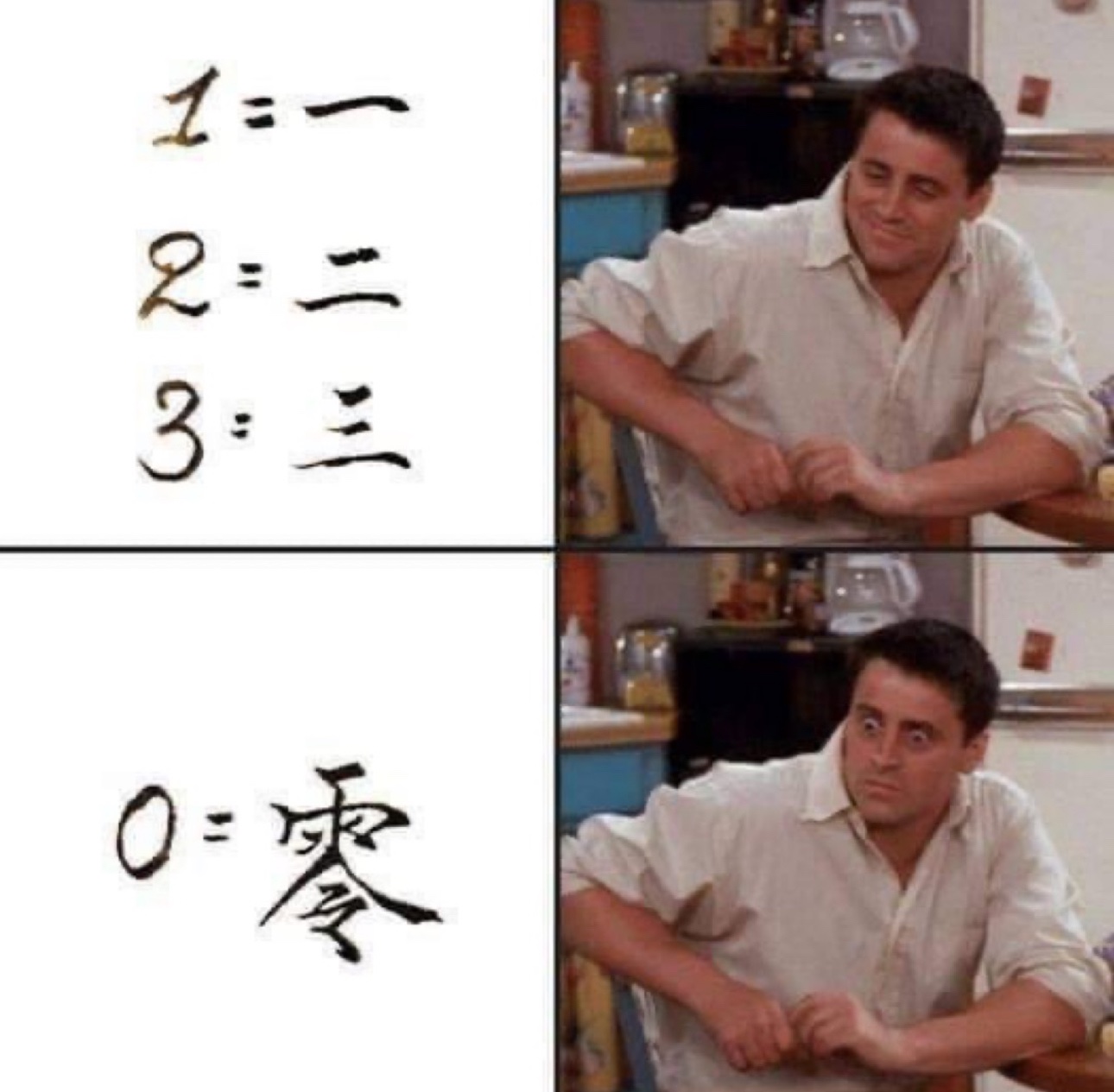
Japanese isn’t much better:
一、二、三… 四。
It’s the same as in Chinese, so I wouldn’t expect it to be 😅
WHY JAPANESE PEOPLE?!
https://youtu.be/zpxJ1WAotnY
Not why, memorize.
Memorize Japanese people?
I want the whole version of that
Most comedians in Japan tend to be famous for 15 minutes and blow up for one schtick. If you want to see more variations on his theme just search his stage name (atsukiri jason) and stuff should come up.
Congrats on being the smart one in this thread. 😞
In Spanish it’s 1,2,3 and 0.
The fourth character he wrote means 4, not 0, though.
Why would he do that?
And then the other person doesn’t even tell us what 0 would be. So much disappointment in this thread.
Technically, I think that’s Arabic
No, I’ve studied Arabic and it’s actually ١,٢,٣ and ٠.
الله أبهى
Gracias.
De rien
In Korean it’s not so bad: 한, 둘, 셋, 넷. Or 일, 이, 삼, 사. Yes there are two different types of numbers…
the latter set is just the same chinese characters spelled out phonetically
i feel like most people nowadays are getting lazy and just using the chinese numbers more and more instead of learning a new word for each new ten (twenty thirty forty etc)
Thats good to hear, I made a lot of mistakes of using the wrong numbers for times or dates.
unfortunately hours (not minutes) ages and number of days/months (not years) are still korean numbers not chinese
but i guess you can always just say the year of birth and spell out the date instead both of which would be chinese… haha languages are weird
Wait. I’ve played a lot of Fatal Frame, and they only signify the Zero Lens by its kanji, and it’s not that square shape. So now I’m confused…
Maybe its ghost folklore origins put it more on the Chinese side?
That’s because 四 is 4
In Japanese they also use 零 (rei) for zero. Or 〇 (maru) or ゼロ (zero)
Chinese characters are seen in Japanese media as stylistic choice, yes.
The ones I typed are proper Japanese Kanji, which are derived and very simplified forms of Chinese characters. Even more so than Simplified Chinese.
kanji are not a stylistic choice, but an integral part of the writing system
also I think you mean the syllabaries (hiragana, katakana) are ultimately derived from chinese characters, japanese kanji are largely the same as chinese hanzi
You misunderstood me because that’s not what I was saying.
If there are Chinese characters in a Japanese game, they’re there for the visual appeal of them… unless they’re trying to actually teach Chinese, which I doubt the Fatal Frame series (horror) is doing.
when you say “Chinese characters” do you mean kyuujitai? all kanji are chinese characters, that’s what 漢字 literally means
I think they mean Ateji/当て字, when they’re used phonetically just to represent something as foreign or for style. Like how sushi is 寿司, but the characters have nothing to do with sushi other than the pronunciation.
Of course, these are the exception. Kanji is integral to japanese writing and it’s a pain in the ass without them.
I wonder when kanji stop being Chinese characters in the same way that souvenir used by someone speaking English isn’t using a French word. Like characters with different variations in Japanese technically aren’t used (and weren’t ever used) in China, like 誤 vs 誤 (prob won’t show up right with the font on here but the Japanese component on the bottom right uses 六 without the top dot and Chinese uses 大). The kana were all derived from kanji as well, so could those be “chinese” characters? The etymology is obviously Chinese in the same way souvenir is French, but what does that really mean?
Dunno, maybe it’s mostly semantics, especially when trying to talk about it in English
to me, “Chinese characters” means a certain writing system that is used by several languages (and not just Japanese and Mandarin, but also Cantonese, Korean, Vietnamese etc.), but doesn’t inherently belong to any one of them. So, in my opinion, Japanese variants or 国字 are totally valid Chinese characters.
whether kana are also Chinese characters is a very interesting question. I think the main thing that makes them distinct is the purpose they serve, as they no longer convey any meaning by themselves but are instead used to write language phonetically. but I wouldn’t be so sure when it comes to 万葉がな. although manyogana was used the same way as modern kana it retained the shape of chinese characters. so maybe it’s the combination of both the evolved shape + different purpose that makes kana distinct from kanji?
Yeah, upon further consideration it seems less like a loanword being considered part of another language and more like they’d have to be called Chinese characters because that’s the origin and nothing else has replaced it, apart from some variants. It’s like how a lot of modern languages use the Latin alphabet, even if some add diacritics like ñ in Spanish.
A) Kanji are Chinese characters.
B) Both languages simplified their characters, but Chinese was actually more aggressive in simplifying than Japanese, not the other way around.
For example, look at the character for turtle:
Traditional Chinese: 龜
Simplified Chinese: 龟
Japanese: 亀