You could similarly say that Europe is huge, or that China is huge, or that the whole planet is huge, and therefore the people living there must need a vehicle. Except, most people dont leave their local area all that often, and when they do, theres nothing that inherently requires that the vehicle used to do so much be individually owned. This isnt to say that nobody needs a car, obviously if you live way out in the middle of nowhere, running transit might not be so viable- but that does not describe how and where most people live, even in the US, and for the majority that do live in urban areas, the size of the whole country is irrelevant to if they would need cars if we just built the proper infrastructure.
There are many such areas, what I was trying to say was more that that is a solvable problem, if the government of the area was sufficiently motivated to solve it, rather than something like “we’re too big for anything but cars”, which is more of an excuse to not do any of that change to the infrastructure because it implies that nothing can reasonably be done and that cars are simply the natural way of things.
The problem is that making my area pedestrian friendly would involve doing a lot more than just adding sidewalks.
For example, it would make much more sense to link all the cul de sacs with walking/biking paths. But to do that we’d need to bulldoze some houses, get easements from property owners, and then pay for the paths to be put in while hearing construction equipment for months.
And our local government just doesn’t have the power to do that in a reasonable amount of time, or with any guarantees of it even surviving election season.
And that’s not even talking about dealing with improving the main thoroughfare which is a state highway, meaning the local government has no say in how it’s built.
I guess what I’m saying is the big flaw with your plan is “if the government of an area was sufficiently motivated.” The way the US government is structured means you need agreement from the voters all the way to the federal government for years to do it.
I could go down to Sunbelt and get a bulldozer and start knocking houses down for bike paths today if I wanted, but that is largely frowned upon.
The Local Group, which includes the Milky Way galaxy, is over 10 million light years, so you can easily see that I have no choice but to own a car to be able to get around.
Most places in Europe and many places in China have functioning mass transit. Most places in the US do not. The car lobby is very powerful in the US, and they work hard to make life impossible without a car.
Well yeah, that’s my point though, there’s nothing about the US’s size that means it cant have that stuff, the big country argument is functionally just an excuse to distract from what the car industry has done here.
The size isn’t that relevant. Trains are far better than cars for long distance travel. The problem with the US is the many areas of low but non-zero population density.
To accommodate that you need a good rail network and then probably cars to take you the last few hours. This would work best if those cars were self driving, so they can get back to a hub rather than wherever you are in bumfuck nowhere.
I agree that subsidizing more rail would be good, but it’s pretty fixed, location wise. It’s already in place for most intercity travel.
Rural/outside city living is diffuse, scatters in all directions from a city. It’s why there’s rush hour in most cities. How do you run rail to all those locations? Can you imagine the nimby screams? It also significantly drops real estate values having trains rolling through the backyard.
According to Wikipedia there are three U.S. cities with populations over 2 million that have no intercity passenger rail service (Las Vegas, Columbus OH, and Nashville). Dozens of cities used to have rail services but don’t any more. In European countries, it’s normal for all cities and towns with a population of at least, say, 50,000 to be served by intercity rail, so there’s a lot of improvements possible.
I’m not saying that US rail should aim to serve the rural population - that’s what the cars are for.


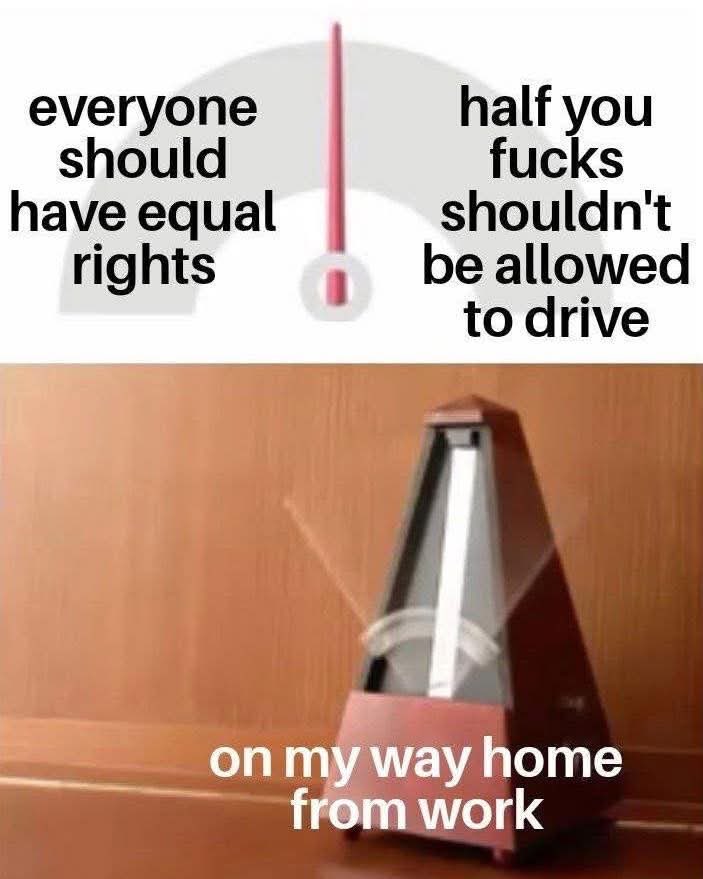
Synthesis is: no-one should be allowed to drive
The US huge. Unless you live in a metro area and never leave you’re going to need a vehicle.
Moving state to state, generally, it will take you an entire day at a freeway speed to get 2 states over. We have 48 on the drivable side.
You could similarly say that Europe is huge, or that China is huge, or that the whole planet is huge, and therefore the people living there must need a vehicle. Except, most people dont leave their local area all that often, and when they do, theres nothing that inherently requires that the vehicle used to do so much be individually owned. This isnt to say that nobody needs a car, obviously if you live way out in the middle of nowhere, running transit might not be so viable- but that does not describe how and where most people live, even in the US, and for the majority that do live in urban areas, the size of the whole country is irrelevant to if they would need cars if we just built the proper infrastructure.
The problem is that even in my local area the infrastructure is built for cars so much that walking takes 10x longer than it should.
There are many such areas, what I was trying to say was more that that is a solvable problem, if the government of the area was sufficiently motivated to solve it, rather than something like “we’re too big for anything but cars”, which is more of an excuse to not do any of that change to the infrastructure because it implies that nothing can reasonably be done and that cars are simply the natural way of things.
The problem is that making my area pedestrian friendly would involve doing a lot more than just adding sidewalks.
For example, it would make much more sense to link all the cul de sacs with walking/biking paths. But to do that we’d need to bulldoze some houses, get easements from property owners, and then pay for the paths to be put in while hearing construction equipment for months.
And our local government just doesn’t have the power to do that in a reasonable amount of time, or with any guarantees of it even surviving election season.
And that’s not even talking about dealing with improving the main thoroughfare which is a state highway, meaning the local government has no say in how it’s built.
I guess what I’m saying is the big flaw with your plan is “if the government of an area was sufficiently motivated.” The way the US government is structured means you need agreement from the voters all the way to the federal government for years to do it.
I could go down to Sunbelt and get a bulldozer and start knocking houses down for bike paths today if I wanted, but that is largely frowned upon.
The Local Group, which includes the Milky Way galaxy, is over 10 million light years, so you can easily see that I have no choice but to own a car to be able to get around.
Intergalactic travel is rough, make sure you get all wheel drive
What, you want to trust Boeing, now that it too has been enshittified? No thanks, I drive the lower 48.
Most places in Europe and many places in China have functioning mass transit. Most places in the US do not. The car lobby is very powerful in the US, and they work hard to make life impossible without a car.
Well yeah, that’s my point though, there’s nothing about the US’s size that means it cant have that stuff, the big country argument is functionally just an excuse to distract from what the car industry has done here.
The size isn’t that relevant. Trains are far better than cars for long distance travel. The problem with the US is the many areas of low but non-zero population density.
To accommodate that you need a good rail network and then probably cars to take you the last few hours. This would work best if those cars were self driving, so they can get back to a hub rather than wherever you are in bumfuck nowhere.
I agree that subsidizing more rail would be good, but it’s pretty fixed, location wise. It’s already in place for most intercity travel.
Rural/outside city living is diffuse, scatters in all directions from a city. It’s why there’s rush hour in most cities. How do you run rail to all those locations? Can you imagine the nimby screams? It also significantly drops real estate values having trains rolling through the backyard.
According to Wikipedia there are three U.S. cities with populations over 2 million that have no intercity passenger rail service (Las Vegas, Columbus OH, and Nashville). Dozens of cities used to have rail services but don’t any more. In European countries, it’s normal for all cities and towns with a population of at least, say, 50,000 to be served by intercity rail, so there’s a lot of improvements possible.
I’m not saying that US rail should aim to serve the rural population - that’s what the cars are for.