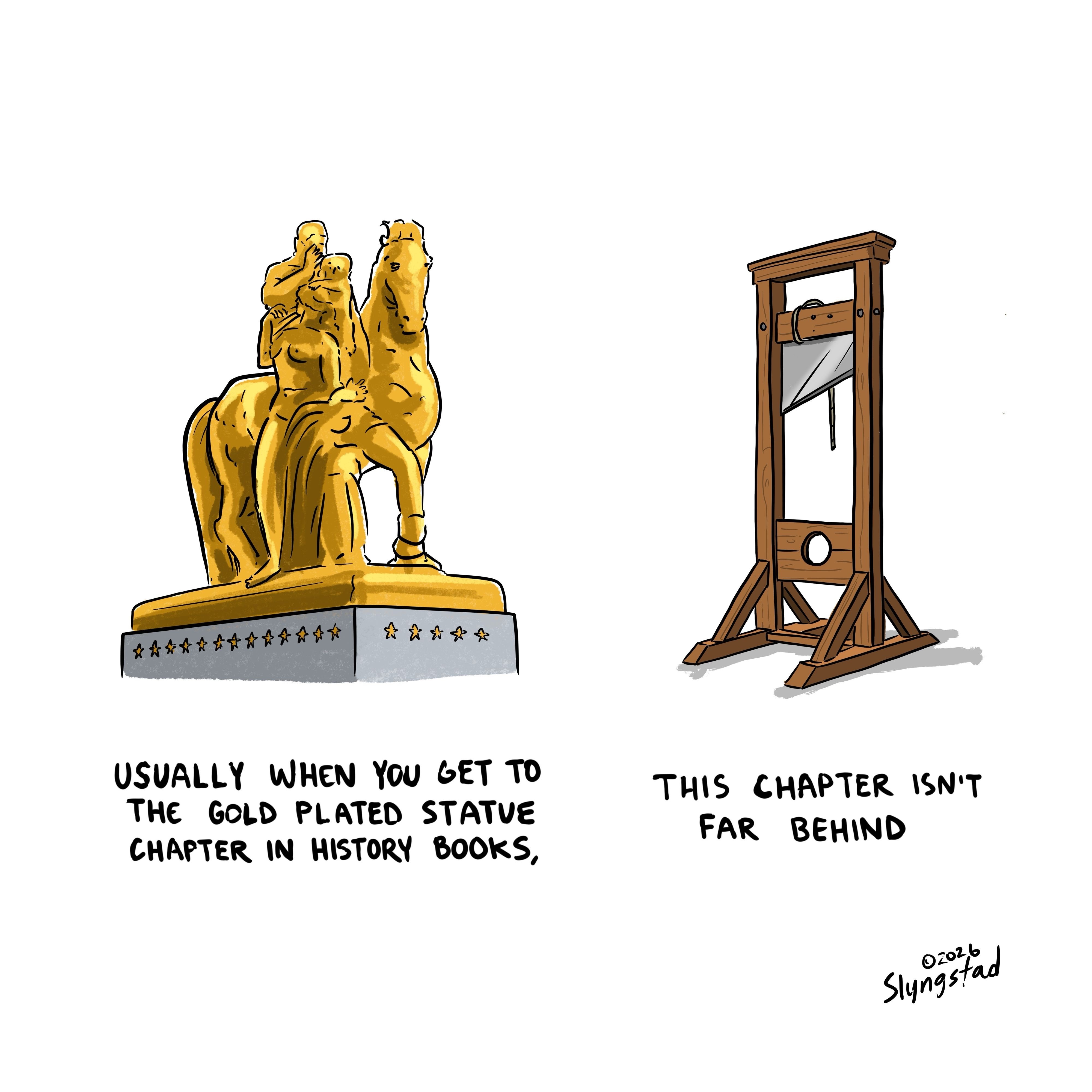

I think people forget how that chapter turned out.
- First French Revolution (1789–1792): Absolute monarchy collapses; replaced by a shaky constitutional monarchy.
- National Convention (1792–1795): Republic declared; quickly devolves into the Reign of Terror (1793–1794).
- The Directory (1795–1799): Moderates take over; heavily corrupt and universally disliked.
- The Consulate (1799–1804): Napoleon overthrows the Directory in a military coup.
- First French Empire (1804–1814): Napoleon crowns himself Emperor and invades Europe.
- Battle of Waterloo (1815): Napoleon’s final “Hundred Days” comeback fails; exiled for good.
- Bourbon Restoration (1814–1830): The old royal family returns to the throne.
- The July Revolution (1830): A 3-day revolt replaces the Bourbons with a more liberal cousin, King Louis-Philippe.
- The February Revolution (1848): The king is ousted; Louis-Napoléon is democratically elected President of the Second Republic.
- Second French Empire (1852–1870): Louis-Napoléon pulls a family tradition, ends the Republic, and becomes Emperor Napoleon III.
- Third French Republic (1870–1940): Napoleon III is captured by Prussia; France sets up a highly unstable parliamentary democracy.
- Vichy France (1940–1944): Nazi puppet state led by Marshal Pétain during WWII.
- Provisional Government (1944–1946): De Gaulle cleans up the post-war mess and restores basic laws.
- The Fourth Republic (1946–1958): A weak, hyper-unstable republic that collapses during the Algerian crisis.
- The Fifth Republic (1958–Today): De Gaulle writes a new constitution with a strong President. See EZPZ!
I think people tend to forget that it was a very long 169 years from bopping off rich people’s heads to stable government. Millions of people died in senseless acts of violence along the way. Whispers were treated as fact and rumors as final judgement. It was an absolute terrible time.
And yet, to this day, the French government and French companies are very hesitant to piss off their population, who proudly protest and strike at every perceived grievance.
We have faster computers now, so hopefully it will take less time.
Faster time to kill millions? I believe it.
Faster to oust the oligarchs and restore democracy? Not so much.
Third French Republic (1870–1940): Napoleon III is captured by Prussia; France sets up a highly unstable parliamentary democracy.
Is it really that unstable, if it lasted for 70 years and only ended due to foreign invasion, not internal collapse?
The highly unstable part is a selling point for the 5th republic, directly inherited from De Gaulle, who was more inspired by a military style chain of command. Parlementary negociations and proceeding are not optimal from this point of view (one of the reason why the French defeat is attributed to the 3rd Republic, which is somewhat exaggerated). Same for the 4th Republic, it didn’t fail because of the war in Algérie but was ended by De Gaulle as a condition to his return to power (at a time where generals in Algérie were organizing a coup to support him).
You seem to forget that one of the most important legacies of the French Revolution was how it inspired people in other countries. People all over the world got inspired by the ideas present in the early stages of the Revolution. For example the revolutions of 1848 wouldn’t have happened without the French Revolution, but so many other democratic events owe their debt to it as well.
Including the Declaration of the Rights of Man and of the Citizen which was further refined and eventually integrated to the current constitution and, IIRC, the European texts.
People haven’t forgotten. Just now, I saw a very thorough breakdown on the history of the French Revolution, summarized down to social media length, by someone masquerading as a slime monster with a moniker about how they feel about less than stellar code.
Sure, not everyone remembers the specifics of how XYZ was achieved throughout history. Some willfully, others because the opportunity was taken from them.
That’s why it’s so important to remember History. A cautionary tale is an approach in need of reforms, with pre-identified lessons to be built upon.
There’s a world’s worth of work, and a need for (the collective unnamed) you.
And by the end France is still a dictatorship of capital with its own billionaires and a rising nazi party, which will lead to a repeat the same cycle of violence again at some point.
That’s greatly overselling the Fifth Republic. Sure, it lasted a long time by French standards, but it’s one of the weakest democracies in Europe, inches away from falling to fascism.
They seem to try out a new government every 14-18 years or so, which reminds me of Jefferson’s quote about watering the tree of liberty with “the blood of patriots and tyrants,” and he thought that should happen no more than every 20 years or so.
Sometimes you have to plant a tree, even if you don’t get to sit in it’s shade.
200 years later, companies and government dont want to cause too much trouble because the people will riot. Should they have sat down and let the rich demons eat everything?
It’s so bred into us over generations, that we don’t even SEE it sometimes:
People have been trained to buy the argument that they have to keep fast food wages low, or prices would have to increase amd people couldn’t afford the food. But there IS a third choice: the company could simply make less profit, and not pay the C-Suite multi-million salaries and bonuses and perks.
Workers wages could be increased, prices could be lowered. Staff morale would skyrocket, customers would boom, and the PR would be amazing, and shame other chains into following.
If workers’ wages are on the table, so are executive’s, and it could be the best thing for business.
It’s time to start trying new stuff. Every other country that’s doing it is leaving us in the dust.
Who said it was gonna be fun?
We can only hope…
Be the change you wish to see in the world
Hope for 100 years of chaos and death?
It’s called a clensing… The world needs it. Thanos was right.
Oh it does. For sure. At least a few billion.
I keep hoping they go ahead and colonize mars and ship all the billionaire-class off planet…
Dude clear your inbox 😭

Holy shit dude! What did you do? Post negative remarks about Arch in a Linux com?
RIP
i dont know how honestly. i visit that tab but the number stays like this.
Your client doesn’t have a mark all Read button? That’d bug the shit outta me tbh, but I know some people just live with it lol

thanks, it was hidden behind a 3 dot menu
Eh, it’s often very far behind or doesn’t happen at all. I deeply hope this is one if the times where it’s not far behind but it’s not a certainty.
I mean… no? The “gold-plated statues chapter” is just history; elite vanity projects happen both in good and bad times. The question is how much restraint they can exercise while robbing the lower class blind; too little and you (sometimes) get the guillotine chapter.
Yeah, ancient history is full of gold plated statues, and not a guillotine in sight for thousands and thousands of years.
I mean if you take the guillotine to be a stand-in for retributive violence directed at the elites (which is incidentally not what the actual guillotine was for) then there’s actually a good deal of that historically, though it’s rarely as explicit as—say—the execution of Louis XVI. The assassins of Julius Caesar (among other things, a popular reformist politician at the time) for instance tended to be executed or kill themselves in the subsequent civil war.
“But surely this time it will be different”
At some point, pervasive surveillance alongside an army of AI-controlled bots and drones with unquestioning mechanical loyalty might actually make it different.
That’s one possibility of the near future that really scares me: it might become practically impossible to have a revolution anymore. Of course, the tyrant can’t depend entirely on the AI bots, but they could easily be enough to tip the balance in the tyrant’s favor – revolutions are already a dicey business, before introducing that factor. Historically, revolutions have succeeded because while the revolutionaries might not be as well trained or as well equipped, they have the numbers, and they might be able to get some of the tyrant’s own forces to turn against him. But in an age of AI surveillance along with plentiful, cheap, and deadly robots, that may change. The robots could outnumber revolutionaries, and they could be immune to being turned against the tyrant.
Can we move on to that phase now, please?
It’s part of the reason the founding fathers set up a representative democracy. They saw the tendency for leaders to lose their heads, and didn’t want to put themselves in that position.
The french revolution happened after the American one
The constitution wasn’t drafted until after the French Revolution had kicked off though.