Mexico is expanding its fledgling electric vehicle brand Olinia with a compact electric transporter. The Olinia Carga will offer a range of more than 120
It’s unclear to me what kind of person would buy this over some different kind of a vehicle. As a novelty item yes but I mean for actual work use. The cargo carrying capacity seems to be somewhere between a hatchback and a station wagon yet it only seats 2, has lower range, the cargo space is uncovered and the footprint of it still remains compareable. Even if the tradeoff seems worth it I still don’t understand why they wouldn’t get a small van instead. Seems far superior vehicle in every aspect. Maybe there is an actual niche that this fits into that I’m just not seeing but to me it just seems what someone would design who actually haven’t ever used a truck for work.
Light trucks like Piaggio Ape did a lot to help people with small commerce. Most of the world doesn’t drive around for hundreds of kilometers a day without getting anywhere. When I was living on almost the opposite side of the city from my work, I still only drove about fifteen km one way. Scooters are also a massive thing in some countries, currently including electric scooters for delivery and such.
Most people who have to haul stuff don’t drive around for 200km. They need to carry a load 20km - and since that car can be charged from a normal socket you can basically charge anywhere.
Imagine a local delivery for a supermarket. Or a regular postal service driver.
Also - charging this should be damn cheap compared to refueling for like 6$/gallon (which another commenter said is the current price in Mexico)
Most people who have to haul stuff don’t drive around for 200km.
Really? All of that depends an where you live and what you need to haul. In a large city you might be able to get by with that 200km range. (That’s about 120 miles for those in California). But even that might be very, very tight for a contractor going to a job site. Or if you live where I do, the nearest UPS terminal is almost 260km one way.
So this isn’t a solution for everyone or even possibly most. Does it have a place? Probably yes. But it will be fairly niche I think.
It might not be for your area, but maybe your usecase is the more niche one?
Imagine something like this in NYC, Detroit for e.g. delivering parcels. And if the battery is empty? Well the cargo space also will be empty so you can have it loaded up at the fulfillment center and also recharged - while the driver hops into the next already loaded vehicle. That’s easily doable because hey it’s just 10k.
Are you sure it always will work that way? Logistics can be a real bitch. Returning back to the fulfillment center has costs you need to consider. What’s the range reduction when fully loaded? When you need to run the heater and air conditioner?
You’re thinking about it from an American perspective, but these are aimed at Mexicans. It’s more about competing with motocarros (motortricycles with cargo beds commonly used in rural Mexico) than trucks.
Funny thing, upon seeing the post I immediately thought of Italian Piaggio Ape, which is a light cargo truck based on the Vespa scooter, and was made starting in the post-WW2 years when the economy needed cheap commercial cars. It’s still in production to this day, in Italy and India.


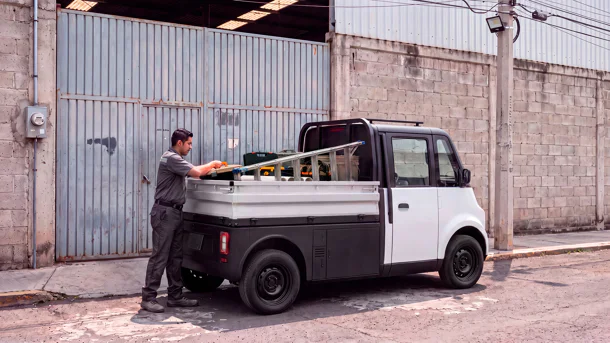
It’s unclear to me what kind of person would buy this over some different kind of a vehicle. As a novelty item yes but I mean for actual work use. The cargo carrying capacity seems to be somewhere between a hatchback and a station wagon yet it only seats 2, has lower range, the cargo space is uncovered and the footprint of it still remains compareable. Even if the tradeoff seems worth it I still don’t understand why they wouldn’t get a small van instead. Seems far superior vehicle in every aspect. Maybe there is an actual niche that this fits into that I’m just not seeing but to me it just seems what someone would design who actually haven’t ever used a truck for work.
Light trucks like Piaggio Ape did a lot to help people with small commerce. Most of the world doesn’t drive around for hundreds of kilometers a day without getting anywhere. When I was living on almost the opposite side of the city from my work, I still only drove about fifteen km one way. Scooters are also a massive thing in some countries, currently including electric scooters for delivery and such.
There are a lot of different types of work.
Most people who have to haul stuff don’t drive around for 200km. They need to carry a load 20km - and since that car can be charged from a normal socket you can basically charge anywhere. Imagine a local delivery for a supermarket. Or a regular postal service driver. Also - charging this should be damn cheap compared to refueling for like 6$/gallon (which another commenter said is the current price in Mexico)
Really? All of that depends an where you live and what you need to haul. In a large city you might be able to get by with that 200km range. (That’s about 120 miles for those in California). But even that might be very, very tight for a contractor going to a job site. Or if you live where I do, the nearest UPS terminal is almost 260km one way.
So this isn’t a solution for everyone or even possibly most. Does it have a place? Probably yes. But it will be fairly niche I think.
It might not be for your area, but maybe your usecase is the more niche one? Imagine something like this in NYC, Detroit for e.g. delivering parcels. And if the battery is empty? Well the cargo space also will be empty so you can have it loaded up at the fulfillment center and also recharged - while the driver hops into the next already loaded vehicle. That’s easily doable because hey it’s just 10k.
Are you sure it always will work that way? Logistics can be a real bitch. Returning back to the fulfillment center has costs you need to consider. What’s the range reduction when fully loaded? When you need to run the heater and air conditioner?
You’re thinking about it from an American perspective, but these are aimed at Mexicans. It’s more about competing with motocarros (motortricycles with cargo beds commonly used in rural Mexico) than trucks.
Funny thing, upon seeing the post I immediately thought of Italian Piaggio Ape, which is a light cargo truck based on the Vespa scooter, and was made starting in the post-WW2 years when the economy needed cheap commercial cars. It’s still in production to this day, in Italy and India.
It would probably be useful in Mexico City itself. Not so much in rural Mexico where there might actually be distances between pick-up and drop-off.
So, the driving distance would probably be even farther in a rural area?