It’s finally happening. Brings a tear to my eye.
I’ve been following the drama for years. This should’ve happened many years ago but for some reason Google was blocking it in favor of AVIF, which is worse in a number of ways.
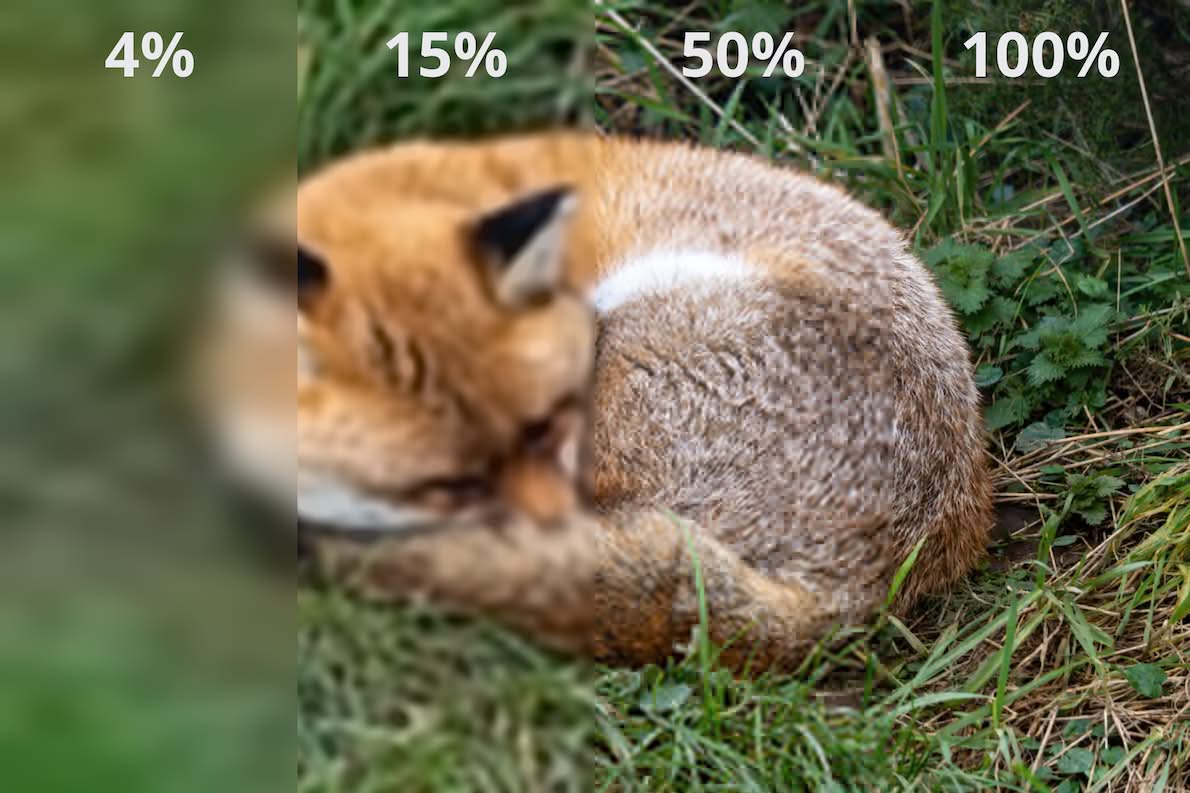
Progressive rendering
This is really interesting. Now I wonder: would it be possible to use the same image for thumbnail and full view and instead control its display by maximum allowed transfer percentage? For example, by default, for thumbnails, all images on page are served only up to 15% of their full size, and when you click on them, the same image resumes downloading to 100% size. I mean, it’s definitely possible to implement this, but it would be nice to see this widely supported without getting too hacky.
I’m not too familiar with this. Is the JPEG-XL already adopted by other browsers (read: Chome)?
Not by default, but it can be enabled with
chrome://flags/#enable-jxl-image-format. More on support here.
[…] today we posted our intent to ship JPEG XL. Chrome are also intending to ship, and given there’s already a partial implementation in Safari, the format will be supported across browsers before the end of the year.
Hoping for the best 🙏
YES! finally!
What is the big gain over AVIF?
It’s great at lossless? but I never use lossless for web images
The argument for it is only lossless and progressive rendering. So if you have large files, it might be better to serve it as JXL, so it can show the image at least in some quality before it fully loads (for slow connections). If you have lossless files, then it’s better also.
AVIF is better otherwise, so we will probably see AVIF become the new web image standard and JXL have a niche for higher quality images.
If JXL is good for lossless, it’ll probably AVIF replacing JPEG and JXL replacing PNG.
Yup, that makes sense! It’s about time we replaced them.
Jxl lossless can sometimes produce smaller images than even lossy compression, so it makes sense to use it when it does.
- “lossless” reencoding of jpeg
- Encoding with “butteraugli distance =1” ensures that you compress optimally without the human eye being able to see the difference, it’s an awesome “fire and forget” setting for all your images besides lossless. You basically don’t have to guess or check your saved image if it looks good enough.
- Unlimited size, multiple layers, better colors, more bit depth. Avif has severe limitations as an image format.
But for specific cases like comics and stronger compression at about 60% quality it’s currently better. I’ve heard jpegXL encoders still have some ways to improve though. For stronger compression avif can use “ssimulacra2” which is a great metric to avoid compression artifacts for encoders. So ideally jpegXL would support both butteraugly (high quality) and simulacra2 for low quality / high compression.
the big win is that it can re-encode existing jpegs to shrink them by like 30%. also the image is compressed spatially (i think that’s the word) so it can be displayed as it’s downloading rather than coming in line by line.
I think many of us have several GBs of JPEGs that have accumulated over the years. It would be nice to shrink them a bit.
However I wouldn’t do it until the majority of my software supports it. At least with JXL, you can transcode it back to legacy jpeg without losing quality
Does the lossless transcode work both ways? Thought it was only jpg -> jxl
There seems to be a “JPEG reconstruction” feature that gets the original JPEG back.
The biggest hurdle are messengers, especially including cross-platform support and mobile devices.