Built to spec does do a lot of heavy lifting. American distances are larger than European distances. China has the advantage of a dictatorship which can be decisive.
But the Interstate system was expensive and had a crazy spec and was built and continues to be maintained at an extremely high cost.
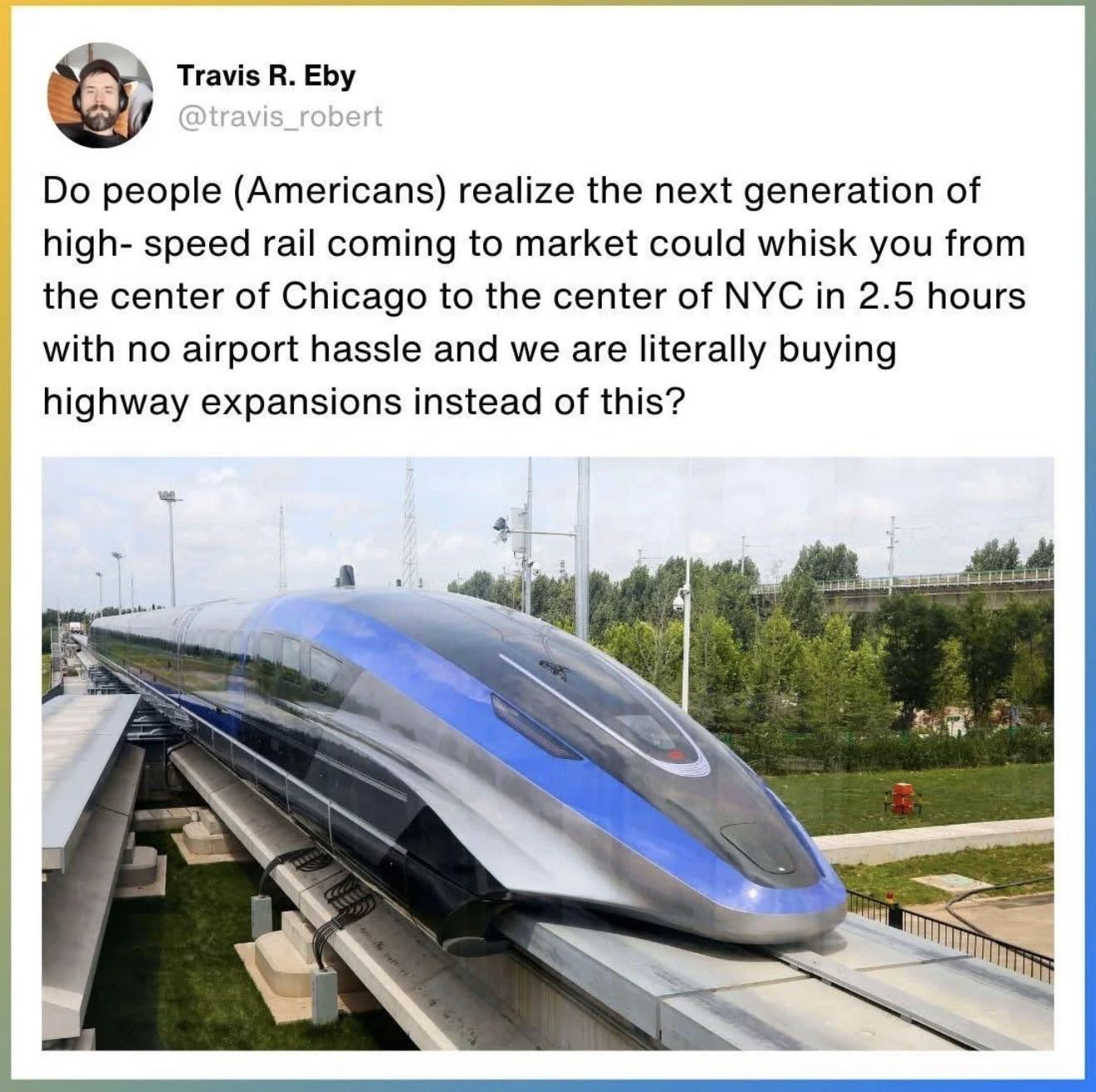
Last I heard, maglev is mostly vaporware. Just build good tracks.
tbf idk on which behalf you argue about american distances. But i feel(!)¹ like thats another reason to prefer regular ass trains(with implied heavy lifting specs). Like it is known that you can build >tenthousand miles of regular high speed tracks to build a tight network between major cities. It has been done. America doesnt even have the huge issue of several differing national standards which are in competition to eachother but still want to be connected ideally like in europe.
Track maintenance is expensive and even more so when in remote areas. Population density is much lower in USA than most of Europe so km rail per person is just much higher.
Hasn’t stopped the interstate system from taking billions of dollars a year though.
Building a strong high speed rail in dense areas like New England and Midwest probably would be a good starter because people can see how well it works. But there’s so much carbrain inertia.
Indeed, that’s really only true because the United States and Canada have vast areas in which nobody lives. About 1/3 of the U.S. is federal land managed by the Bureau of Land Management; that really throws off the average. If I recall correctly, around 40% of the population of Canada lives along a line between Windsor and Montréal. Meanwhile, this is Spain compared to the Northeast:
Spain has a population just under 50 million. It also has a high-speed rail network. You’d think that in a region with a far, far higher population density, the U.S. and Canada could do better than the Acela.
Japan and afaik also china are building long distance maglev lines at the moment. We will see if there are any issues that regular hsr wouldn’t have. It’s certainly expensive to build, but high speed connection between major cities can be worth it. Technology that can go at almost 2/3 the speed of planes but is able to run entirely on electricity isn’t necessarily just some gimmick, there is an actual use case for it. 300 km/h is fast, but 500 is a lot faster. Of course just like with existing HSR, building routes that support these high speeds is a challenge (and part of why japans line under construction is so much faster than the existing shinkansen is that it just cuts straight through the mountains, which is of course expensive).
The planned line is supposedt to be even faster than flying (45m vs 1h) overall, probably due to the overhead of taxiing. And that’s without considering security.


Built to spec does do a lot of heavy lifting. American distances are larger than European distances. China has the advantage of a dictatorship which can be decisive.
But the Interstate system was expensive and had a crazy spec and was built and continues to be maintained at an extremely high cost.
Last I heard, maglev is mostly vaporware. Just build good tracks.
Not to worry! The USA is catching up real quick on that point
tbf idk on which behalf you argue about american distances. But i feel(!)¹ like thats another reason to prefer regular ass trains(with implied heavy lifting specs). Like it is known that you can build >tenthousand miles of regular high speed tracks to build a tight network between major cities. It has been done. America doesnt even have the huge issue of several differing national standards which are in competition to eachother but still want to be connected ideally like in europe.
¹am just random idiot on the internet.
ahem excuse me.
ooof, i’m so sorry
😉
Track maintenance is expensive and even more so when in remote areas. Population density is much lower in USA than most of Europe so km rail per person is just much higher.
Hasn’t stopped the interstate system from taking billions of dollars a year though.
Building a strong high speed rail in dense areas like New England and Midwest probably would be a good starter because people can see how well it works. But there’s so much carbrain inertia.
Indeed, that’s really only true because the United States and Canada have vast areas in which nobody lives. About 1/3 of the U.S. is federal land managed by the Bureau of Land Management; that really throws off the average. If I recall correctly, around 40% of the population of Canada lives along a line between Windsor and Montréal. Meanwhile, this is Spain compared to the Northeast:
Spain has a population just under 50 million. It also has a high-speed rail network. You’d think that in a region with a far, far higher population density, the U.S. and Canada could do better than the Acela.
Japan and afaik also china are building long distance maglev lines at the moment. We will see if there are any issues that regular hsr wouldn’t have. It’s certainly expensive to build, but high speed connection between major cities can be worth it. Technology that can go at almost 2/3 the speed of planes but is able to run entirely on electricity isn’t necessarily just some gimmick, there is an actual use case for it. 300 km/h is fast, but 500 is a lot faster. Of course just like with existing HSR, building routes that support these high speeds is a challenge (and part of why japans line under construction is so much faster than the existing shinkansen is that it just cuts straight through the mountains, which is of course expensive).
The planned line is supposedt to be even faster than flying (45m vs 1h) overall, probably due to the overhead of taxiing. And that’s without considering security.
There’s only 6 globally, under 100km total track. Shinkansen trains are conventional rail. It’s been just around the corner for 100 years.
https://en.wikipedia.org/wiki/Chūō_Shinkansen