You must log in or # to comment.
I have the utmost confidence in the TSAs ability to make rail stations just as bad as airports.
Oh you complain now, but as soon as someone hijacks a train and steers it off course into a building, you’ll be begging TSA to grope you before letting you cram yourself into a reasonably spacious train seat that a public entity runs and has no reason to maximize the number of bodies it can cram into one area to create more shareholder value.
(I’m not crying you are………)
They already do the inspections for rail stations and they’re about 1/10th as annoying and time-consuming as the ones for airports.
Trains just don’t have the capacity for a 9/11 so I don’t see that changing any time soon.
But, but, but, trains are communism!
Seriously, though, far too many Americans still tie their identity to their vehicle. The stupid notion of rugged American individualism has really held the country back.
There are plenty of other things, but I’m just pointing out this one.
Nice try, commie, but a train doesn’t help GMAC make more car loans, nor does it help Exxon-Mobil sell more gasoline. Worse still, if people are commuting together they might build community and solidarity and then how will we keep them all working for 1/10 of the value they produce, huh? Next time think about Wall St before you go suggesting crazy ideas like high speed rail!
You also forgot about the private interests in building the rail. We can’t have the government doing this, that’s insane. Instead we need to find a way to funnel money to Union Pacific so they park their 2 mile long cargo trains for 3 hours blocking all amtrak trains. Then they can keep collecting maintenance fees which they pocket for decades until a train derails, at which point they begrudgingly replace some of the rotting lumber that’s been there for 200 years.
That’s the true american capitalist way. Anything else is just too expensive.
As a Londoner I can tell you straight up that commuting together does not build community and solidarity
Speed ideology
Michelle, Tamika, and Tonya wanna ride this train.
It’s all because of Big Road.
American here, we’re dumb.
Its all the lead in the pipes, it makes the frogs gay with all the chemtrail fallout on this flat earth being watched by Jewish space laser satellites.
He’s trying to make his followers feel better, match their energy so he doesn’t come across as an elite billionaire
or he just learned about the B in dumb
Honestly I’d give shit like that a pass, silent letters are stupid and sometimes don’t even exist in certain spellings for the same word looking at you soder, sodder, solder. Also if anyone brings up the l in solder being pronounced, not in my dialect nor in most other older dialects I’ve encountered only the ones wherein they reromanticized random words.
Why use mass transit when AI transit do trick?
We’re dumb? I though we were winning!
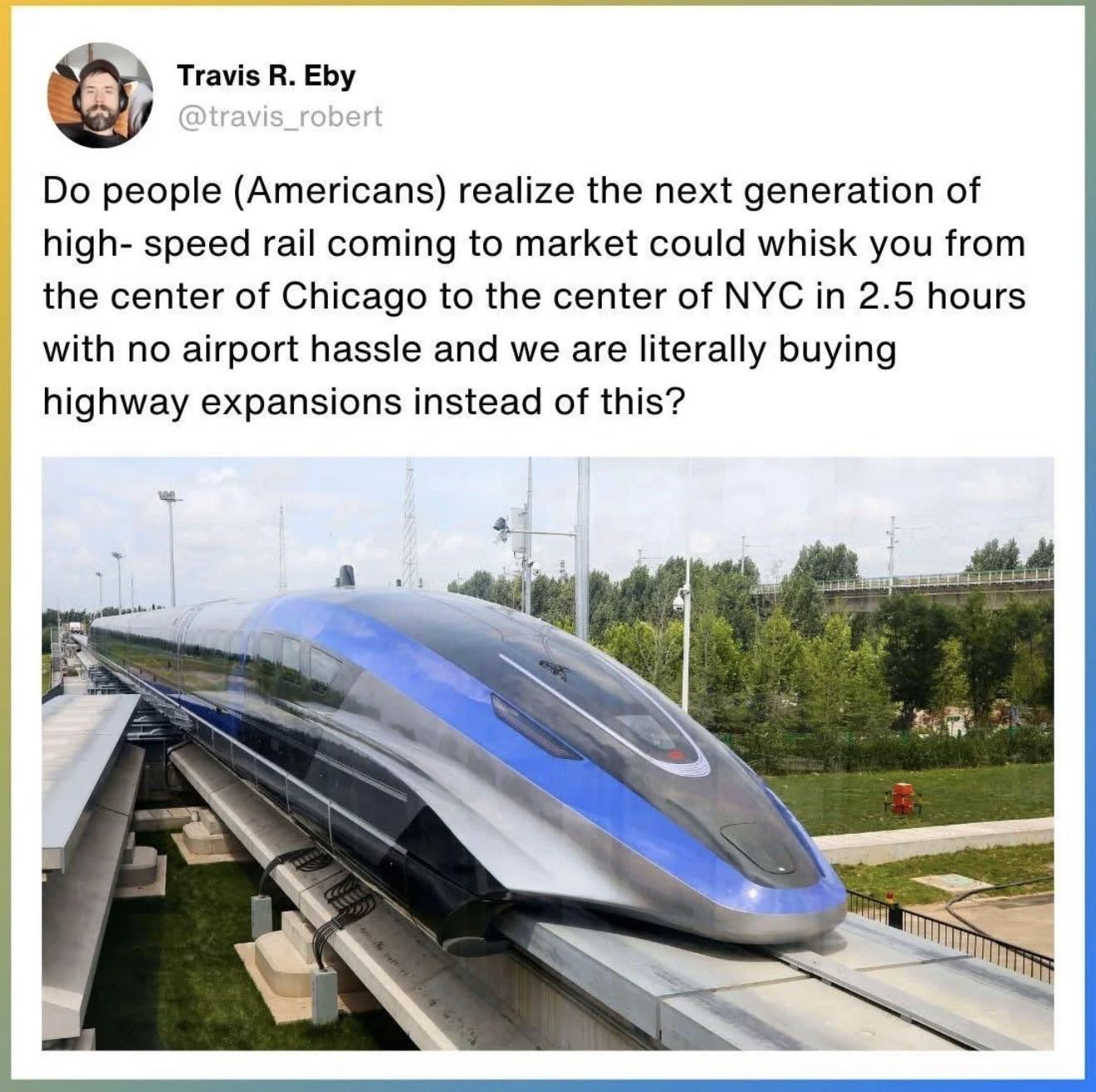
More like three and a half hours if you want an actually usefull line that stops.at places where people wanna stop at and you add the time needed to accelerate and decelerate but yeah. Also thats calculating with 500kmh which is very much cutting edge and constructing a line like that takes decades BUT that doesnt mean such investments arent worth it and also just fixing transport within a city is already worth it.
three and a half hours if you want an actually usefull line that stops.at places where people wanna stop at
You can run a multi-stop and an express train concurrently.
China and Japan seem to have figured this shit out. How come the largest economy in the world can’t? Pissed about with Elon and his Hyperloop which would be too expensive for any regular person (extreme maintenance costs) and can’t move as many people (very limited size). And it didn’t even work! Meanwhile elsewhere the train wasn’t being reinvented, but improved, and it’s actually functional.
Also, you can have high speed transit between two major stations, then take local transit to your specific destination. That’s what central stations are supposed to be for.
Hyperloop is incredibly stupid on the face of it for so many reasons, the two largest of which IMO actually being that it would be incredibly unsafe as escape would be impossible in case of an incident and that it’s literally physically impossible, as the material tolerances required are incompatible with the temperature shifts that happen everywhere on account of weather and seasons.
Musk has openly admitted he propped Hyperloop for the sole purpose of stopping California to build a high speed train. He never intended to deliver anything.
This is one of those moments when I mentally ask “how the fuck is that even legal” but then I remember who writes the rules.
And Elon has not produced a single workable anything, but sucked up billions in subsidies.
Yeahhh but chicago is several large cities away from new york so thats why im saying they would need a stop for each of them. You can of course have commuter trains that skip some of those and others that serve the less used ones of course, and shuttles as well but you also have to consider that chicago and ny are 1100kms away from each other in a straight line while tokyo and kyoto are 370kms from each other in a straight line for example and those are 2 hours by train(and i looked from the train stations which are not in the center of the city tho you could argue they are somewhat but these metropolitan areas are so large that they have multiple city centers) so that means if you just multiply it up you would get that the chicago-ny line would be a six hour journey. This is, of course, probably not correct. Im just trying to show how you cant just draw a straight line between two places and say “Train!”. Tho of course you also have to calculate with the fact that the us is much richer than both china and japan but once again that just complicates things again.
you cant just draw a straight line between two places and say “Train!”
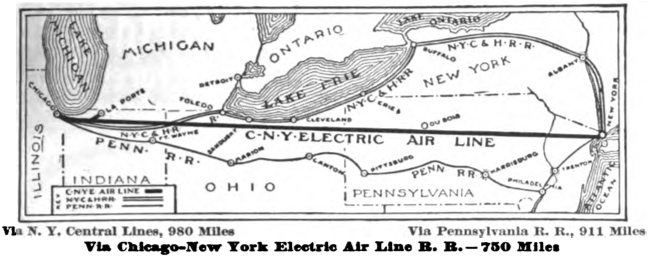
Never forget what they took from us. They being the promoters of the ny-chicago electric air line railroad. Also if it were built and the right of way stayed intact we could absolutely build a maglev that could go center to center in 3 hours.
Nobody even considers that a problem for airplanes.
Plains fly over the obstacles? Thats kinda the point? Also i may have underestimated the amount of people flying in the us cause in europe one flight a day is completely normal for destinations at this distance. Of course if thousands of people want to move between these two locations each day a regular shuttle could make sense but you cant just ignore the distance, 2.5 hourse is a very very best case scenario. Planes can also fly boutta 1000kmh but that doesnt mean a place 1000kms away takes 1 hour, 1.5 to 2 hours is completely normal for a journey like that without accounting for all the flight related hassles. Of course thats a huge upside of trains but you cant just freely apply train to everything. This is very likely a place where a highspeed rail connection would make sense but nothing is ideal instantly. Not to talk about how these cities would have to improve their own public transit to be able to connect to a wider network efficiently.
Having to plan connecting flights is a thing.
A thing a lot of people don’t understand about high speed rail is that it needs to be very straight and very flat. Draw a straight line from those two cities and count the number of places it goes through, the different elevations and figure out how you’d bulldoze through it all.
China seems to have figured it out in their mountainous regions. Some of the lines are 90% tunnel+raised rails. And as an American we should talk about how China is roughly the same size as America. The excuse well has run dry.
I’m all for high speed rail in the US, but comparing the land area of the two countries is not really that relevant.
China’s network is really focused on about a third of the land area. US could do the same, but the big population hubs are separated and on opposite sides of the country, so it’s less ideal - lot of track to connect the two. It’s like 2-3x the distance to connect LA/NYC vs Chongqing/Shanghai.
China also has 4x the population of the US. So the cost/benefit to build this out is simply much more favorable for china.
Most importantly, China’s autocratic government can clear the red tape to get big projects like this done. Just getting the land rights to build the right track could kill a transcontinental project in the US. But that decision is consolidated in the Chinese government. This cuts time and cost immensely.
Cool cool
Then build a HSR on the east coast and one on the west coast. How about we start with that first?
Then you can worry about the detail that isn’t even that important. Nobody is saying to build HSR coast to coast
Next you are going to tell me it’s not a good solution because of Hawai
But that’s a non issue. If you want to get from LA to NYC, you fly. If you want to get from Chicago to NYC or from LA to San Francisco, you take the HSR… I mean you would if the US had a fully developed transport infrastructure.
None of these points are strong enough to stop the idea of high speed rail in the US. The auto lobby alone does that.
Thats why i drew a squiggly line when i calculated this lol
Just bring a non-stop train, a limited stop train and/or a full stop train. It’s more expensive, but it’s overall better.
Yeah i mention that in a different comment, many cities and countries have systems with full service, shuttle, commuter, etc trains that all serve different modes of transport with the same vehicle(idk how to phrase it exactly). Point is one machine and line(your train in this case) can serve customers demanding different kinds of service by running different schedules.
Also high-speed rail doesn’t run at top speed the whole time. You might have a few flat spots here and there, but most of the time it’s running much slower.
Also, if there’s a problem with a train, the whole rail goes down. If there’s a problem with an airplane, the other planes have a whole lot of sky they can still use.
Aviation is grounded way more often than rail corridors are blocked. You’d know if you’d ever had lived in a place with developed infrastructure.
Also, yes, HSR built on dedicated high speed infrastructure, like the TGV or Shinkansen, does run most of the time close to max speed.
Also, if there’s a problem with a train, the whole rail goes down. If there’s a problem with an airplane, the other planes have a whole lot of sky they can still use.
That’s not how rail works.
There absolutely are passing places where a train can hop onto the left track and then back again, or just a long stretch of an extra track going parallel to the main route where either the faulty train can sit and wait for repairs, or the working trains can jump around the faulty one.
Source: living in a country that actually has a working passenger railway system.
So only 4000 miles of grade-separated high-speed rail (and all the infrastructure and private property easements, divisions, etc required for the construction) just to connect just these 2 cities? No problem.
If you think that’s ludicrous, may I present Interstate 80?
You don’t connect just those two cities, mate. You connect them as the main artery and then do split-offs to other areas. Or, even better, you weave the main railway between major cities East-to-West to connect them directly.
What are you talking about? Chicago-NYC are maybe 1200 km, perfectly within HSR distance and definitely within Maglev distance. The two urban areas are also huge enough to support such a thing, especially as there are a few mid sized urban areas in between.
we’ll be saying this 200 years from now
This passing problem was solved a long time ago, it’s just that the freight rail corps in the US have “optimized” for trains that are longer than the passing rail sections. It’s extremely bad for the entire rail industry and the cause of many of the derailments and accidents, but because capital always gets its way in the US, nothing significantly has changed to resolve the issue.
It’s very frustrating how often there are perfectly workable solutions to making the world better, but if it doesn’t have a fat profit margin, it just gets strangled to death by capital interests in this country.
Imagine how this would disempower landlords if you could commute to either of those cities from anywhere between them.
Car dependency is about power, it’s about keeping workers vulnerable and reliant on constant employment to participate in society. The one thing the US and Canada has over other imperial powers is the obscene amount of space each state has at its disposal within the metropole with which to construct what really is an exceptional form of oppression. It’s important to recognize that when you’re talking about ending car dependency, this is an existential threat to either power, and they will treat it in kind.
There is convenience in the ineptitude of neoliberal politics in state-planning and infrastructure, which most people attribute as the cause of this development, but it’s crucial to remember that suburban sprawl and car dependency were state projects by the US and Canada in very much they same way neoliberal privatization is.
America is just a collection of subscription fees you must pay in order to survive. You need a car, rent, groceries, and bills at the bare minimum so you must have a job or you will die in the street.
Yes, and it’s important to identify why that happens and how it functions, not satisfy ourselves with the certainty that it is bad, or unjust, or unreasonable; which many of these posts end up doing.
The US is the way it is because that is what settler-colonialism and capitalism require to continue. Even when there were periods of “reform,” such as the labour and state policies of the welfare liberal era in the 1930s-40s (which is how suburbanism and car dependency came about), or the civil rights movements of the mid- to late-twentieth century (which is how neoliberalism and the liberal appropriation of social justice was achieved), victories in reform are inevitably eroded by these fundamental imperatives.
you must have a job or you will die in the street
And here’s the punchline: no more jobs!
It’s the same everywhere. Not just American thing.
Though capitalism is pervasive globally, I don’t think it’s necessary to narrow our understanding of its specificities within the US metropole to be able to discuss the commonalities globally.
Car dependency is certainly more prevalent within the US than it is the EU, but even it’s presence in either takes on different forms and performs different functions. And then, the car dependency in the US is different from colonized spaces in Latin America, or between Latin American settler-colonial states like Brazil or Argentina.
And it’s all shit that should be paid for with our taxes. But instead, they need to use that money to bomb kids on the other side of the planet.
Car dependency is about power
BAM
Well it will take more than 2.5 hours if you start adding a bunch of stops.
I don’t think having one track would necessarily mean there is only one train route.

GREEDThe fingers thing means… Greed?
Do non-Americans not realize that not everything is 700 miles away?
You do know that trains can stop earlier too right? And a good railway network has multiple rails with 2-4 different speeds available.
You do know that people aren’t going to take a high speed rail to go 5 blocks down the street, right?
No other means of transportation exist to cover 5 blocks, than a car?
I’m really sorry, but if a train exists, then we might all forget how to walk. I can only remember so many different things.
LMAO… you people crack me up.
I don’t see what that got to do with anything to be honest … But let me introduce you to concepts like “the bus”, " the tram" or for the freaky “walking” or “bycicles”
Or…. Cars.
So you connect 5 blocks via a highway?
A lot of countries figured out how to do it correctly already.
too much negation in your comment I’m too tired to understand
Considering the community, this tracks.
BigOil would like to have a word.
They have all the words. That’s why we don’t have shit like this and seemingly never will.
Elon would like to have a word
Shit is so far apart here it’s more difficult and expensive to connect the cities. It 100% should be done but instead we need to reeeealy invest in city infrastructure around data centers right now. Sowwy
Fuck Maglev.
Regular ass trains on steel tracks can go >200mph if built to spec. Suuuure, maglev can go even faster. But regular ass trains on steel tracks can actually be build on a realistic budget. Like in theory atleast. But before the US does something this sane they’re gonna nuke themselves. idk
Maglev isn’t even more expensive. High speed rails that are built “to spec” for 400 km/h are expensive as fuck. Trains are usually shorter but frequency is higher, so per passenger it roughly evens out.
The real deal breaker is the lack of compatibility. Can’t ever run a maglev train on legacy rail while your high speed train can use the existing system to bridge gaps in the high speed network.
Not more expensive? Hard to say because also nobody builds them! But I don’t think there’s any specification you could make today that could be met cheaper with maglev than with old school big iron.
I don’t know why you would want compatibility. The Shinkansen is also always on their own track. Air planes aren’t compatible with train tracks either, so if you look at it more from a perspective of what they’re trying to replace I don’t think it’s that big of a deal.
I think it’s also mainly the start up and build costs, I think the wear of the rails of high speed trains on wheels is very costly
So you can have your high speed trains run to more remote stations, limiting the amount of changes for passengers. Took the train to Grenoble that way, which is quite comfortable with a direct connection from Paris.
also, monorails of any sort are harder to switch than dual-rail lines, making the networks less flexible.
Well sir, there’s nothing on Earth like a genuine, bona-fide, electrified, six-car monorail!
Brockway!
I don’t see any problems with switching tracks on this thing.
Regular ass train gang. Let’s stop trying to reinvent something that already works way better than whatever half ass bullshit you thought about for a couple hours.
Trams for short distance, metro for medium, trains for long and high-speed for very long.
It’s trains all the way down.
Well my train has blackjack and hookers
“Sir, as I’ve repeatedly told you, this is the casino and not a train. Are you hitting or sticking?”
We need a rail line that is strictly for commuters. Right now the rails are owned by freight companies so they prioritize freight over people. Yes we do have the infrastructure to initiate high speed rails, but those rails are used for objects not people.
Passengers is the term you mean, not commuters. I read the first sentence and thought you were going to suggest something that is only open to people coming from and going to work.
But yes, we need passenger rail that’s exclusively passenger rail.
Tbh they don’t even prioritize the freight, that went away with psr
Also like, magnets get destroyed in water, so how do you deal with rain? /s
Reverse the polarity
regular ass trains on steel tracks can actually be build on a realistic budget
Cries in HS2
I don’t know much about various train technologies, but surely that’s going to cause massive wear and tear on the tracks and need to be serviced very often right? And any debris on the track is probably going to cause quite bad damage to the wheels too.
I don’t know, but I feel like your “if built to spec” is doing a lot of heavy lifting here, what kind of spec? Is that sort of quality realistic for a real-world installation? Exposed to the elements?
Maglev is definitely more expensive to build and probably to run, but it seems like it’d be far more reliable? And also a much smoother experience for those on-board?
And I feel like Maglev has much greater theoretical speed limits than typical contact tracks, as, well, we basically remove the friction between the wheel and the track?
Also imo Maglev is cool and gets style points.
Most industry nations around the world are running high speed trains by now. They’re doing petty fine I’d say. China threw a ton of money into German maglev tech and there isn’t really much to see still. There’s a reason most countries gave up on it.
Zehn Minuten!!
More like zehn minuten später
Ich wünsche mir die Zeit zurück, in der ich über Politiker fast ausschließlich lachen musste, statt mich endlos über sie aufzuregen.
Nicht, dass es da nicht auch genug Gründe gegeben hätte, aber zwischendrin kam immer mal wieder etwas raus was nicht komplett gestört war.
I reckon it’ll be one of those things that was just ahead of it’s time, I think the concept is sound, but other infrastructure to run it, energy, rare-earth mining, just isn’t ready to keep up yet.
Yeah, and dont forget the scale.
Japan is building a maglev line right now. But they have >60 years of experience with high speed rail and the whole concept is established. Even then its “only” about to be 400km to connect three major metropolian areas. https://en.wikipedia.org/wiki/Chūō_Shinkansen Still:
Construction is expected to cost over ¥9 trillion Japanese yen (approximately $82 billion USD) and commenced in 2014. The start date of commercial service is unknown,[…]The Nagoya–Osaka section was planned to be completed as late as 2045, but the date was moved to as early as 2037 following a loan from the Japanese government.
Chicago to New York are more like 1200km and major stops between them are like Cleveland and Toledo. Uuuh… just build regular ass rail with a bit higher specs for higher speeds…
approximately $82 billion USD
We’ve spent over half that on the Iran war so far.
https://www.nytimes.com/2026/09/18/us/politics/iran-war-cost-pentagon.html
? ICE 3 trains are already running 300 km/h in Germany and 320 in France. Nothing “ahead of its time”
I’m saying Maglev is ahead of it’s time.
The main issue is that you need absurd amounts of resources just to build the track alone.
In the end the maintenance cost for maglev vs bullet trains are about the same. Bullet trains focus more on mechanical maintenance of the track and wheels. While the maintenance of maglev is typically more technical, it requires constant recalibration of the electronics and constant monitoring for alignment.
Maglev is definitely more expensive to build and probably to run, but it seems like it’d be far more reliable? And also a much smoother experience for those on-board?
Traditional steel on rail is actually more reliable in practice. Theoretically the basic mechanics of maglev are more reliable, but in practice they tend to suffer from longer delays when they do fail. This is mostly because the repairs/maintenance for traditional rail can be done by just about anyone, where maglevs tend to be locked in by a single vendor contract.
Maglev has much greater theoretical speed limits than typical contact tracks, as, well, we basically remove the friction between the wheel and the track?
They are theoretically faster, but in practice the speed of trains are most often governed not by the limitations of the trains themselves, but instead are limited by the surrounding infrastructure and terrain.
The cruising speed of railed bullet trains are around 200mph, while the cruising speeds of maglev is around 265mph. Maglevs have gone significantly faster around 375mph, but thats not really a realistic expectation for daily operations.
Imo both are extremely cool, but traditional rail is just a lot more practical for a plethora of reasons. The most important being that the installation and operational cost are just a lot more realistic than maglev. There’s a reason there’s only a total of 37 miles of maglev in operation today compared to over 30k miles of high-speed rail.
Remember that the TGV has the high speed record for rail, at 574kmh or 356mph
Yeah, but it’s not something you would ever see in operation. The V150 trial had special modified and powered cars running on the most favorable railway conditions possible. Plus, running over 200mph on steel starts to create enough friction to damage the wheels and rail.
Built to spec does do a lot of heavy lifting. American distances are larger than European distances. China has the advantage of a dictatorship which can be decisive.
But the Interstate system was expensive and had a crazy spec and was built and continues to be maintained at an extremely high cost.
Last I heard, maglev is mostly vaporware. Just build good tracks.
China has the advantage of a dictatorship which can be decisive
Not to worry! The USA is catching up real quick on that point
tbf idk on which behalf you argue about american distances. But i feel(!)¹ like thats another reason to prefer regular ass trains(with implied heavy lifting specs). Like it is known that you can build >tenthousand miles of regular high speed tracks to build a tight network between major cities. It has been done. America doesnt even have the huge issue of several differing national standards which are in competition to eachother but still want to be connected ideally like in europe.
¹am just random idiot on the internet.
¹am just random idiot on the internet.
ahem excuse me.
ooof, i’m so sorry
😉
Track maintenance is expensive and even more so when in remote areas. Population density is much lower in USA than most of Europe so km rail per person is just much higher.
Hasn’t stopped the interstate system from taking billions of dollars a year though.
Building a strong high speed rail in dense areas like New England and Midwest probably would be a good starter because people can see how well it works. But there’s so much carbrain inertia.
Indeed, that’s really only true because the United States and Canada have vast areas in which nobody lives. About 1/3 of the U.S. is federal land managed by the Bureau of Land Management; that really throws off the average. If I recall correctly, around 40% of the population of Canada lives along a line between Windsor and Montréal. Meanwhile, this is Spain compared to the Northeast:

Spain has a population just under 50 million. It also has a high-speed rail network. You’d think that in a region with a far, far higher population density, the U.S. and Canada could do better than the Acela.
Japan and afaik also china are building long distance maglev lines at the moment. We will see if there are any issues that regular hsr wouldn’t have. It’s certainly expensive to build, but high speed connection between major cities can be worth it. Technology that can go at almost 2/3 the speed of planes but is able to run entirely on electricity isn’t necessarily just some gimmick, there is an actual use case for it. 300 km/h is fast, but 500 is a lot faster. Of course just like with existing HSR, building routes that support these high speeds is a challenge (and part of why japans line under construction is so much faster than the existing shinkansen is that it just cuts straight through the mountains, which is of course expensive).
The planned line is supposedt to be even faster than flying (45m vs 1h) overall, probably due to the overhead of taxiing. And that’s without considering security.
There’s only 6 globally, under 100km total track. Shinkansen trains are conventional rail. It’s been just around the corner for 100 years.
- Korea, 1km
- Shanghai, 30km
- Linimo, Japan, 8.9km
- Incheon, Korea, 6.1km
- Changsha, China, 18.5km
- beijing, China, 8.2km
“It seems like this experimental tech is going to be more reliable than the proven thing that’s existed since the 19th century.”
You sure about that, hoss?
Pretty sure there’s been more than a couple times in history when new technology has replaced old technology…
I prefer my bread in hand torn chunks thanks.
Can it also do heavy freight?