More like three and a half hours if you want an actually usefull line that stops.at places where people wanna stop at and you add the time needed to accelerate and decelerate but yeah. Also thats calculating with 500kmh which is very much cutting edge and constructing a line like that takes decades BUT that doesnt mean such investments arent worth it and also just fixing transport within a city is already worth it.
China and Japan seem to have figured this shit out. How come the largest economy in the world can’t? Pissed about with Elon and his Hyperloop which would be too expensive for any regular person (extreme maintenance costs) and can’t move as many people (very limited size). And it didn’t even work!
Meanwhile elsewhere the train wasn’t being reinvented, but improved, and it’s actually functional.
Also, you can have high speed transit between two major stations, then take local transit to your specific destination. That’s what central stations are supposed to be for.
Musk has openly admitted he propped Hyperloop for the sole purpose of stopping California to build a high speed train. He never intended to deliver anything.
Hyperloop is incredibly stupid on the face of it for so many reasons, the two largest of which IMO actually being that it would be incredibly unsafe as escape would be impossible in case of an incident and that it’s literally physically impossible, as the material tolerances required are incompatible with the temperature shifts that happen everywhere on account of weather and seasons.
Yeahhh but chicago is several large cities away from new york so thats why im saying they would need a stop for each of them. You can of course have commuter trains that skip some of those and others that serve the less used ones of course, and shuttles as well but you also have to consider that chicago and ny are 1100kms away from each other in a straight line while tokyo and kyoto are 370kms from each other in a straight line for example and those are 2 hours by train(and i looked from the train stations which are not in the center of the city tho you could argue they are somewhat but these metropolitan areas are so large that they have multiple city centers) so that means if you just multiply it up you would get that the chicago-ny line would be a six hour journey. This is, of course, probably not correct. Im just trying to show how you cant just draw a straight line between two places and say “Train!”. Tho of course you also have to calculate with the fact that the us is much richer than both china and japan but once again that just complicates things again.
you cant just draw a straight line between two places and say “Train!”
Never forget what they took from us. They being the promoters of the ny-chicago electric air line railroad. Also if it were built and the right of way stayed intact we could absolutely build a maglev that could go center to center in 3 hours.
Plains fly over the obstacles? Thats kinda the point? Also i may have underestimated the amount of people flying in the us cause in europe one flight a day is completely normal for destinations at this distance. Of course if thousands of people want to move between these two locations each day a regular shuttle could make sense but you cant just ignore the distance, 2.5 hourse is a very very best case scenario. Planes can also fly boutta 1000kmh but that doesnt mean a place 1000kms away takes 1 hour, 1.5 to 2 hours is completely normal for a journey like that without accounting for all the flight related hassles. Of course thats a huge upside of trains but you cant just freely apply train to everything. This is very likely a place where a highspeed rail connection would make sense but nothing is ideal instantly. Not to talk about how these cities would have to improve their own public transit to be able to connect to a wider network efficiently.
A thing a lot of people don’t understand about high speed rail is that it needs to be very straight and very flat. Draw a straight line from those two cities and count the number of places it goes through, the different elevations and figure out how you’d bulldoze through it all.
From a network perspective it wouldn’t make sense to build a Chicago - New York straight line with 0 stops… You’ld better link up Chicago to Cleveland, probably even do the Detroit detour and continue that in an expensive Appalachian tunnel to Washington DC. Then in a separate project build a high speed rail connecting the east coast cities: Boston, New York, Philadelphia, Washington…
China seems to have figured it out in their mountainous regions. Some of the lines are 90% tunnel+raised rails. And as an American we should talk about how China is roughly the same size as America. The excuse well has run dry.
I’m all for high speed rail in the US, but comparing the land area of the two countries is not really that relevant.
China’s network is really focused on about a third of the land area. US could do the same, but the big population hubs are separated and on opposite sides of the country, so it’s less ideal - lot of track to connect the two. It’s like 2-3x the distance to connect LA/NYC vs Chongqing/Shanghai.
China also has 4x the population of the US. So the cost/benefit to build this out is simply much more favorable for china.
Most importantly, China’s autocratic government can clear the red tape to get big projects like this done. Just getting the land rights to build the right track could kill a transcontinental project in the US. But that decision is consolidated in the Chinese government. This cuts time and cost immensely.
But that’s a non issue. If you want to get from LA to NYC, you fly. If you want to get from Chicago to NYC or from LA to San Francisco, you take the HSR… I mean you would if the US had a fully developed transport infrastructure.
The corridors I mentioned are perfectly fine HSR corridors, the population numbers and distances are great for HSR, perfectly suitable. That is absolutely not the propblem. Developed countries would have already HSR along those corridors, heavily used HSR, that is transformative for the places along it.
The problem is not getting the land, the problem is politics and legislation that is hostile to it and as a consequence it is nigh impossible to get that land for critical infrastructure like that (hostile legislation is also the reason why multiple the times of construction costs have to be paid for non-construction expenses, not even counting land acquisition). Curiously enough it is not impossible to ever widen highways or even build entirely new ones.
Yeah i mention that in a different comment, many cities and countries have systems with full service, shuttle, commuter, etc trains that all serve different modes of transport with the same vehicle(idk how to phrase it exactly). Point is one machine and line(your train in this case) can serve customers demanding different kinds of service by running different schedules.
Also high-speed rail doesn’t run at top speed the whole time. You might have a few flat spots here and there, but most of the time it’s running much slower.
Also, if there’s a problem with a train, the whole rail goes down. If there’s a problem with an airplane, the other planes have a whole lot of sky they can still use.
Also, if there’s a problem with a train, the whole rail goes down. If there’s a problem with an airplane, the other planes have a whole lot of sky they can still use.
That’s not how rail works.
There absolutely are passing places where a train can hop onto the left track and then back again, or just a long stretch of an extra track going parallel to the main route where either the faulty train can sit and wait for repairs, or the working trains can jump around the faulty one.
Source: living in a country that actually has a working passenger railway system.
So only 4000 miles of grade-separated high-speed rail (and all the infrastructure and private property easements, divisions, etc required for the construction) just to connect just these 2 cities? No problem.
You don’t connect just those two cities, mate. You connect them as the main artery and then do split-offs to other areas. Or, even better, you weave the main railway between major cities East-to-West to connect them directly.
What are you talking about? Chicago-NYC are maybe 1200 km, perfectly within HSR distance and definitely within Maglev distance. The two urban areas are also huge enough to support such a thing, especially as there are a few mid sized urban areas in between.
This passing problem was solved a long time ago, it’s just that the freight rail corps in the US have “optimized” for trains that are longer than the passing rail sections. It’s extremely bad for the entire rail industry and the cause of many of the derailments and accidents, but because capital always gets its way in the US, nothing significantly has changed to resolve the issue.
It’s very frustrating how often there are perfectly workable solutions to making the world better, but if it doesn’t have a fat profit margin, it just gets strangled to death by capital interests in this country.


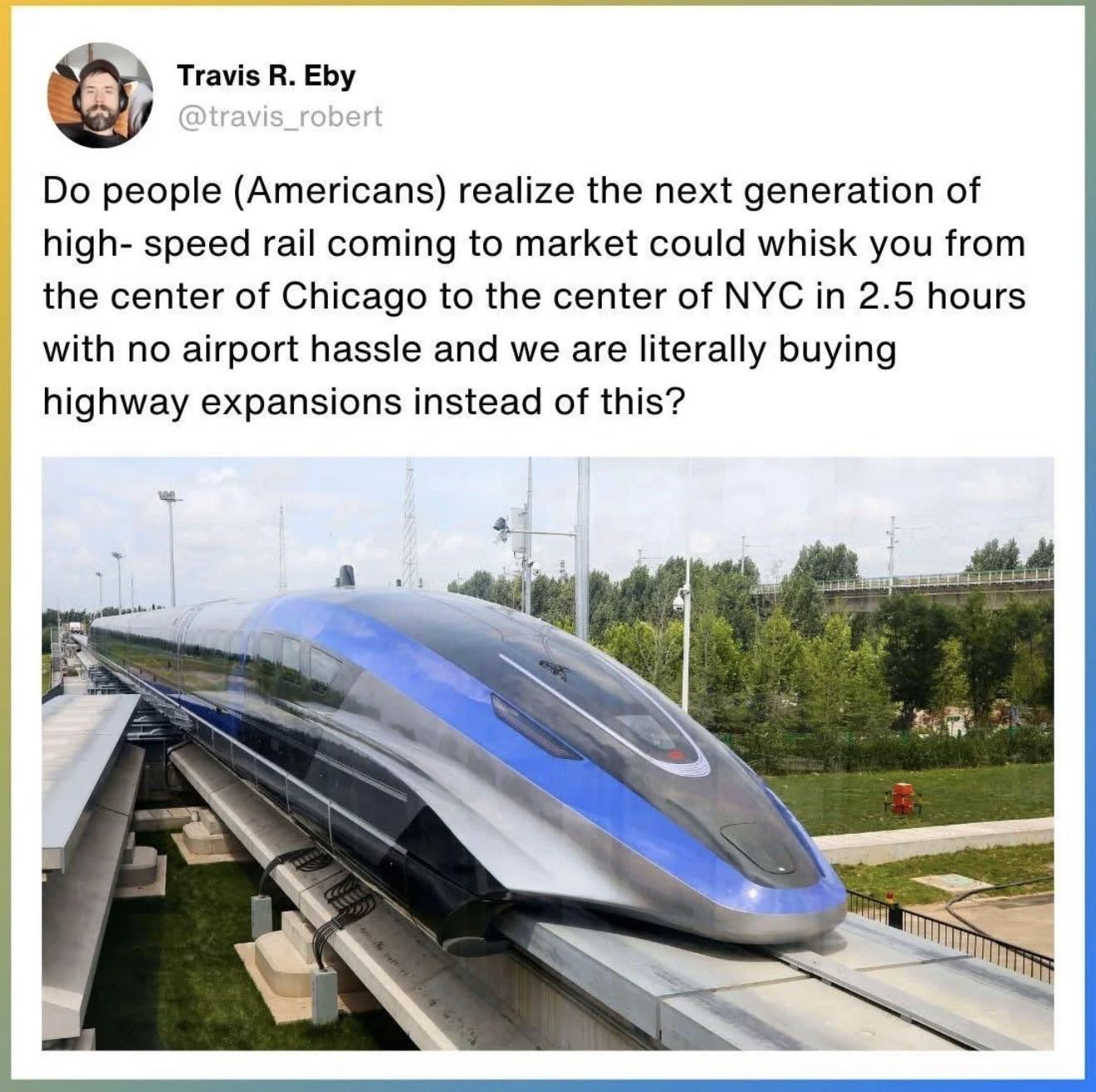
More like three and a half hours if you want an actually usefull line that stops.at places where people wanna stop at and you add the time needed to accelerate and decelerate but yeah. Also thats calculating with 500kmh which is very much cutting edge and constructing a line like that takes decades BUT that doesnt mean such investments arent worth it and also just fixing transport within a city is already worth it.
If you want to stop at multiple towns, then regular HSR makes sense. Maglev is suitable if you stop at most at Cleveland. (And extend to Minneapolis)
You can run a multi-stop and an express train concurrently.
In fact, that is the norm.
China and Japan seem to have figured this shit out. How come the largest economy in the world can’t? Pissed about with Elon and his Hyperloop which would be too expensive for any regular person (extreme maintenance costs) and can’t move as many people (very limited size). And it didn’t even work! Meanwhile elsewhere the train wasn’t being reinvented, but improved, and it’s actually functional.
Also, you can have high speed transit between two major stations, then take local transit to your specific destination. That’s what central stations are supposed to be for.
Musk has openly admitted he propped Hyperloop for the sole purpose of stopping California to build a high speed train. He never intended to deliver anything.
This is one of those moments when I mentally ask “how the fuck is that even legal” but then I remember who writes the rules.
Hyperloop is incredibly stupid on the face of it for so many reasons, the two largest of which IMO actually being that it would be incredibly unsafe as escape would be impossible in case of an incident and that it’s literally physically impossible, as the material tolerances required are incompatible with the temperature shifts that happen everywhere on account of weather and seasons.
And Elon has not produced a single workable anything, but sucked up billions in subsidies.
Yeahhh but chicago is several large cities away from new york so thats why im saying they would need a stop for each of them. You can of course have commuter trains that skip some of those and others that serve the less used ones of course, and shuttles as well but you also have to consider that chicago and ny are 1100kms away from each other in a straight line while tokyo and kyoto are 370kms from each other in a straight line for example and those are 2 hours by train(and i looked from the train stations which are not in the center of the city tho you could argue they are somewhat but these metropolitan areas are so large that they have multiple city centers) so that means if you just multiply it up you would get that the chicago-ny line would be a six hour journey. This is, of course, probably not correct. Im just trying to show how you cant just draw a straight line between two places and say “Train!”. Tho of course you also have to calculate with the fact that the us is much richer than both china and japan but once again that just complicates things again.
Never forget what they took from us. They being the promoters of the ny-chicago electric air line railroad. Also if it were built and the right of way stayed intact we could absolutely build a maglev that could go center to center in 3 hours.
Nobody even considers that a problem for airplanes.
Plains fly over the obstacles? Thats kinda the point? Also i may have underestimated the amount of people flying in the us cause in europe one flight a day is completely normal for destinations at this distance. Of course if thousands of people want to move between these two locations each day a regular shuttle could make sense but you cant just ignore the distance, 2.5 hourse is a very very best case scenario. Planes can also fly boutta 1000kmh but that doesnt mean a place 1000kms away takes 1 hour, 1.5 to 2 hours is completely normal for a journey like that without accounting for all the flight related hassles. Of course thats a huge upside of trains but you cant just freely apply train to everything. This is very likely a place where a highspeed rail connection would make sense but nothing is ideal instantly. Not to talk about how these cities would have to improve their own public transit to be able to connect to a wider network efficiently.
planes missing connections is rare and the airlines provide some degree of compensation, Amtrak has no such reputation.
Having to plan connecting flights is a thing.
A thing a lot of people don’t understand about high speed rail is that it needs to be very straight and very flat. Draw a straight line from those two cities and count the number of places it goes through, the different elevations and figure out how you’d bulldoze through it all.
From a network perspective it wouldn’t make sense to build a Chicago - New York straight line with 0 stops… You’ld better link up Chicago to Cleveland, probably even do the Detroit detour and continue that in an expensive Appalachian tunnel to Washington DC. Then in a separate project build a high speed rail connecting the east coast cities: Boston, New York, Philadelphia, Washington…
China seems to have figured it out in their mountainous regions. Some of the lines are 90% tunnel+raised rails. And as an American we should talk about how China is roughly the same size as America. The excuse well has run dry.
I’m all for high speed rail in the US, but comparing the land area of the two countries is not really that relevant.
China’s network is really focused on about a third of the land area. US could do the same, but the big population hubs are separated and on opposite sides of the country, so it’s less ideal - lot of track to connect the two. It’s like 2-3x the distance to connect LA/NYC vs Chongqing/Shanghai.
China also has 4x the population of the US. So the cost/benefit to build this out is simply much more favorable for china.
Most importantly, China’s autocratic government can clear the red tape to get big projects like this done. Just getting the land rights to build the right track could kill a transcontinental project in the US. But that decision is consolidated in the Chinese government. This cuts time and cost immensely.
But that’s a non issue. If you want to get from LA to NYC, you fly. If you want to get from Chicago to NYC or from LA to San Francisco, you take the HSR… I mean you would if the US had a fully developed transport infrastructure.
I mean sure but it’s the same issue, smaller scale at that point. You slashed the distance, but also the demand.
The big problem is always going to be getting the land anyway
The corridors I mentioned are perfectly fine HSR corridors, the population numbers and distances are great for HSR, perfectly suitable. That is absolutely not the propblem. Developed countries would have already HSR along those corridors, heavily used HSR, that is transformative for the places along it.
The problem is not getting the land, the problem is politics and legislation that is hostile to it and as a consequence it is nigh impossible to get that land for critical infrastructure like that (hostile legislation is also the reason why multiple the times of construction costs have to be paid for non-construction expenses, not even counting land acquisition). Curiously enough it is not impossible to ever widen highways or even build entirely new ones.
None of these points are strong enough to stop the idea of high speed rail in the US. The auto lobby alone does that.
Cool cool
Then build a HSR on the east coast and one on the west coast. How about we start with that first?
Then you can worry about the detail that isn’t even that important. Nobody is saying to build HSR coast to coast
Next you are going to tell me it’s not a good solution because of Hawai
Thats why i drew a squiggly line when i calculated this lol
Just bring a non-stop train, a limited stop train and/or a full stop train. It’s more expensive, but it’s overall better.
Yeah i mention that in a different comment, many cities and countries have systems with full service, shuttle, commuter, etc trains that all serve different modes of transport with the same vehicle(idk how to phrase it exactly). Point is one machine and line(your train in this case) can serve customers demanding different kinds of service by running different schedules.
Also high-speed rail doesn’t run at top speed the whole time. You might have a few flat spots here and there, but most of the time it’s running much slower.
Also, if there’s a problem with a train, the whole rail goes down. If there’s a problem with an airplane, the other planes have a whole lot of sky they can still use.
That’s not how rail works.
There absolutely are passing places where a train can hop onto the left track and then back again, or just a long stretch of an extra track going parallel to the main route where either the faulty train can sit and wait for repairs, or the working trains can jump around the faulty one.
Source: living in a country that actually has a working passenger railway system.
So only 4000 miles of grade-separated high-speed rail (and all the infrastructure and private property easements, divisions, etc required for the construction) just to connect just these 2 cities? No problem.
You don’t connect just those two cities, mate. You connect them as the main artery and then do split-offs to other areas. Or, even better, you weave the main railway between major cities East-to-West to connect them directly.
If you think that’s ludicrous, may I present Interstate 80?
What are you talking about? Chicago-NYC are maybe 1200 km, perfectly within HSR distance and definitely within Maglev distance. The two urban areas are also huge enough to support such a thing, especially as there are a few mid sized urban areas in between.
we’ll be saying this 200 years from now
This passing problem was solved a long time ago, it’s just that the freight rail corps in the US have “optimized” for trains that are longer than the passing rail sections. It’s extremely bad for the entire rail industry and the cause of many of the derailments and accidents, but because capital always gets its way in the US, nothing significantly has changed to resolve the issue.
It’s very frustrating how often there are perfectly workable solutions to making the world better, but if it doesn’t have a fat profit margin, it just gets strangled to death by capital interests in this country.
Aviation is grounded way more often than rail corridors are blocked. You’d know if you’d ever had lived in a place with developed infrastructure.
Also, yes, HSR built on dedicated high speed infrastructure, like the TGV or Shinkansen, does run most of the time close to max speed.