I thought UEFI was just a solution to move to be able to work on GPT. Essentially the old setup (MBR)could only max out at 2.2 terabytes of storage, so if you needed more you were hosed. GPT can support magnitudes more storage and could support a lot more partitions. (Instead of 4, you could do say 32 without issue)
I’m not understanding how being able to support say a 5tb hard drive during boot is the same as forcing AI on us. Can you extrapolate on what you mean there? Like once the initial drive boots sure I guess you could work around it (I have 1 media server that does just that), but you would just never be able to have the boot disk larger than 2.2tb. the 64 bit firmware is what I thought couldn’t be stored on the hardware/serup previously used.
When UEFI was imposed upon the plebeians it was marketed as improving security and increasing hardware limitations. BIOS could have fulfilled those same requirements but Microsoft imposed TPM support which was new at the time by requiring TPM to install windows which in turn required UEFI over BIOS.
hardware developers, out of fear of not selling units, switched to UEFI because Microsoft strongarmed manufacturers into adopting UEFI by force.
similar business model to how AI is being rolled out to businesses. if you are running a company and plan on selling within the next year, you should be heavy on AI, otherwise not just potential buyers lose interest, but lenders have been rejecting proposals to purchase businesses that don’t use AI.
BIOS was old, yes. it was also limited in by the bit-size however they were working on a replacement but refused to “play ball” with big tech. so naturally they created their own. within the first few years it was found that Microsoft was using UEFI to track installations of the OS on your system. so if you had installed windows more than 3 times on the system it would just brick the system. why does a glorified boot system need to track any of that? trick question, it doesn’t.
UEFI was the first deathgrip big tech had on consumer electronics.


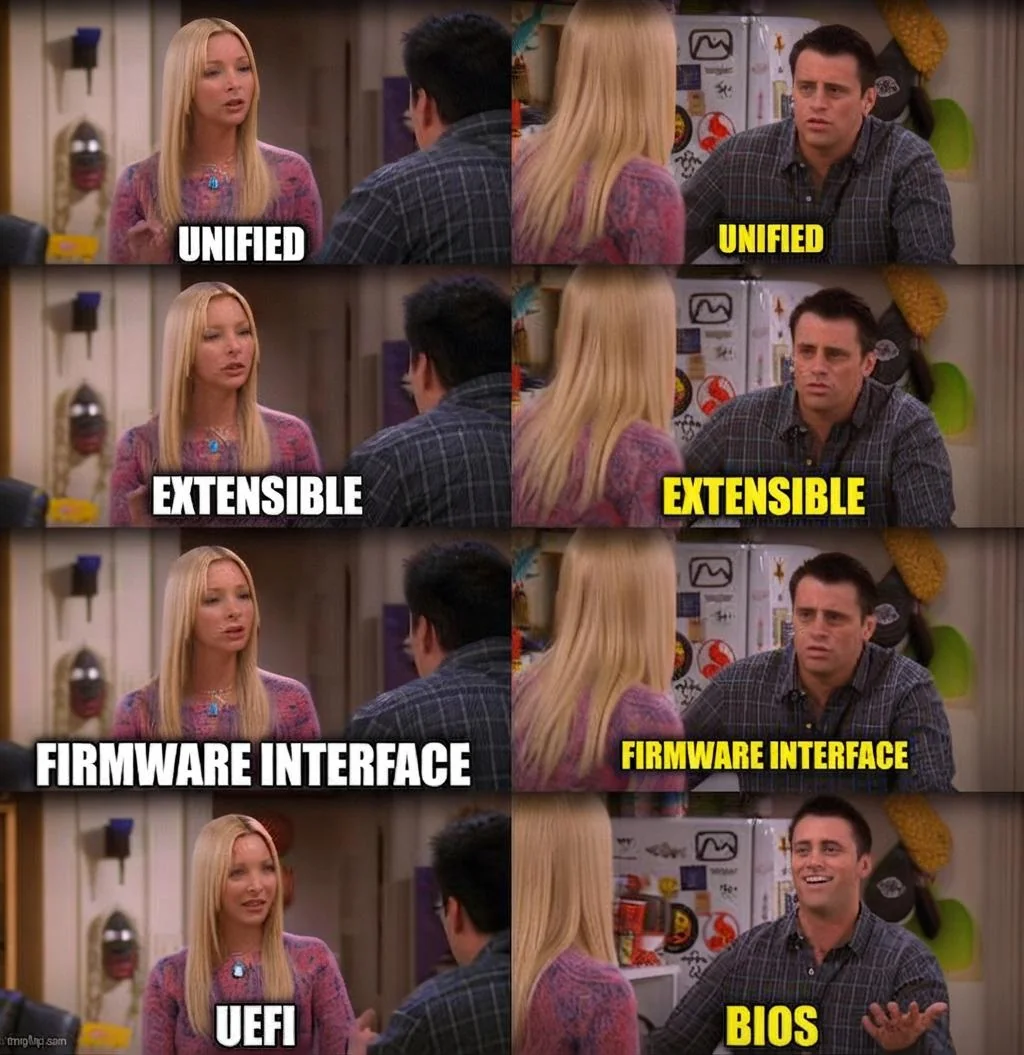
fuck UEFI, it was a solution to a problem that Microsoft and all the tech oligopolies made up.
Same for Secure Boot.
If it wasn’t for Microsoft holding the signing keys, secure boot does make sense
what if i tell you someone got DOOM on a UEFI shell
I would say that if UEFI can run doom it’s needlessly complex as a BIOS alternative.
Someone got doom running on a pregnancy test too.
Its not a bios alternative
but it is. BIOS is still a thing that still ships on new hardware.
UEFI is an alternative to BIOS.
I thought UEFI was just a solution to move to be able to work on GPT. Essentially the old setup (MBR)could only max out at 2.2 terabytes of storage, so if you needed more you were hosed. GPT can support magnitudes more storage and could support a lot more partitions. (Instead of 4, you could do say 32 without issue)
that’s the neat thing with software, it can change.
BIOS itself wasn’t broken, but it wasn’t controllable by the tech companies.
closest thing I can compare the BIOS > UEFI switch is similar to how AI is currently being shoved down our throats.
I’m not understanding how being able to support say a 5tb hard drive during boot is the same as forcing AI on us. Can you extrapolate on what you mean there? Like once the initial drive boots sure I guess you could work around it (I have 1 media server that does just that), but you would just never be able to have the boot disk larger than 2.2tb. the 64 bit firmware is what I thought couldn’t be stored on the hardware/serup previously used.
When UEFI was imposed upon the plebeians it was marketed as improving security and increasing hardware limitations. BIOS could have fulfilled those same requirements but Microsoft imposed TPM support which was new at the time by requiring TPM to install windows which in turn required UEFI over BIOS.
hardware developers, out of fear of not selling units, switched to UEFI because Microsoft strongarmed manufacturers into adopting UEFI by force.
similar business model to how AI is being rolled out to businesses. if you are running a company and plan on selling within the next year, you should be heavy on AI, otherwise not just potential buyers lose interest, but lenders have been rejecting proposals to purchase businesses that don’t use AI.
BIOS was old, yes. it was also limited in by the bit-size however they were working on a replacement but refused to “play ball” with big tech. so naturally they created their own. within the first few years it was found that Microsoft was using UEFI to track installations of the OS on your system. so if you had installed windows more than 3 times on the system it would just brick the system. why does a glorified boot system need to track any of that? trick question, it doesn’t.
UEFI was the first deathgrip big tech had on consumer electronics.