

They all got caught in an unsustainable build out. They are all under pressure to find some gentleman’s agreement to slow it down so they have more time before investors realize they aren’t getting their money back. It is the usual tech scam of fake it til you make it. When you aren’t going to make it you need to find excuses and delay.
This isn’t cartel behavior at all
There is clearly a push coming from these companies in the past month to present AI as something extremely dangerous. The way I see it, it’s just marketing for the industry to keep the grift bubble going a while longer still: (1) there’s no such thing as bad press, (2) if it’s dangerous it must also be good. IMO public statements like this is just another element in that marketing campaign.
Maybe the bubble is closer to bursting than I imagine and they’re trying to stretch it out until the US midterm elections end.
I suspect in reality it’s a combination of all those reasons, probably in different amounts for all three.
The bond market turning means they can’t borrow money cheaply anymore. They are looking for an excuse to reduce capex.
You remember how agreements like this used to be called a cartel and how a country should have a functioning and independent government body to prevent these?

It might also be that Altman and Musk are deliberately lying, intentionally feigning agreement to encourage other models to slow down while they quietly ramp up development.
It seems all the US models want their AI to be the one that becomes hostile, escapes confinement and attempts to dominate the world.
(In reality, they want their own AI to be the one that is able to obediently dominate the world, which is just as bad a scenario for the rest of us.)
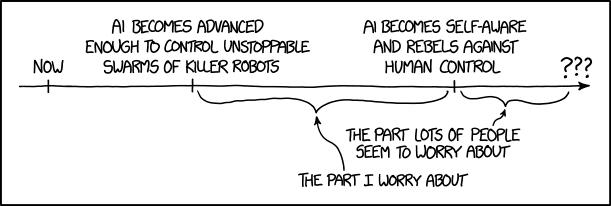
I don’t see how anything they do can possibly affect what Chinese labs are doing. And that’s the only alternative to American labs right now. So, who are they going to convince exactly?
The point is to get laws passed in the US that create a moat for them as businesses. They don’t care about competing with China, they care about competing with the next YC cohort.
That’s definitely a plausible option, but it’s going to be very hard to ban use of open models. They could get use of official Chinese services banned, but justifying why OpenRouter and others can’t run them is going to be a lot harder. And there’s also a ton of money invested in all these AI companies running on open models now. So, the pushback will be significant.
It would be a lot easier to regulate open models if they perform regulatory capture first
Seems like one of several last ditch efforts to keep the bubble going IMO. They’re flailing
It’s possible they are going to push the chinese labs to do the same. Doubtful it will happen. So they’ll go back developing AI and pretend nothing happened
The problem for them could end up being that the economics simply don’t work. If more capable models are more power hungry, then operating them might be too expensive to justify. Or it could be that there are diminishing returns, and they simply can’t make a model that’s significantly better than the current frontier.
I doubt the Chinese companies will comply, even if they agree on the surface. Whoever releases the most powerful model when the truce ends, will have the advantage. If anything, research and training will continue, releases will slow down.
They have no leverage over Chinese labs, and China has every incentive to continue developing this tech. The only real explanation I see here is that they’re starting to get into diminishing returns territory, investors are getting edgy, and the costs of running this stuff are exploding.
i’d say that’d be a worse development for humanity if it ends up obeying the epstein reich
The money ran out and they need an excuse.
I’m not sure Chinese labs are even going in the same direction as the AI projects in the US. They’re working to see what they can do with a (more) reasonable amount of buildout, rather than building data centers from horizon to horizon.
Also, the Chinese are motivated by seeing what AI can do for a larger society. American AI systems are being refined automation and instruments of control, specifically military and national security interests.
Essentially, the US industry is trying to get AI to train a gun on the entire US population.
Oh they definitely aren’t, there’s an interview with Alibaba Cloud founder where he discusses the direction in China. Basically, the goal is to find useful niches for this tech early on, then iterate and improve. They’re not chasing AGI or trying to make one model to rule them all. That said thoough, the capabilities of Chinese models in the same domains where American ones shine are very close as well. So, I do expect that Chinese models will catch up and start surpassing American ones on their own turf before long. I’m also expecting that the trend will shift towards running smaller and local models for most things because you just don’t need a giant model to do most tasks.
I’m looking forward to when hardware gets cheap enough to try Qwen 3.8
I’m hoping Alibaba will start selling these things at rpi prices https://wccftech.com/alibabas-tsmc-built-5nm-risc-v-chip-xuantie-c950-now-runs-qwen-3-8-27b-model-natively-unlocking-massive-vertical-integration-tailwinds/
It’s because they’re hitting model size constraints. There’s only so much memory bandwidth you can get between racks or even rack spaces and memory bandwidth is the constraint for nearly every ml thing.
Expect a reversal once a more memory dense component hits.
There’s no reason to think that the architecture itself can scale indefinitely. It might very well be that LLMs have some hard constraints on the scope of the problems they’re capable of solving.
Of course, that’s what I’m saying. Physical constraints of hardware mean there’s a limit to how much further (read: larger in terms of working memory footprint, because that’s how they’re getting “better” and better “frontier” models) development can continue until a more dense component comes along.
Every singularity a sigmoid.
I meant that simply making models bigger might not actually make them more capable. So even if you had unlimited hardware to play with, you might have to find a different approach.
You could create a way to measure the idea of capability that would bear that out but from a pure discrete mathematics perspective, no, you only get better with a larger memory footprint.
There’s a lot of ways to make that faster or make that behave like a process running on a bigger memory footprint, but ultimately that’s the constraint.
And companies competing in the field of ai can’t justify the expense of cutting down their gigantic model to only know how to identify wood because that has a known and limited impact. They already said they’re shooting for unlimited immeasurable impact on the scale of replacing all human labor and got massive funding for it.
It doesn’t matter if it’s easier to do one backflip, you asked me to triple dog dare you to do a million backflips. Well… we’re waiting!
Again, there is no reason to think that you can just keep making the model bigger and keep getting improved capability that way. In fact, we already know that’s not the case because simply making them bigger stopped being the focus. The real breakthrough is going to come from better algorithms.
You said there’s no reason to think you can just keep making the model bigger and keep getting improved capability.
there’s the structure of the neural network itself. Fundamentally, adding nodes and layers increases the ability of the model to handle more complex input.
Then there’s the actual models we see in use. They are literally as large as the hardware allows. The only reason to use smaller models are to fit some constraint.
So both by the book and in practice bigger is always better.
Now we can’t always go big. I can’t afford to purchase a dgx or even upgrade my wiring to power it, let alone pay the power bill it would rack up or all the other utilities alone when my wife leaves me because of the sound.
My computer can only fit so many expansion cards and pcie is so slow compared to hbm that I’m better off running a small model quickly that fits on one card as opposed to a larger one slowly across several cards.
But those are all constraints. When I replace my motherboard with supermicro gpu host fabric I no longer am limited by the pcie bandwidth and can quickly use models that fit across several cards.
I do agree with you that the future is smaller models, not because of the fundamental nature of the concepts involved but because of the complex constraints that are coming into play.
Ligmoid
They all must have figured out by now that they are hitting a limit. I honestly don’t think LLMs will lead us to AGI. I’m sure it’s a step on the path to it, but I’m think it’s a lot further than most think.
So, they make this “agreement”, then the slowdown is just being “responsible” so that the investors don’t panic. Meanwhile they all go full tilt behind the scenes to try to find the next breakthrough.
It’s become so focused on LLMs that that’d be a better outcome, some new research in a new direction
That’s my view as well, LLMs are likely just one piece of a much bigger puzzle and we’re now hitting the limit of what you can do with them in practical terms.
They hit a wall and want to prepare everyone for the fact that they won’t be able to meet the expectations that they themselves created.
They lied their asses off about capabilities and are using “safety concerns” as means to get investors off their asses. Google didn’t get new billions of investments and oh look their model didn’t “escape”.
None of them will slow down though. Because they all want to be ahead of the competition. I can also only imagine intelligence agencies are going full send with AI for better or for worse. And we all know it is the latter.
Fun times!
There is absolutely no reason to expect that you can scale LLMs indefinitely.
Not now, but I’d expect LLMs to be much more efficient in a couple of years.
I expect more efficient LLMs to come out of China, who has turned to the AI-as-software model (contrast the AI-as-service model in the US).
They already are, DeepSeek/GLM/Qwen are great models and can run on 2 DGX Sparks
I expect so as well, and my prediction is that we’ll have LLMs that are roughly as capable as the current frontier that can be run locally within a year or two. At that point, it’s just going to be good enough for vast majority of tasks most people need to do.
Option 3: JP Morgan, Goldman, etc told them to settle down or they’ll get throttled economically.
They must realize by now that they have no business model viable enough to repay the money they burned for the last two years, and if they are given an excuse to stop, they can tell their investors they are not responsible for the absence of any ROI.
yup, that’s a totally valid option if the costs for their bigger models are going through the roof
The backlash against AI is more than a mirage, and SpaceX’s IPO didn’t go the way they wanted, so now they’re looking for reasons to delay their IPOs without revealing how screwed they are. This will probably slow data center buildout even more, and Softbank and Oracle are gonna die.
Softbank and Oracle are gonna die
Please I can only get so erect.
It’s the energy crisis. They realized “oh shit money is real now” and are trying to sooth investors.
Interested how Monday will go. This is not what investors want to hear, even if it’s softened by markets being closed.
The whole bubble might be about to pop.
Have been hearing that for 2 years now
I heard on the Framework subreddit that they just secured a cheaper batch of RAM and refunded their customers, so could be something or maybe it’s just a blip. I’m also wondering if the recent Flash model releases are disrupting investor interest in the AI datacenter projects especially since running them on local hardware is starting to become more feasible, and for businesses in particular possibly more cost-effective.
The nature of a bubble means that the longer you go the more likely it actually is. And this is a bubble I frankly can’t wait to pop.
Significant portions of Lemmy are turning into debate bro bro hreads on AI and its relevance.
The market can stay irrational for a long time but it does eventually have to happen. The 2008 crisis was the result of overleveraging in 1999-2003 and interest rate rises from 2004-2007, so it can take years for it to crumble. Two years is a long while but it could easily take two more before people realise the emperor has no clothes.
I think it’s a combo of this and the fact that “intelligence” continues to not scale with the inputs as they’d hoped. I haven’t been keeping up with developments, but it feels like they’re finding new ways to discover that the brain is in fact an miraculously efficient and effective mechanism. Most their party tricks seem to be reproducing brains more minor processing feats in interesting ways. All the promised advancements have stagnated and what remains is just exploitation of economies of scale and its consequences, which is far from the revolution investors were promised.
My read on this is, that they realize that the full AGI is not coming and they need to focus on computational efficiency to be profitable. We will probably see a lot of work from them focusing on increasing switching costs as the models themselves become commoditized.
Their problem is, that their frontier models get distilled quickly by DeepSeek and co. The distilled models will then go on to provide 90% of the efficiency for 10% of the compute.
I’m skeptical they ever expected AGI to come as a result of LLMs, I believe it’s just a convenient talking point both for hype, and to distract from more immediate issues, like how corporations use these tools to screw over workers.