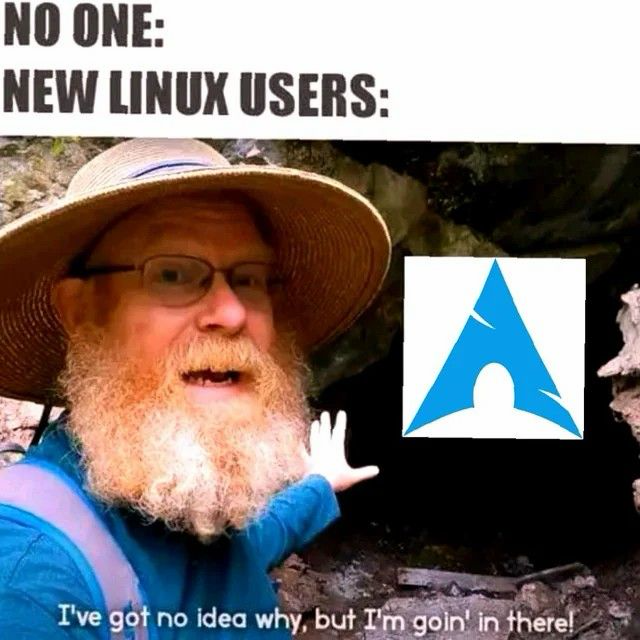

I’ve been working on Linux since '96. As time goes by I keep drifting more and more towards boring and stable distributions. I just don’t want to be bothered with a system that needs me to groom it constantly.
I use arch because it is the boring but stable system. Rolling release means you just keep updating it and it works forever rather than having to do big bang upgrades between LTS versions that always break something
this
you can just choose to use software that isn’t dev/nightly versions, and you’re fine
unless you want to see stuff break… then you install all of the nightly versions and have stuff break sometimes!
Nah. It just means that the breaking updates could surprise you at any time.
With a LTS version upgrade, I can plan for the potentially breaking updates. I can set aside time when my schedule is free to do the big update and work through any potential bullshit. It won’t interrupt my work.
But in a rolling release, you’re still going to get that same breaking update … but with no warning this time. It might come at a crucial time when you’re trying to get other work done, forcing you to stop your more important work and fix your computer first.
And that’s not even counting the number of breaking updates. A relatively ‘bleeding edge’ rolling release distro like Arch is going to include much newer software versions that haven’t gone through as much real-world testing and bug reporting as the stale old packages in a LTS release. The price you pay for more updated software is that it’s less thoroughly tested software and more likely to include undiscovered, unfixed bugs.
By the time the same package update finally makes it to some stable LTS distro, more of the bugs have been discovered, reported, and hopefully fixed … before you ever even see it.
(Not to say that nobody should run cutting-edge rolling release distros. I’m glad you guys are out there. You’re the ones reporting those bugs that end up getting fixed before it makes it into the LTS version. If everybody was running LTS stuff, it would lose that advantage because nobody would be testing things before they make it to the LTS.)
Overall, I think cutting-edge rolling release is fine for a computer that doesn’t really matter, like a gaming PC. (And you’ll probably get a gaming performance boost from having the latest and greatest versions of things.)
But for an essential computer that you need for doing important things, a LTS stable release is the way to go 100%.
You can write a whole essay of theory, but my experience is running several arch devices for years and years with no problems and having ubuntu distro upgrades break so badly I just reinstall completely every single time.
Another hiccup is that LTS are not actually running stable packages. They are running Frankenstein versions of packages with backports that are not supported by the project maintainers, because the software has to be maintained for security if nothing else.
It just means that the breaking updates could surprise you at any time.
I keep hearing this but in my roughly 20 years of running Arch that’s happened no more than a handful of times. And usually because I missed an announcement. I don’t know what y’all are doing to your systems but Arch has been incredibly solid for me.
And complete distro version upgrades like with CentOS/Debian have always been such a fucking massive hassle. And CentOS often deprecates hardware shit I need which of course I never find out until after I run the update and the shit won’t ever boot again.
Lol. You guys write pacman -Syu into your .bashrc or what?
So I’m assuming you’re the type who says it’s on the user to carefully review all package updates before running the update (rather than running updates automatically)? And therefore the user’s fault if something breaks in an update?
Yeah … no. Ain’t nobody (who has a job and/or a life) got time for that. My computer isn’t a hobby, it’s a tool. And, as much as possible, I want my tool to ‘just work’. And I certainly don’t want to spend more time than necessary maintaining it. So I’ll stick with a distro where the work of vetting updates and making sure they don’t break anything has already been done by someone else – a distro where I can just run updates automatically in the background (if I choose) without any significant worry that it will interrupt my workflow in any way.
So you went on assuming and responding to your assumptions. Yeah… no. Have a good day
Well you didn’t give me much else to go on, had to fill it in with assumptions.
Since you seem to consider automating updates an absurd proposition, what else am I supposed to think?
I asked a general question. You know, the one that only requires “yes” or “no” as an answer. When doing that, I am not expecting you to think anything about me
Back to the topic at hand: absurd is not automatic updates, but your foolish thinking (I would have said “illogical”, but failing to follow logic and breaking its rules are differen things), now demomnstrated twice in a row. So, if that is how you want to manage your computer - well, on the second thought who am I to save you from trouble
Also, pkgbuildis by far the simplest package build system I’ve ever encountered. That’s why aur is so prolific, though troublesome
Polishing dotfiles is a valid hobby, and can be fun now and then, but when I need to do actual work I reach for my debian laptop.
Yep.
In 2002, I used Gentoo.
In 2026, I use Kubuntu.
(I should probably switch since Canonical’s policies are increasingly bothering me, but meh, I can’t be bothered to reinstall more than once a decade.)
This was me!
2002 - - Gentoo
2026 - - Xubuntu
And I ALSO just found out how bad Canonical’s policies have gotten and I’m also considering switching but it just seems like a lot :: le sigh::
24.04 will be my last ubuntu lts. 26 doubling down on snap for system level packages, yea no that’s enough of that. I too was a gentoo lunatic in the early 2000s and will likely head back in that direction.
Ah, thanks for the warning. My install has been badgering me to upgrade because my (non-LTS) version just stopped getting security updates. I ought to get off my ass and switch distros.
What is your position on getting extended updates via a free account on their ‘pro’ program? That’s what i did when i didn’t want to leave 16.04 lts
Bleh, I don’t want to keep running old software, either. If they’re making the newer versions worse then it’s time to ditch them for someone who’s not doing that.
Don’t get me wrong, I’ve been procrastinating about upgrading for a few weeks, but that isn’t the same as staying on the same version for years.
Youve got a point. For me i dont mind old software if it works; i dont want to invest time into installing and learning a new distro on old hardware.
I’ve used Debian since 2001 or so. I reinstall whenever I have a new computer, unless I’m decommissioning another computer at the same time.
Debian since the year after you, but I reinstall with every new version. Mostly just cuz it’s a great excuse to ‘start fresh’ with just the applications I want and to get the ‘new computer experience’. Totally unnecessary, but nice anyways.
I don’t like the new computer experience. Whenever I restart, I have to rediscover all the old hardware bugs that I’ve made configuration changes to improve.
Same for me. I clearly separate my “experiemental” machines from my “just works” machines now.
My laptop runs LMDE, my servers are mostly Debian 13, a handful of Ubuntu Server in there. My gaming rig is Nobara Linux, which is just Glorious Egg roll’s gaming-optimized Fedora build. When I first set it up a few years ago, I had everything all customized, themes, fonts, icons, fancy desktop/window effects, etc.
I actually considered just going with something vanilla recently, not because I have had any major issues with my current set up, but just because I don’t feel like tinkering with it anymore.
My tinkering desire has shifted more and more towards server/enterprise infrastructure and DevOps automation.
I’m older now, my career has taken off, and with that comes more responsibilities and mental energy required during the workday, then family obligations through the week/month, etc. I find myself with less time and mental energy to just tinker and play with tech. So when I do find myself with a bit of free time, I want to maximize it and work on stuff that both helps with my actual career, and helps me get more stuff self-hosted for myself and my family.
Way back in college, I used to spend more time tweaking my PC’s overclock than actually gaming xD
imho that’s kinda why i went ios for my phone. i dev in linux, deal with robotics, hardware, signals, “security” and whatnot to get paid. i just want something that works.
Nowadays you dont even have to use iOS/android to get something that just works, GrapheneOS for example also is fully there already (apart from NFC payment but that’s really the only thing)
Eh. You already can’t pair it with your Volkswagen (or was it Volvo? one of those car brands), a lot of Banks won’t fuck with it and just won’t let you use their app or website, and Google is actively trying to kill it off (whether they’ve said it out loud yet or not, it’s happening). I’ll be interested to see where it is in the next few years, hope it manages to keep going and all, but I am much more personally invested in a properly working Linux mobile option that works on a modern phone with all of the modern amenities.
Both my banks work (one local, one international) and both my cars work (Volvo and Audi)
GrapheneOS for example also is fully there already
There are some caveats to that. You do have to jump through some hoops to for instance get RCS working. I think it is worth it to feel like I’m actually in control of my device, and I would even recommend it to friends and family that I’m willing to play tech support for, but I can’t truthfully say I would recommend it to an arbitrary non technical person
Going to an Indian restaurant and asking for a lot of spice can work… if you’re a veteran of Thai or Mexican spice first

Fixed:

Appreciated! I’ve always hated that nonsensical format
One time I was eating at an Indian restaurant that had a 5-star heat scale, and then “Indian hot” which was just another level beyond the scale. I ordered 3 star heat and my buddy ordered “Indian hot.” The waitress confirmed 3 times that was what he wanted (we’re white).
I was impressed that my friend was managing his meal pretty well so I asked if I could try it to compare. It wasn’t any hotter than mine. I’m sure the chef took one look at him and was like “I’m not remaking this dish when that white boy can’t eat what he ordered.” Not like my friend would’ve been a dick about it or demanded another dish, but yeah I doubt he could’ve handled the heat level he asked for. In the end, the food was great and my buddy didn’t feel cheated and didn’t destroy his guts.
This has happened to me repeatedly at Thai places and it was honestly infuriating the first few times it happened. Luckily, I found out that at Thai places they usually have a spice tray they can bring out on request as long as you are eating at the restaurant instead of takeout. It became my common thing to expect to do so after my first bite when eating at places. At home I have my own dried peppers so I can make food as silly hot as I want.
Indian place I used to live near had a similar system. Each time, I ask for Indian hot. They confirm. What they bring is not Indian hot. They ask about it, I tell them “this is really good, but next time, I’d like hotter”
This goes on for freaking forever before he finally makes a dish that’s genuinely hot, and it’s great, but I can do more. Lol. The next time I come in, I tell them hotter than last time, and he says he’ll make it like he does for his own mom.
Lit me up. It was really good. Not too hot for me, but hot enough that I’m pushing my limits. He asks after the meal, and I tell him it was hot enough. He says “good. I won’t make any hotter! That’s hot enough!” Haha
it’s funny because as an asian person i’ve never really run into this problem; if i ask for spicy i get spicy but i think the difference is we don’t really use it as a dick measuring contest like white people do (ours are all small anyway lol). some people like spicy some people don’t nobody cares what you order
it’s only when either white people are ordering or white people take my order it turns into this weird back and forth and then ultimately the white customer has to be convinced he is a really strong eater and got the “authentic” spice so he can brag about it and feel like a man and then post about it on reddit
it’s like vanity sizing on my pants i’m still wearing a 32 inch waist even 20 years after graduating high school now with a sizable dad bod
meanwhile i’m still so confused why there are so many memes about spicy foods changing your poop i mean sure my poop can change when eating corn or other veggies like beets but spicy vs nonspicy food never changed my poop/guts must be another white people thing. fascinating creatures, love you guys, but endlessly confusing
Haha, it’s why I added the “we’re white” detail near the beginning. I knew that the waitress confirming 3 separate times would probably sound weird to anyone who’s not white.
I imagine that, at least for Americans, the reason spice is such a macho thing is because our food isn’t very spicy, so it’s more of a novelty for “sometimes” meals instead of just a standard part of our cooking. Our palettes aren’t used to it, and Americans especially will compete over anything. I definitely don’t want to compete with anyone when it comes to spice because I still want to enjoy my food. My ideal spice level is for the dish to be just a bit of a struggle at the end. If I shed a few tears with the last few bites, that was the right amount of spice for me.
As for the poop memes, depending on the meal, my b-hole can detect spice just as accurately as my mouth, and that is… not fun. If your digestive system doesn’t work that way then I envy you. One sufficiently traumatic “ring of fire” experience is enough to get some people to decide that spicy food is not for them. Personally, I’ll risk it if the food is amazing. That’s a problem for future me.
I like to ask Linux people “Would you recommend Arch for a newbie?” Not because I have any intention of using Arch, but their answer to that question helps me judge the quality of their advice going forward.
Honestly, if you are new to Linux and are making the switch because you enjoy customisation and tinkering, a manual Arch install is the way to go. It’s fun and you learn a lot, while still having a good OS.
Guys stop this nonsense. I spent 2 hours in wpa_supplicant trying to fix Wi-Fi because I missed a package containing regional wpa shit.
You all vastly under estimate how quickly a novice may be overwhelmed.
I have multiple times partitioned the wrong drive. With a graphical installer.
I now physically remove the SSDs I don’t want to partition.
It’s still a bad place to start. Go try a curated experience or two before you try building a system from the ground up.
That also means you’re less likely to end up with a final bloated system with 7 DEs, 16 shells, 4 file manager, and every piece of software installed that sounded cool because you wanted to try them all out.
Eh, rolling release distros are great for gaming. I recommend it enthusiasts (noob or not) and gamers. If you just need a rock solid platform for a server or browsing the web / word processing then sure slap some Debian or Fedora on there and call it a day.
It really depends on whether they’re an enthusiast excited about it or they’re just trying to ditch windows…
9/10 times, no.
And believe it or not, the 1/10 case: also no.
I guess I’m the 0/10 case then
I don’t recommend things based on if people are new to it or not. I recommend things based on if they read and are willing to learn or not.
If you don’t read, arch is not a good distro for you.
If you don’t read, nothing is good for you, you’ll kill all distros if you don’t care and aren’t willing to learn
Agreed. Also I would rather read the archwiki than loads of outdated faq posts when troubleshooting an issue.
I guess a lot of accurate text is intimidating compared to a concise message that is very confident.
I’ve also seen people just refuse to read an error message. I think this is from using Microsoft products that never have accurate error messages.
Anyway, I hope people willing to learn try a whole bunch of things, and don’t give up at the first problem because that is how you learn.
The Arch wiki’s secret: Most of the time, the info is applicable to other distros, even when you’re running Debian oldoldstable.
*judges the quality of your advice going forward*
You should always judge the quality of advice others give, especially random internet bozos.
So what would “Would you recommend Nix for a newbie?” reveal?
The cat shelter probably doesn’t let you adopt anymore.
Mint, Fedora, Pop_OS!..these are good distros to start on. Some people start and end on these.
CachyOS, Arch, Manjaro…these are not what you throw at a newbie.
I think it really depends on the person (and a few other “luck” factors). Like, if they are truly generically computer savvy enthusiasts, they might actually have better luck on an Arch derivative. I’ve seen hardware compatibility issues plague a machine until it got Arch on it - sometimes that bleeding edge has what you need already and you don’t have to hunt for it.
I still like the play of suggesting new people download every distro that piques their curiosity, put them all on thumb drives, and spend a weekend giving them a go. But, if they aren’t willing to do that, then throw Mint or Bazzite at them and hope all their hardware just works because they probably don’t fit into the category above.
Except Manjaro. I feel like at least 70% of the Arch family hate is actually Manjaro’s fault. I’m glad it works for some people and they can use and enjoy it, but I just don’t have the faith in it to recommend it.
A new distro every day… that was me last year when switching over to Linux
Fedora for my desktop, cachy on my portable is what stuck around, debian for all the homelab stuff
Get them some nix

Went to a family-run Indian place in Cornwall looking for vindaloo, but the guy talked me down to a madras. Good thing cuz it was right on the edge of my tolerance level. I couldn’t have eaten their vindaloo.
Project car vs daily driver.
Just different purposes and people have different tolerances for tinkering.Also, when you want the car to behave in a specific way, you’re willing to tune it to do so.
As someone that was already in the IT realm professionally, and had previously dabbled with Linux on old hardware I decided that I would take the plunge. Trial by fire if you will.
Every distribution I had tried up to Arch didn’t sit well with me. At least not to replace my Windows install. On the same note; I hated that I could only delve so deep into understanding my Windows system. And I absolutely despise the data greed from Microsoft as well.
It was time to take matters into my own hands. What better way for me to learn than to “build it myself.”
The Arch Wiki was a huge help. First install I ever did I neglected to use archinstall. Just so that I could grasp some of the concepts of what archinstall was doinig.
The more and more I used Arch, the more and more I learned.
Arch has been the distribution for me. It has offered me everything that I need, and everything that I want. It has become mine to a degree that I am comfortable. It has taught me so much that it makes using other Linux distributions natural. The only real difference is that other distributions I use I just have to learn what underlying services and such are on it, and even then, the Arch Wiki has me covered.
I feel like a crack dealer right now, but, have you heard of Linux from Scratch?
I get what you mean with build it yourself, but Arch is more or less like a lego kit. LFS is the material manifestation of the concept of madness. I did it once, it was fun, it was crazy, I don’t want to ever do it again. Afterwards I immediately switched my main machine from Arch to Mint. I have a deeper understanding of how an OS works under the hood now, and a strong appreciation for the work put forth by distro maintainers. All I want now is a system that works straight away. I no longer want to build myself anything. Tinkering is a hobby, I need a working tool. Today I use Bazzite and all my tinkering is devoted to how can I make rare old games run on Linux. It’s the difference between buying a chair and taking up carpentry as a hobby.
It’s tough for a distro to have both a strong newbie community and a strong old-timers community at the same time. Well done Arch community!
I found it a great way to learn what the different components are actually for and how they interconnect/interact. But honestly, I would not use it as a daily driver again. I’m tired of fixing everything afer each update.
Went to Fedora, good and stable. Tried some OpenSUSE, nice and European. Settled with MX Linux. Ticked all the boxes, best Linux experience so far.
Since archinstall is a thing, arch really isn’t that hard to install or use, but these days I favor nixos for the reproducibility.
What’s architectural? I tried looking it up but didn’t find anything.
Mb autocorrected from archinstall and i didn’t notice X’)
Some windows refugees do start with arch, btw.
Which is awesome (as long as they know what they’re getting into, or even if they don’t, if they’ve got the patience and stamina to learn a lot)
Yup.
Compassion for those poor unfortunate souls who are introduced to linux with arch, eat their system, find it too hard, and throw the entire Free Software / Open Source baby out with the one-bad-experience bathwater, thinking it’s all like that, not realising freedom has availed a variety, to suit nearly all needs, preferences, skill levels.
But yeah, [windows to arch,] it’s impressive [levels of patient diligent learning].
A few years back, I think I caught glimpse of a gentoo-started windows-refugee in the wild once, in passing. Add that to the rumours these mythical beings may actually exist.
I know there are actually several who started with LFS! Never underestimate the power of suggestion [… the title said Linux From Scratch… so of course that makes sense to start there! LOL].
Man, that Indian restaurant reference is just fucking spot on
One of my biggest mistakes was ordering “spicy” level Thai food. Took me about a week to finish it because I could only handle one bite every few hours.
One local Thai shop had the sense to offer both “
$nationalityspicy” and “thai spicy”When my wife and talk about spice level, we clarify if it’s white-boy spicy or Hispanic spicy.
The Venn diagram is a circle?
I mean, mexican spicy is way above white spicy. Hell, some white people consider pepper to be spicy. To be fair, mexican spice is still kinda low on the scale compared to thai etc.
That’s because spicy has multiple meanings. The numbing of pepper is spicy but not hot spicy.
You’ll find white people in Mexico.
Yeah, white-boy spicy is an imperfect term, but helpful to stop an Anglo unused to high levels of chilli from having a bad time.
My grandpa thought black pepper, as in salt and pepper, was too spicy. White guy born in 1933 in Australia, “ethnic food” didn’t arrive in his world for a while.
Lmao. I’m from the Middle East and we eat spicy food regularly, but Indian spicy is on a whole new level for me. I’ve had their “hot” once and never again. I always get “medium”.