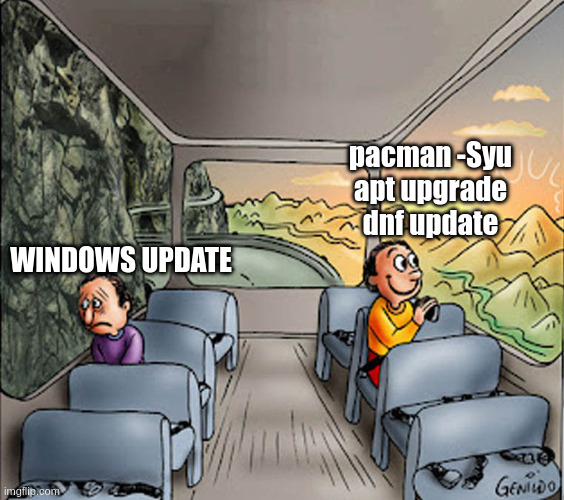
The best one is where the install size is negative that peak joy.
I’m glad I’m not alone in this joy
I love looking at my NixOs rebuild result (using nh) and seeing -50MB.
… Then I remember I’m on nixos and it doesn’t matter much
Do you not remove older versions? How much memory are you using?
I do remove older versions, but I set the auto GC to do it at 5% storage remaining, so it doesn’t matter that the update is lighter, I actually increased the storage usage.
I also use bees to dedupe the nix store so I cannot say the raw size
Its possible to set it to do it when a set amount of storage is occupied?
It’s possible if you know the size of the disk. Here’s the docs https://wiki.nixos.org/wiki/Storage_optimization#Garbage_collection
And the system gets quicker!
Don’t hate, but I actually like the GUI update manager in Mint. ¯\_(ツ)_/¯
That just runs apt and prints it nicely to you
That is exactly the sort of behavior every gui should do.
Oh, I’m well aware. It’s just that sometimes I like a cushion on my chair, you know?
It’s so simple but it’s huge for normies.
Exactly what I expect it to do!
Well, many of these softwares can’t do that properly, so…
I notice mine has updates outside of apt, but I’ve wondered if some are just duplicates that haven’t refreshed yet.
It does also update Cinnamon add-ons (spices I think?) and Flatpaks, which apt doesn’t handle
The key here IMO is that you decide both when and how.
No such option with Windows, but if you like the GUI and are used to using that, I don’t see why anyone of their right mind would have a problem with that.Personally I prefer to open a terminal and press the up key so I don’t have to type the command again, it takes 30 times until I get to the correct command, so it’s clearly slower, but hey we all have our little quirks.
history | grep <something I vaguely remember >
!<number of that command>
You can do reverse search but I’m too lazy to remember the sequence right now
ctrl R then type
Never tried history | grep though. Thanks for the tip!
Oh thanks for this. I’ve been using
history | grep $somethingfor the longest time, but i always end up copy pasting the actual command cause i didn’t remember how to invoke the number, and copy pasting is so quick that you end up never looking up how to do it properly lol.!${number}
Though i don’t know if that actually works while using a variable.
Just use FZF (fuzzy search finder) with the CTRL+R keybind.
I got a new function for my bash aliases file lol
CTRL + R for history search
Its all the same under the hood.
I had the problem that all old kernel images were kept when updating through the GUI updater. This led to my root partition getting fuller and fuller*. I needed some really obscure commands to remove those old images, since then I only update via terminal. I guess it was some kind of bug, but for me as a standard user it was a really serious one.
*I need to say I made the mistake of splitting root and home and giving the root partition only 40 GB, because I read internet advices about needing to change my distro frequently, turns out that was not the case
same here, and I don’t know how long ago you had this problem, but the GUI can handle that as well.
If you click the View menu, and choose Linux Kernels, it’ll give you a list of all installed and available kernels. You just need to click the “remove kernels” button and check the ones you no longer need for it to clean up.
(There is an option to remove old kernels automatically in Preferences-Automation but it doesn’t seem to work)
I don’t quite remember what I set as this was more than half a year ago. But the images couldn’t be removed as easily, also not from the GUI view, as they were somehow not registered in a certain list that should have shown them. And since then I just use the terminal out of habit.
However I just found an article about Mint removing old kernels once a week automatically.
That’s actually easier on regular Mint than LMDE, but the advanced Synaptic package manager works on both to remove old kernels.
… but they’re adding a dedicated kernel management tool for both versions in the next releases if I understand their most recent blog correctly.
Like the native Mint tools, it’s basically a front-end to apt and related commands.
That’s a front end on apt. You’re just making it pretty.
Permit me to repeat what I said to a similar reply:
Oh, I’m well aware. It’s just that sometimes I like a cushion on my chair, you know?
I’m not saying that’s a bad thing. I’m saying ‘one of us’.
The importamt difference between apt and windows update is not how pretty it is. You still update at your leisure in like three clicks, more if you want to be fiddly. You can choose to jot update this or that. If your connection is slow it will keep going while you go about your business and if you need to restart to finish anything it will tell you, rather than interrupting you with an implied ‘but if you don’t save every ten seconds you deserved this. Computer will be ready when its ready.’
As a long time windows user who has switched to CachyOS, I agree, even get notifications about updates
I like a GUI updater but the Plasma Discover one is so shit, it errors almost every time. I keep it for updating the odd flatpak, etc, but I always have to update from the terminal first.
Shelly is amazing for Arch. Both CLI and GUI.
And I love the pacman eating the progress bar on arch terminal.
same for me
Why anyone will hate that?
Ive said that Linux turned tech and computing back to fun for me, after hating interacting with computers and devices more and more. Linux is just fun to learn and rewarding.
Sometimes I have to remind myself how horrible locked down maliciously coded OS’s are and how good I have it with Linux.
The thing with Linux is that it’s 100% freedom. It lets you do whatever you want with it, there’s plenty of tools that facilitate customization and management.
By contrast, when I use windows at work I often find it won’t allow me to do what I want.
“What do you mean that’s not possible?”
exactly. That and being forced into stuff I don’t want. The amount of times i’ve about exploded in anger at windows forcing updates on me that make everything worse…
For someone living in linux for a while, interaction with windows is simply infuriating.
No, no, I’ve crunched the numbers. I know this is possible on the x86/64 construction set. What the hell?
I do believe it’s not just one of the things to keep getting better, it’s a blueprint for the things we want to build in the future. From software to society. More individual participation, less corporate involvement, zero corporate ownership of essentials.
My current enemy is the stranglehold of corporate OSs in the mobile space. That really really needs to go for good.
I agree, however, rather than individual participation, I would say Linux represents a victory for the collective spirit. Yes Linus has spearheaded the kernal development for years, but without all the other contributors sacrificing countless hours, Linux wouldn’t be nearly as successful (and ubiquitous) as it is. Linux demonstrates that we, as a community, can come together to work towards something we know is good and right, without the drive of monetary gain or social recognition, but just because it’s fun, or fills a need, or helps us learn.
That’s one of the biggest reasons I think Linux is so evangelised on Lemmy specifically: because it epitomises the power of collective altruism in a world increasingly dominated by corporate greed.
Couldn’t have said it better.
On mobile we got the different Linux Phone OSes, unfortunately none of them come pre-installed (not counting the obsolete phones from Pine or Librem) and they’re still very much beta software. But they too get consistently better, both Plasma Mobile and Phosh make great strides.
There are more recent devices from Jolla, Finnish company. The only problem is the price, roughly the same as basic iPhone 17 (≈700€).
I think we need to collectively understand that freedom and privacy have a cost. That $200 phone is subsidized with the spyware baked into it and the expected income of future repairs and upgrades, ad sales, etc. a $2k phone made with modular parts and software based on open source has a much higher up-front cost, won’t be quite as sleek, will require some technical understanding, but a much lower maintenance cost.
Game consoles, phones, computers, cars and even refrigerators. If some company now considers the product a loss-leader, we should collectively shun it.
It’s a hard sell, though, when everything is super expensive and things like phones and cars are pretty much requirements for living in some places.
And even worse when you are poor or simply cannot pay.
We really need to find the square of the circle on this, where we can have total freedom, low cost, high modularity and grassroots origin.
I think that an progressivist approach would be the correct (basically, not static prices, but dynamical prices: you’re rich? Then you pay more; you’re poor? Then you pay less or don’t pay at all. The ones in the top do subsidize the ones on the bottom). But of course, that’s hard asf to do.
It’s also slightly cheaper (per unit) to manufacture a million phones vs ten thousand.
I thought we were talking about open phones. Sailfish OS is not fully open, and I see no reason to go from “open but Corpotrash” to “partially closed with a little bit less (?) Corpotrash”.
Until they finally Open-Source their libraries Jolla is just one among many.
I’m an open source zealot as much as the next but I don’t get this view honestly.
Sailfish is about the best you can get that’s not based on one of the two main OSs. Normal people could use it and it’s got the best shot to make inroads. Even if it’s just a foothold til postmarket or something else comes along I find that huge.
I’m simply not seeing the benefit over a well maintained degoogled Android ROM such as Graphene or /e/OS. The amount of work I have to out in to relearn stuff is next to none, support is higher and you know hardware support lasts long (thinking of e.g. the Murena Fairphone 6). Sailfish looks like just another corporation with partially closed Source and bumpy track record, and with hardware such as Fairphone (and many other phones) you at least got some digital mobility to move to something else if your distribution of choice goes down the drain.
I get that having a third option is always better even if all three are questionable, but I don’t see that in Sailfish either.
For me graphene and the like only enshrine the dominance of the two OSs, especially while governments seem all too happy to make laws that do the same.
We need more options to make sure all the functions of our digital lives are not beholden to two corporations. And make no mistake, Android despite being “open” is beholden to Google.
That’s my angle anyhow. Sure, it’s not fully open source but it will enforce actual openness more than using offshoots of the main two. Jmho.
Fairphones don’t come with Linux pre-installed (I think you can pick LineageOS or /e/OS iirc), but they all support Linux and the past couple models of them are basically just regular smartphones specs-wise. Probably gonna upgrade to one of those when my GrapheneOS Pixel 8 dies.
Fairphones don’t come with Linux pre-installed (I think you can pick LineageOS or /e/OS iirc), but they all support Linux and the past couple models of them are basically just regular smartphones specs-wise. Probably gonna upgrade to one of those when my GrapheneOS Pixel 8 dies.
More individual participation, less corporate involvement, zero corporate ownership of essentials.
I’ve got some bad news about Linux then, the main contibutors are companies, and the infrastructure is owned by them.
It’s not individuals who paying Linus $1.5 million a year (Under “Compensation”).
Beautifully put.
apt upgrade -UDoes both update and upgrade.
One fun thing about Linux is that you always learn
I don’t want to learn. I have job to do.
Then you can use Linux Mint, super easy.
You don’t learn things at your job? Damn, you must not be a good employee.
Learning OS wizardry is counterproductive. I have more important stuff to do.
Windows is usable without os wizardry? I know it used to be, but that wasn’t my experience last time I used it.
Dude on mint I just open terminal and type apt install (thing I want). All dependencies handled. No fuckery. No bullshit.
So you don’t learn OS wizardry and don’t fuck around with working machine when there is stuff to do, duh. This doesn’t depend on OS in use
This thread is highlighting exactly why windows users think Linux is unusable - apt, pacman etc are all commands that require a minimal understanding of the terminal, and the average person does not have that. The answer isn’t “learn in your own time”, because that simply isn’t going to happen - they have no interest in the internals, how things work, they just want the end product.
Regular users just want it to update itself in the background or have a nice obvious “system update” button like Mint. The only thing they understand about “apt upgrade -u” is the word ‘upgrade’ - the rest might as well be ancient sumerian to them. Even remembering the short phrase is infinitely more complex than pressing a clearly labelled button. You will never convert a single user by trying to convince them to use any form of CLI over a GUI.Oh, so you are from one of my favourite gangs - “terminal is scary and a no-go”. Okay, I am yet in a good mood, so
apt, pacman etc are all commands that require a minimal understanding of the terminal, and the average person does not have that
they don’t require that. “open terminal, type this incantation, press enter” requires zero knowledge of how any of that works. Also, “average person” is wildly different depending on where it is measured
Regular users just want it to update itself in the background
Bullshit. You ever seen threads of how windows users hate its forced updates fuckery?
The only thing they understand about “apt upgrade -u” is the word ‘upgrade’ - the rest might as well be ancient sumerian to them
So let it be sumerian. Only thing anyone cares about is they know how to use it
Even remembering the short phrase is infinitely more complex than pressing a clearly labelled button
First - bullshit. Second - “clearly labeled” my ass, because human language is not maths, any text can be understood very differently depending on a number of things
You will never convert a single user by trying to convince them to use any form of CLI over a GUI
That made me chuckle. Go on, give me more insights about my life, it is so funny
Alias na=“Sudo nala upgrade -y”
Does update and upgrade with parallel downloads from fast high bandwidth repos and pretty colors 😍
Dammit, learning about this right after switching from Mint to OpenSuSE
Honestly great switch though. OpenSUSE is lovely and I bet you’ll like Zypper. :)
Definitely make sure you know how to use BTRFS Snapper rollbacks and always
zypper dup(not up) on Tumbleweed!Also the community is great.
To quote the login terminal:
Have a lot of fun!
Yeah, liking zypper so far, except that it decided I must have forgotten to install the games and kde-games patterns which I deselected during install because I’ll never use them (my games are pretty much all on steam, I’ve got no real interest in the built-in ones). Blocked them but now it’s warning me about that every time I update, which is a bit obnoxious, but I’m sure I’ll either figure it out or learn to not care about that
Maybe I can help! I’m sure somebody knows a slick CLI way, but I know that using YAST Package Manager (or maybe the new and fancy Myrlin), you can see what version of packages are installed and from which repo.
If it’s available in the standard SUSE open repo, you can just switch to that.
Also, you can go to that open repo and there’s an option at the top that says “Switch all packages to this repository” or something like that. Then you can probably safely remove KDE-Games if you don’t want it.
The KDE-Games repo sometimes will have drivers or game related tools and things like that, but no, I don’t think it’s strictly necessary if there’s nothing in it you want.
Whelp. Dang. Guess I know what I’m trying on my Ubuntu & Debian VMs next :D
Good to know. I just have a script that does like everything in order, but I could save a line by doing that instead of both beinv separate commands.
Returning to Linux reminded me that devs/tech people have a good sense of humour. Like the old days.
Gave me a chuckle that pacman launches pacmen(?) to nomnom for progress. Love it.
Promise: “Linux is cool! You can update and just use your running system while it handles it, then restart when you feel like it!”
Reality: “Heehee Linux is cool…wakka wakka wakka wakka wakka wakka wakka…”
.....C• • • • •You know, if some one created an in-terminal Pac-Man game to play during the update, that’d be awesome.
Windows got so bad that Linux attracted genuine user base. 10/10 marketing from Microslop
Poor zypper gets forgotten again!
Zypper is the Gen X of package managers.
zypper dupMy boy zypper. Was hoping someone else liked this flavour.
Didn’t think I’d like it that much but so far I’ve really been happy with it
Free as in freedom. One of the last living things from the hippie movement, by the people, for the people. No governments required.
eeehhh some of the largest contributors are sponsored by mega corps and governments, but yeah the leading ethos is FOSS
You sure the guys running pacman are sitting on the right hand side of the bus? Seems a bit more like they should be in the back doing a skill check for luck and rolling a d20
The recent attacks have been against the AUR.
Which pacman doesn’t reference.In terms of sneaking in malicious code, that’s possible in the official repos of all operating systems, including the windows store.
The actual meme speaks more to the fact that windows update is enforced unless you jump through enormous flaming hoops, and it will measurably make your already running system worse as it forces the installation of things the user wouldn’t want (ie copilot) or removes functionality they do (classic control panel).
But you know… I use Arch btw.
My comment was just a joke man, wow
Sometimes it feels more like in front of the bus, and running pacman just puts you a little further up the road
considering the malware attacks if it’s yay or paru it should probably be a d2
nixos-rebuild switchbrh rebase image:versionimage can be any in the bazzite universe or one you pinned to save because it specifically works really well for whatever reason
I unironically pacman -Syu’d today and it broke 3 applications that depended on ffmpeg (yes it did update ffmpeg correctly) all from official repos
Tried to build them all from source for like an hour but the compilation also fails, ended up symlinking the libavcodec.so into it’s previous’ version name and everything works again with zero issues (who designed this shit?)
Add a pacman hook to create a btrfs snapshot before ever update, if anything stupid breaks, rollback to the snapshot and wait a week for it to get fixed before trying again.
That would be “snap-pac” for anyone wondering, thanks for the tip but my system is not on btrfs yet, I did try all of it on a VM though so that’s my next reinstallation for sure
Add a pacman hook to create a btrfs snapshot before every update, if anything stupid breaks, rollback to the snapshot and wait a week for it to get fixed before trying again.
In a universe of enshitification, Linux is one of the few things that consistently gets better.
Try telling that to someone who had a spinning cube desktop on their 386 or 486.
Ask not how worthy an idol Linux is, but what you can do to give back to free software.
xbps-install -u
Based Void enjoyer