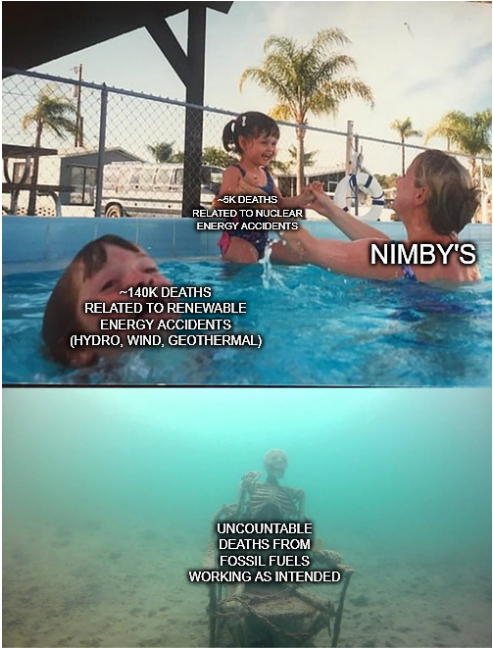

Nuclear is cool. With proper regulation, it’s amazing!
BUT, it’s not what we must be focusing on right now. Renewable sources of energy are safer and much MUCH cheaper to implement than nuclear. Also, renewables don’t require decades to come online.
So, “why renewables? Just go nuclear brooo” is a bad bad argument, likely made in bad faith by OnG companies to delay implementation of renewables.
The goal should be “how do we go from the status quo to a non GHG emitting source of energy generation as fast as possible?”.
I live by a bunch of nuclear plants. One day, I got a text alert from the government saying something was going on at one of the nuclear plants. I decided I was probably already going to die and the went back to watching porn on the toilet. I will have my dream of being an environmental telling skeleton.
There is no one ideal energy source. The best approach is, as always, to diversify. Relying completely on one source is irresponsible. Nuclear with renewables is a fantastic mix. Especially in countries that can’t reliably generate significant amounts of electricity with hydro.
Renewable sources of energy are safer
They’re actually not, generally speaking. All types of renewable energy, with the exception of solar, cause more deaths than nuclear does.
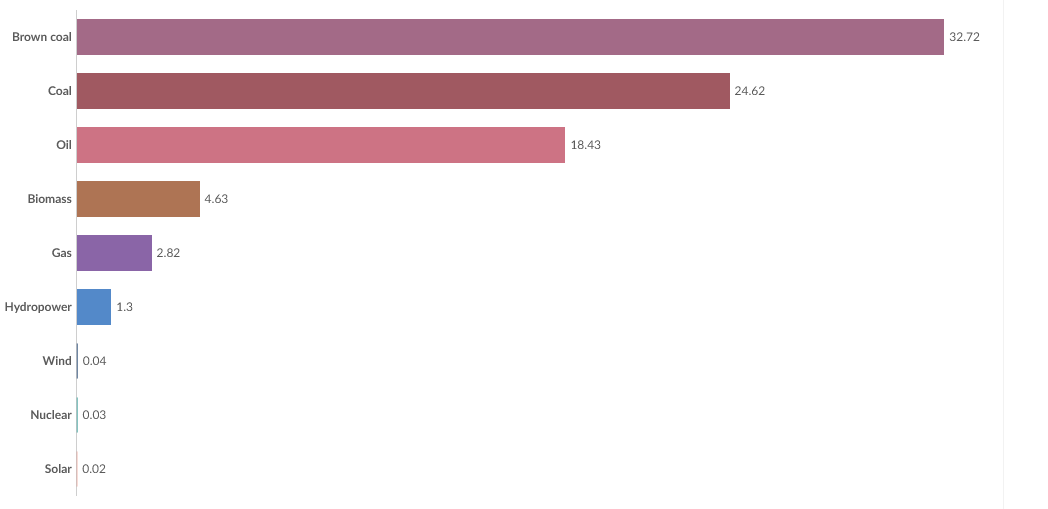
- https://ourworldindata.org/grapher/death-rates-from-energy-production-per-twh
- https://cheatsheets.davidveksler.com/deaths-per-terawatt-hour.html
Some articles report slightly lower death tolls for renewables, but don’t provide any sources for that data. Geothermal energy, which neither of the two sources above includes for some reason, sits right next to wind, so slightly above nuclear in terms of deaths caused per terawatt-hour.
I didn’t include geothermal because of how rare it is. We don’t all live in Iceland.
For electricity true. But lots more places can take advantage of ground source heat pumps as an energy efficient heating method.
You can drill down to get to the heat. The problem is the people with the skills and equipment needed to do this all work for the oil industry.
Yes but no. But yes.
Fault lines, water tables and permabality of rock are major constraints.
Sure it wouldn’t be as easy as in places like Iceland, and I’m sure it would mean figuring out a lot of issues. And yeah, you wouldn’t be able to do it literally everywhere, but it probably would work in a lot more places than Iceland. But there’s currently no incentive to even try.
Nuclear doesn’t compete with wind and solar. You can put up wind and hydro cheaply and quickly almost anywhere, and that’s great and all and we should honestly subsidize manufacture inside Europe rather than just rely on buying from China.
But you still need base load and nuclear is the only option that makes any sense on scale from an ecological perspective. Hydro is highly situational and almost always a worse option for the environment, as well as for safety. Coal plants should never be an option.
So yeah, just go nuclear bro.
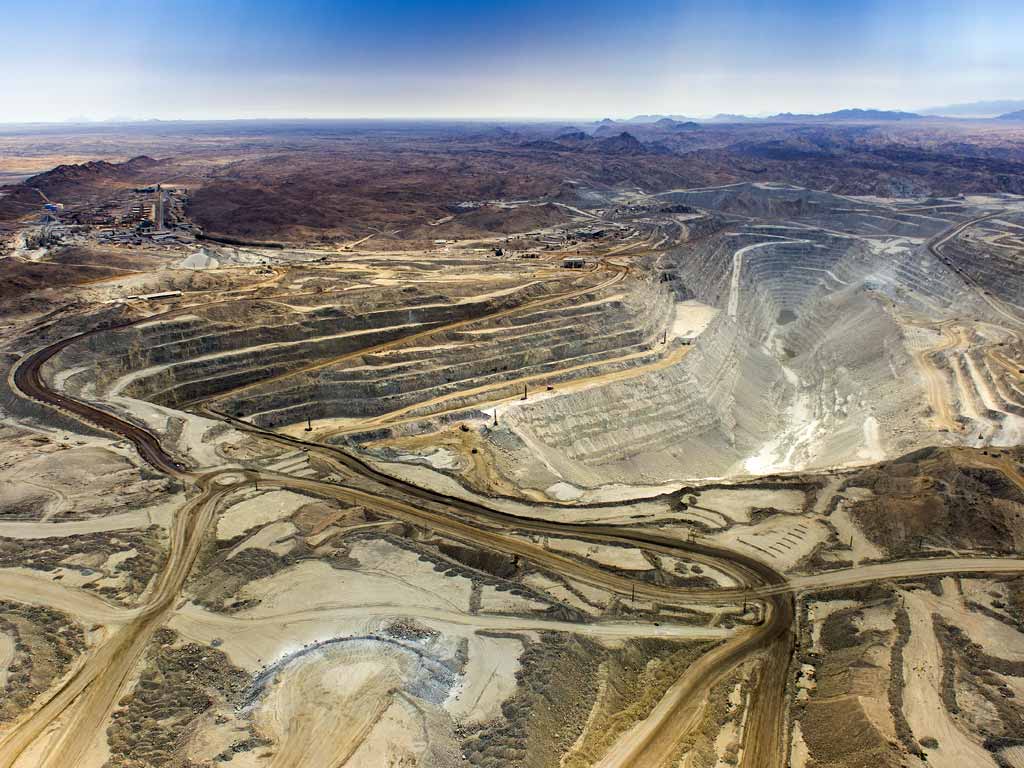
Yeah nobody ever died here (an uranium mine) and you absolutely don’t need any fossil fuel to make it works.
Nuclear energy is better than fossils, but it’s far from green.
Nuclear is very green.
Source: Watching too many Simpsons episodes in my misspent youth
Are the fossil fuels used to create wind and solar power are also unavoidable?
Absolutely. If you broaden the scope to include R&D, mining, transport, manufacturing, service, and disposal, you can’t eliminate fossil fuels from everywhere. And if you widen the scope even further and look at the absolute numbers, it’s very clear: even if the share of renewables in total energy production grows, fossil fuel use still increases in absolute terms. Renewables do not replace fossil fuels; they add to the energy mix. There is no transition. That doesn’t mean we shouldn’t use them, because they are faaaar better than “pure” fossil fuels and better than nuclear. It just means we shouldn’t think of them as the solution. They are not green; green energy simply does not exist. The only solution is degrowth. And it will happen, with or without humanity’s consent.
Nuclear causes the fewest deaths out of all available energy sources, except solar, which is a tiny bit lower in that regard. Both wind and hydro have a higher death toll, with wind being just slightly above nuclear, and hydro being a lot higher (about 40x more deaths).
https://ourworldindata.org/grapher/death-rates-from-energy-production-per-twh
Usually I wouldn’t cite this source, but in this case their data matches other, more trustworthy ones, and is the first that shows up in search engines.
It also have a bit of due to regulations making sure people who work on nuclear are way more compentent, while other green energy infrastructure can be built by rando workers like your roads and such. Kind of similar to how air travels are the safest only because of strict protocols and requirements to work on it.
This is probably true when it comes to wind, but deaths from hydro is all about dams breaking.
Almost all deaths from both nuclear and hydro are caused by major accidents like Chernobyl or the Banqiao Dam.
Which makes you think, considering coal power plants still cause infinitely more deaths - and that’s just standard operation.
Exactly. Also the deaths from coal are not contained to a single spot.
Just the radioactive damage from coal under normal operation is worse than the radioactive damage from nuclear disasters.
Open pit mining doesn’t require that much energy or labor, and they’re relatively safe for the same reason because being underground is much more dangerous.
Still more risky than constructing a windmill, which was what OP’s post was about.
Those deaths are counted in my 5 k
You actually don’t need any fossil fuel to make it work. You just have to electrify the mining machinery then you can power it with solar, wind, hydro and nuclear.
“You just have”… that wishful-thinking and technosolutionism.
China is doing that. It does make sense as mining operations tend to also are far out so not needing to send fuel in would allow the less dense battery to pay itself off if the operation goes long enough.
Electrification of the operation also could benefit if we get better technique to process nuclear to convert some of them to energy on site
We literally have them in use already but ok… https://www.youtube.com/watch?v=ZH8xyFzSMc0 as Ev’s continue to replace autos they become cheaper than diesel.
that wishful-thinking and technosolutionism
you should direct that to the 5 people who have said grid scale batteries in this thread
Oh yes of course, a mine only use fuel for their vehicles. You know a whole lot about mining, obviously.
Edit: and I never said that it was technically impossible. It is. But it’s impractical and far too costly in a lot of places, the vehicies need far too much down time so you need more vehicles, the surplus of electricity needed would be a problem in a lot of places, and it would still need fuel for a lot of adjacent needs. And I didn’t even took into account the other destructive “externalities” to mining not strictly related to air pollution, like the destruction of ecosystems, that we still don’t know how to ecologically treat the electric vehicles after they stopped working, or that it would mean more mining to find the ressources to electrify mining… it’s not green. Not at all. An electrified mine is better than an other, but all mines are catastrophes.
And ironically, electrification is better suited for underground mines. You know which mines are mostly underground? Coal mines. Others are mainly surface mines, and electrification is harder for surface mines.
Incidentally, I live in Sacramento, in the California Central Valley, which is desert. Recently, its gotten up to 117° here (which is still low compared to Death Valley).
Solar is awesome.
It is great, I love solar, I just hate when the sun goes down and my rates spike cause my panels are out of the sun.
Battery technology is booming!
Global grid-scale and stationary battery storage capacity *(Most of that is pumped styorage) is roughly 0.45 TWh We need 31,779 TWh to meet global energy demand for a year (2025) so if your running a world wide grid of renewables that means you want enough batteries to cover 25% of that load to cover bad weather events…
Lifepo4 batteries are available at 100$/kWh so… Why waiting for anything global when you can improve your energy bill by yourself?
Got to start somewhere I guess
A sea cow or a land cow?
First one, then the other
I was nearly killed by a cow.
Driving along a country road and one jumped the fence and went in front of my car. As i hit it, it rolled up the bonnet, tore the roof off my sedan and missed my head by fuck all.
Every year on June 10th I buy a giant steak to celebrate survival.
“Yeah, take that, vegans!”
A lot of people fall off roofs during solar installation. But that’s not an externality – these people know the risks, they can ask for higher pay, or choose to wear their PPE properly. The deaths from fossil fuels are mostly externalities.
Of course it’s an externality! They for sure ain’t installing those panels on the inside of the house. Then it would be an internality. Heh.
(sorry, couldn’t resist. /s obviously)
How many cases of cancer are caused by burning fossil fuels and micro plastics from tires? I bet a fucking dick load.
All the nuclear stuff happens in one place, with a few people minding it. But they do have to be super careful and know what they’re doing.
And if there’s a critical flaw in the reactor design (looking at you Chernobyl) it can go very very wrong.
Renewables are all spread out, and a lot more people manage it for the power output.
That also means a lot more people have power-related jobs.
Fossil Fuels, Methane (Natural Gas) and Coal are just ugly all around. But they have really, really great lobbyists.
The RBMK design was outdated 10 years before construction… but yeah lets unironically compare a model T Ford with no automatic controls slop welded together with shit tolerences and barely any control systems to a modern car with sensors and with safety features because they are both examples of a car.
There’s two problems, and the Kurzgesagt two-parter on nuclear fission power discusses them both.
One is that nuclear power plants are long term projects and you’re stuck with what you built, even as improved versions are designed and flaws are discovered with what you have. Yes, sometimes we retrofit our nuclear plants to make them safer (or more efficient, or prettier).
The other is that contractor firms have had a bad habit of just designing the same simple LWRs over and over again, even as engineers have developed designs that are safer, more efficient, more elegant, etc.
But this doesn’t mean either of those can change.
China seems to be leading the way in LSRs. Using water as a modulator is very old tech.
Public trust in governments and the private sector is at an all time low, all around the world. And that’s an earned reputation.
Nuclear energy is a promising solution, but there are risks associated with it that cannot be ignored.
Can you trust a government that can’t even feed it’s poor and house them to properly dispose of all nuclear waste used at scale? I doubt it. Even if it’s done right for a while, that handling will erode because everything in our system does. That’s the problem.
The question isn’t just efficacy of the technology. It’s implementation. Execution. Maintenance. Long term sustainability.
Thorium Salt Reactors eat waste uranium and are capable of creating more uranium form thorium for legacy reactors in a continuous cycle.
implementation. Execution. Maintenance. Long term sustainability.
Fossil Fuel fired power plants?
I’m ok with Thorium Salt reactors. I believe it was Taylor Wilson who suggested they could even use recycled nuclear missile payloads for this system.
Sustainability is relative. It might seem OK for a very long time. Until a future Trump comes along and rips up all the “nuclear red tape” and it leads to a global Chernobyl disaster. At that point, let’s just use solar, wind and other safer options ey.
what about a cow shark.
Thank God. I’ve never even seen a cow, but I swim wish sharks daily. I have a few small cuts that still bleed a bit when I get into the water, and the sharks have been acting a lot more aggressive and bitey than normal.
I was really starting to get worried until I saw this post.
You can say that but I remember Fukushima. The damage caused by the Fukushima meltdown cost more than the power company’s total profits in Japan over the previous 40 years.
So keep telling me that nuclear is safe, and I’ll keep pointing to the damage it is guaranteed to cause. Low risk high consequence situations are the hardest to regulate. And you’re risking your entire city, all at once, everything in it.
But look, the real question is what new sources to build. Current sources will stay online for years or decades. For new production, the cheapest by far is solar, followed by wind, as long as the externalities are dumped back on the utilities. Also, home solar means the utilities can’t price gouge you.
The cost was because people like you dont understand low dose exposure and stick to the LNT model for radiation exposure. So they literly dug out the ground and removed all traces of radation. On paper that sounds great till you realize that nothing is radiation free and this was essentially a massive theatrical production of mopping the rain.
People never hesitate to show that feels > reals
You can say that but I remember Fukushima. The damage causes by the Fukushima meltdown cost more than the power company’s total profits in Japan over the previous 40 years.
And it’s a mistake that will never happen again, as this accident immediately triggered a ton of retrofitting across the nuclear reactors in use specifically to cover the eventuality that Fukushima showed us.
Now compare Fukushima to the ongoing effects of fossil fuel plants, and the deaths caused. What do you think caused more deaths, Fukushima, or stopping all nuclear plants in the country? This paper argues that the shutdown caused an increase in mortality (people freezing to death over winter due to up to 40% higher energy costs) ultimately killing more people than radiation exposure (emphasis mine):
To put these estimates in context, we calculate that the higher electricity prices resulted in at least an additional 1,280 deaths during 2011-2014. Since our data only covers the 21 largest cities in Japan, which represents 28 percent of the total population, the total effects for the entire nation are even larger. Meanwhile, the number of deaths due to the Fukushima Daiichi nuclear accident is much lower. No deaths have yet to be directly attributable to radiation exposure, though projections estimate a cumulative 130 deaths (Ten Hoeve and Jacobson 2012). An estimated 1,232 deaths occurred as a result of the evacuation after the accident.7 Therefore, the deaths from the higher electricity prices likely outnumber the deaths from the accident in only four years if we extrapolate our estimates to the entire country, and almost certainly outnumber the deaths over a longer time period given that the higher electricity prices persisted beyond the end of our study. This suggests that ceasing nuclear energy production has contributed to more deaths than the accident itself.
So keep telling me that nuclear is safe, and I’ll keep pointing to the damage it is guaranteed to cause.
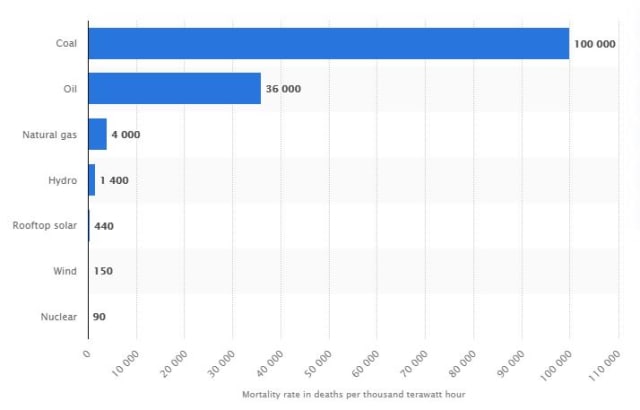
Nuclear power is the safest form of energy per TWH. Tell me again how much you care about guaranteed damage caused by an energy source. Nuclear may have a large local impact, but that’s not remotely comparable to the global environmental impact that fossil fuels have, both in premature deaths and impact on the climate. Shutting down nuclear before you have a non-fossil fuel base load source in the name of safety is spending dollars to get pennies.
And you’re risking your entire city, all at once, everything in it.
Out of over 660 plants over 60 years, there’s been 3 ‘major’ accidents, of which only one of them was even close to what you’re describing. Fukishima has close to a quarter million people living there today. Heck, even the small town of londonberry township (3 mile island) has almost 5000 people in it.
Your argument is based in hysterics, not reality.
You deserve a standing ovation for this comment.
There’s been what, three disasters total similar to the one in Fukushima? And remind me, how many people died from that one? Was it one guy?
it isnt about the total DC its about lasting damage in the affected people and environment
Just to be clear, I’m not claiming that nuclear is not problematic. It is. But the lasting damage from ultra rare major disasters is like a decade of topsoil contamination.
You can compare nuclear to hydro and coal, because those are the similar sources that can produce base load electricity. In that group, nuclear is by far the least problematic.
Are you suggesting that Fukushima did more lasting damage to the environment than the fossil fuel industry…?
Ah yes, surely we should go nuclear! It’s not like countries depending on nuclear energy have to shut them down during summer, which will only get worse every year
Also this meme is just wrong lol. NIMBY culture against wind energy is so much more stronger (to be fair, because of other reasons though)
Best I can see, summer shutdowns are primarily caused by extended spring maintenance. Is there some more concrete reason summer shutdowns happen?
Ohh damn, yeah that’s spicy. The ones near me are on deep water with dams on the river afterward.
The Danube goes a really long distance in between the mountains and the plant. That is certainly not getting better any time soon.
France has similar problems afaik for 4 years now
To my knowledge Francis issue is discharge temperature not inlet height but I’m not French.
Both. Cattenom and Chooz are closed right now because there’s not enough water. And some are constructed near the sea to not have this problem. But with the see level rising, the problems will come soon.
When you burn the remains of these ancient life forms it releases their ghosts and that’s what kills so many when they breathe haunted air
Absolute numbers are meaningless. It needs to be weighted against how much electricity was produced with each.
(And why is solar not mentioned? Plenty of solar installers die from falling off of roofs and whatnot.)
I would also normalize against their frequency. Because if a tech is not used that often for being considered dangerous then of course it can show a low absolute number of deaths.
But then again is a no brainer to tell that this kind of comparison is ill intended from the get go.
The trope defending nuclear energy has always been “too loud” for my “taste”. It’s like mainstream politics, missing the point of why something is actually good and then spouting cherry-picking “facts” but indeed doing propaganda nonetheless.
On the site there is also a direct comparison: https://ourworldindata.org/grapher/death-rates-from-energy-production-per-twh
Grouping Hydro with other renewables is not very nice for wind and solar, which are pretty safe - with the added benefit of being cheaper than nuclear power.
And Nuclear is on par with the safety of solar and wind but you seem prompt to forget that. Your also not counting the cost incurred by renewables being non continuous sources of power. So yes it is cheaper to run a wind or solar farm untill you have to kick on the peaker plant cause the wind died and teh sun went down unless your in one of the super rare places that has pumped storage.
That is outdated information, renewables + battery storage have become cheaper than nuclear power.
Side note, not relevant to discussion:
And Nuclear is on par with the safety of solar and wind but you seem prompt to forget that.
This feels rude. Your post already mentions safety of nuclear power as does the link I posted. Just from the fact that I did not reiterate that information you insinuate an opinion on my side that I did neither write nor imply.
why is solar not mentioned >Because when a accident happens on a solar farm its one guy eating a few KW or falling not entire towns worth of people being erased.
Because when a accident happens on a solar farm its one guy eating a few KW or falling not entire towns worth of people being erased.
So, killing people one by one doesn’t matter – only matters if a lot of people die at once?
im not here to play the trolley problem with you. Solar is the safest. It just doesn’t run all day so to compensate we need something that does like nuclear.
DEATHS per TWH
Nuclear is actually a very poor fit for baseline power because of the high costs involved and the problem of it being expensive and slow to turn on or off. Kept turned off, nuclear is a massive money bleeder which is why investment companies rarely touch them.
Because solar and wind are variable, you need a baseline that’s also variable to be able to quickly compensate. The only real viable options are battery power (harder to scale), hydro (geographically limited) and unfortunately gas power plants (polluting, but cheap). Nuclear is excellent stable power, good if solar/wind are never able to reach 100% of needs, but multiple countries have now shown that that is very much within the realm of possibilities.
Biggest issue with nuclear remains cost, excessively long time to build and if there’s a drought you don’t get enough water to cool with so you need to switch it off (see Hungary and France these days to see the very expensive consequences of that).
Biggest issue with nuclear remains cost, excessively long time to build and if there’s a drought you don’t get enough water to cool with so you need to switch it off (see Hungary and France these days to see the very expensive consequences of that).
Sigh, thats not how any of that works. The plants can run fine in an environment that is much hotter than current the issue is the water they would release back into the river would be hotter than the fish like and cause lower oxygen concentrations as the water temp rises. Its an enviromental protection law and could easily be solved by just not dumping the water directly into the river and instead using it for other industrial and utility purposes till it cools. You should read into this.
Maybe you should read into it more, because what you said is blatantly wrong.
The Paks power plant in Hungary takes water from the Danube, but due to the drought the water level dropped to a mere 23cm. The suction nozzles physically can’t reach enough water. It’s an intake problem, it’s not an issue with pumping it out again or storing it until the water cools.
Here’s an article that mentions this: https://www.bbc.com/news/articles/cn0nqv05g0do
The Soviet-era Paks power plant uses the Danube for cooling but the water level is so low that the suction nozzles cannot reach it.
So in other words: when there is already a heat and probably drought problem, let’s extract even more water from the river than before? Smart! That’s totally not going to be an environmental disaster.
Ah yes lets re-engineer the water intake to force more water through the heat ex changer rather than checks my comment above : not dumping the water directly into the river and instead using it for other industrial and utility purposes till it cools.
im not here to play the trolley problem with you.
No, no – I’m here for the trolley problems!
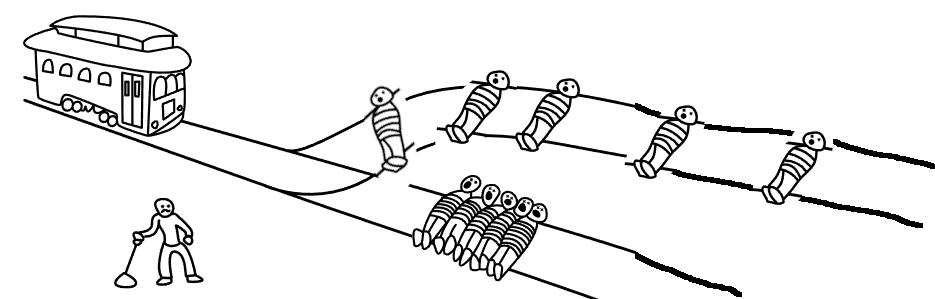
Let’s fucking go!
You are the conductor of the train the switch track is ahead there are two lines of equal length between you and your destination both 1000km long. one is clear 999km and has one guy on the last km of track before your station. The other line has 83 guys tied up over the next 1000km basically one per 120km.