Came to say this! Drug addicts need help, not jail. Sure, if they commit a crime police should be involved, but it’s not going to cure their addiction!
Idk. I’m a public bus driver, am in pretty consistent contact with drug users. Not to mention living in amongst them in the poorer areas of tow. I’m not saying we should arrest them and give them lengthy sentences, but just leaving them on the street ain’t working out.
I think a mandatory “time out” in a facility is in order. At least long enough to work the drugs out of their system. Maybe then they can try for a better way with a little clearer head.
But some days it feels like I’m living in a post apocalypse mad Max type place. It’s bullshit that they’re allowed to just trash anyplace they are. There’s what’s best for them, and there’s what’s best for the rest of us. There’s gotta be something done.
Edit: downvote me all you want, just leaving the problem to fester as we are now is neither kind nor progressive
Their “mandatory time out” doesn’t have to be punitive, or handled by the penal system at all.
Step one: outreach and detox
A social worker could show up and interview them, ask them if they want help. If they do, great. Get them in a car, take them to a detox center. If someone doesn’t want to go with the social worker (which might be a majority of patients), then the social worker gets their name and contact info if they can, gives them some brochures about the program and about the benefits of recovery, and moves on to interview others.
about non-compliant/unwilling patients:
That’s just the first pass. Another social worker comes by on another day and sees if anyone changed their mind, and if so, great, they take them to the detox center.
Eventually though, something will need to be done about those who are unwilling to go; for their own benefit as much as anyone else’s. This should not be done by police though. There needs to be a special task force of social workers who are trained in self-defense, weapons handling, de-escalation, non-compliance, and least-necessary-force techniques.
Basically, they show up sometime after the second or third pass and sweep up anyone who wasn’t willing to go. They take them to a special detox facility, still a comfortable and professional clinic, but with higher security in place, so that these patients won’t present problems for the ones who went willingly.
If they detox successfully and their behavior improves significantly, they can be given an option to move to the next step with the others. If they remain belligerent or hostile, however, they need to be taken to a special higher-security version of it where they won’t be a barrier to others’ recovery. (Again, a clean and professional facility, but the staff have more specialized training for dealing with non-compliant patients).
Step two: residential recovery
After they detox, transfer them to a residential recovery program with a structured regiment, complete with in-house psychosocial therapy, prescription management, and recreational therapy.
Step three: vocational therapy
When they graduate from this program, get them into vocational therapy or a job training program, with the option to either live on their own (if their recovery has progressed well enough), or have them move into a smaller share house with a peer recovery coach.
That’s a three-step approach:
(outreach)→detox→recovery→reintegration.
By the end of it they’ll be an active contributing member of society, have community support, hobbies, be enrolled in therapy, have their prescriptions managed, and have someone to check in on them periodically to help them maintain the good habits they’ve developed.
Step four: return to full independence
After maybe a year in the transitional housing then they get support searching for their own place and return to full independence with a year of sobriety under their belt, but they keep access to the same therapists, recreational groups, prescription management, and can keep in touch with their peer recovery coach.
It sounds expensive, and it does require a lot of real estate, personnel, trained professionals, food and healthcare, etc. But with how much we already spend on police and prisons, it might actually save the taxpayers money in the end. Especially with universal healthcare; this would be harder to implement in the US where prescriptions can cost over $1000 per month for no reason, but universalizing healthcare first will make it more feasible.
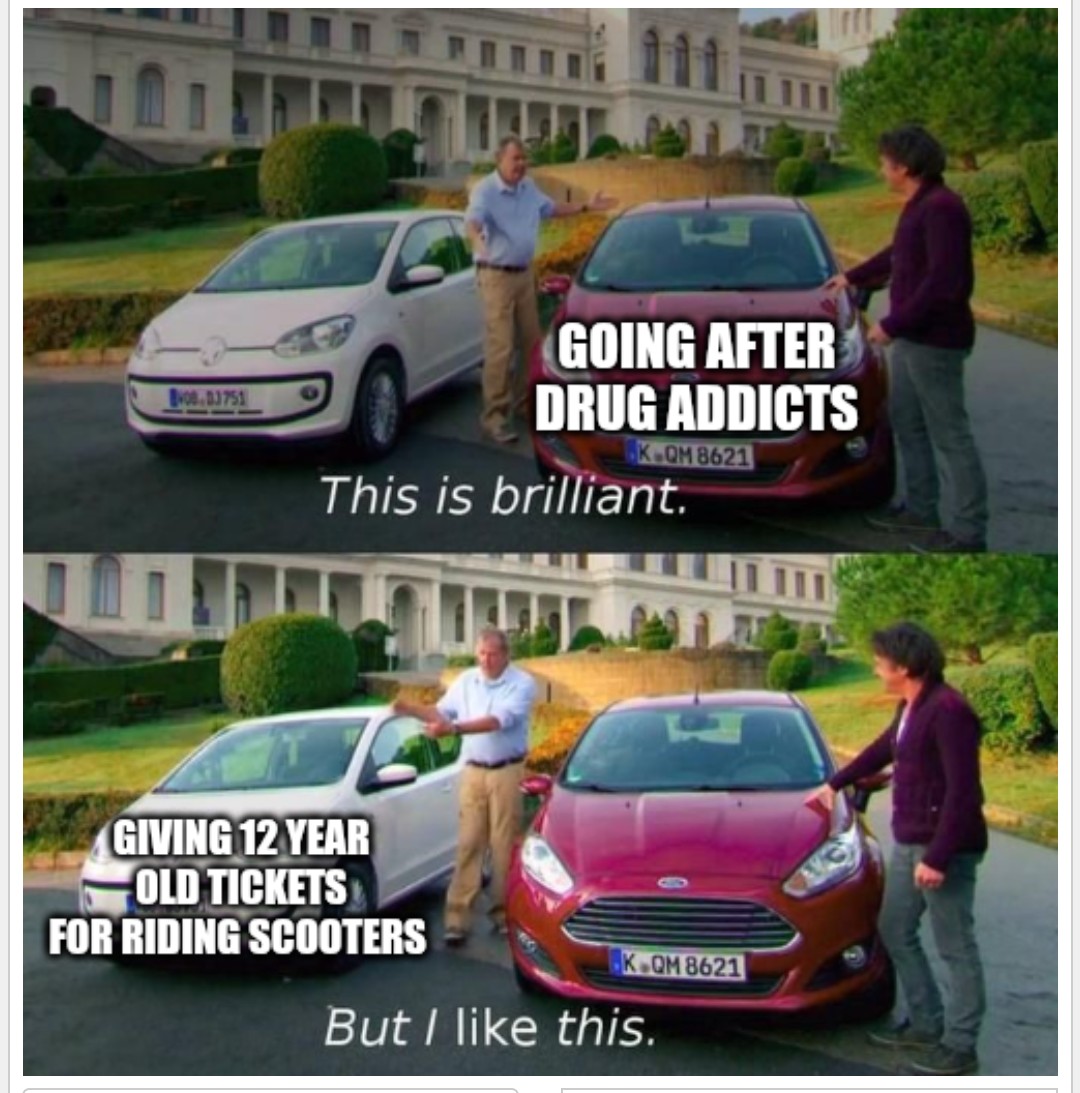
I mean if you want to get specific what I really want is to remind police that doing drugs is illegal and they should focus on busting those people…instead of kids having fun on scooters
Findings: MCDA modelling showed that heroin, crack cocaine, and metamfetamine were the most harmful drugs to individuals (part scores 34, 37, and 32, respectively), whereas alcohol, heroin, and crack cocaine were the most harmful to others (46, 21, and 17, respectively). Overall, alcohol was the most harmful drug (overall harm score 72), with heroin (55) and crack cocaine (54) in second and third places.
riding scooter at 12 seems to be illegal too in vancouver, and people have fun on drugs too, so seems to me both things are pretty much interchangeable in your argument
Busting drug addicts will do ZERO to help the drug and crime problems. Even law enforcers will tell you that.
Those problems are so much more complex, and require fundamental reforms in social policies, mental healthcare, education, youth programmes, city planning etc. And then there’s the issue of dealing with the gangs, smugglers and foreign organized syndicates bringing the stuff into the country.
Kids driving recklessly on scooters (which are often modified) are:
A) A danger to themselves
B) A danger to pedestrians they could crash into
C) A serious danger to cars that swerve to avoid them when they go out on the main road.
Putting someone in timeout maybe works for three year olds but it doesn’t work for adults even if you hold them there 1000 times longer. Restitution and rehabilitation is a significantly more effective solution and results in much lower recidivism. Only reason to lock someone in a box is if they present a significant danger to the public, and that’s not to punish them, but to protect others.


Came to say this! Drug addicts need help, not jail. Sure, if they commit a crime police should be involved, but it’s not going to cure their addiction!
Idk. I’m a public bus driver, am in pretty consistent contact with drug users. Not to mention living in amongst them in the poorer areas of tow. I’m not saying we should arrest them and give them lengthy sentences, but just leaving them on the street ain’t working out.
I think a mandatory “time out” in a facility is in order. At least long enough to work the drugs out of their system. Maybe then they can try for a better way with a little clearer head.
But some days it feels like I’m living in a post apocalypse mad Max type place. It’s bullshit that they’re allowed to just trash anyplace they are. There’s what’s best for them, and there’s what’s best for the rest of us. There’s gotta be something done.
Edit: downvote me all you want, just leaving the problem to fester as we are now is neither kind nor progressive
Their “mandatory time out” doesn’t have to be punitive, or handled by the penal system at all.
Step one: outreach and detox
A social worker could show up and interview them, ask them if they want help. If they do, great. Get them in a car, take them to a detox center. If someone doesn’t want to go with the social worker (which might be a majority of patients), then the social worker gets their name and contact info if they can, gives them some brochures about the program and about the benefits of recovery, and moves on to interview others.
about non-compliant/unwilling patients:
That’s just the first pass. Another social worker comes by on another day and sees if anyone changed their mind, and if so, great, they take them to the detox center.
Eventually though, something will need to be done about those who are unwilling to go; for their own benefit as much as anyone else’s. This should not be done by police though. There needs to be a special task force of social workers who are trained in self-defense, weapons handling, de-escalation, non-compliance, and least-necessary-force techniques.
Basically, they show up sometime after the second or third pass and sweep up anyone who wasn’t willing to go. They take them to a special detox facility, still a comfortable and professional clinic, but with higher security in place, so that these patients won’t present problems for the ones who went willingly.
If they detox successfully and their behavior improves significantly, they can be given an option to move to the next step with the others. If they remain belligerent or hostile, however, they need to be taken to a special higher-security version of it where they won’t be a barrier to others’ recovery. (Again, a clean and professional facility, but the staff have more specialized training for dealing with non-compliant patients).
Step two: residential recovery
After they detox, transfer them to a residential recovery program with a structured regiment, complete with in-house psychosocial therapy, prescription management, and recreational therapy.
Step three: vocational therapy
When they graduate from this program, get them into vocational therapy or a job training program, with the option to either live on their own (if their recovery has progressed well enough), or have them move into a smaller share house with a peer recovery coach.
That’s a three-step approach:
(outreach)→detox→recovery→reintegration.
By the end of it they’ll be an active contributing member of society, have community support, hobbies, be enrolled in therapy, have their prescriptions managed, and have someone to check in on them periodically to help them maintain the good habits they’ve developed.
Step four: return to full independence
After maybe a year in the transitional housing then they get support searching for their own place and return to full independence with a year of sobriety under their belt, but they keep access to the same therapists, recreational groups, prescription management, and can keep in touch with their peer recovery coach.
It sounds expensive, and it does require a lot of real estate, personnel, trained professionals, food and healthcare, etc. But with how much we already spend on police and prisons, it might actually save the taxpayers money in the end. Especially with universal healthcare; this would be harder to implement in the US where prescriptions can cost over $1000 per month for no reason, but universalizing healthcare first will make it more feasible.
Yes! This looks great! Idk who you are or where you live, but ya got my vote.
I’m not in canada, sorry :/
Doing drugs is a crime tho.
So was helping slaves and Jewish people. Your point?
This guy reminds teachers they forgot to give out homework…
I mean if you want to get specific what I really want is to remind police that doing drugs is illegal and they should focus on busting those people…instead of kids having fun on scooters
Why is doing drugs illegal?
In the US it’s so they can give black people felonies for being black so they can’t vote.
That’s literally what started the war on drugs. Well, blacks and hippies.
This is also why alcohol, which is a way more harmful drug to others than all of the illegal drugs[1], is legal.
[1] https://pubmed.ncbi.nlm.nih.gov/21036393/
Because they won’t share with me :(
Because of the law
“Drugs are illegal because drugs are illegal”
It seems you’re stuck on Step 4 in Kohlberg’s Stages of Moral Development:
Do you mind me asking how old you are?
edit: never mind it says it in the meme you created.
Kids having fun on scooters doing illegal things.
One is a felony the other a misdemeanor
Fun fact: Vancouver is in Canada, and in Canada there’s no such thing as a felony or a misdemeanor.
This guy lawyers
riding scooter at 12 seems to be illegal too in vancouver, and people have fun on drugs too, so seems to me both things are pretty much interchangeable in your argument
Busting drug addicts will do ZERO to help the drug and crime problems. Even law enforcers will tell you that.
Those problems are so much more complex, and require fundamental reforms in social policies, mental healthcare, education, youth programmes, city planning etc. And then there’s the issue of dealing with the gangs, smugglers and foreign organized syndicates bringing the stuff into the country.
Kids driving recklessly on scooters (which are often modified) are:
A) A danger to themselves
B) A danger to pedestrians they could crash into
C) A serious danger to cars that swerve to avoid them when they go out on the main road.
Being this stupid should be illegal.
So was giving shelter to undesirables in Nazi Germany. Laws are not inherently moral.
So is what the kids are doing. So…?
No is not
The temporary decriminalization of doing drugs in British Columbia expired in January 2026
So doing illicit drugs like crack or fentanyl on the streets is currently illegal again.
Again i said NO IS NOT
Putting someone in timeout maybe works for three year olds but it doesn’t work for adults even if you hold them there 1000 times longer. Restitution and rehabilitation is a significantly more effective solution and results in much lower recidivism. Only reason to lock someone in a box is if they present a significant danger to the public, and that’s not to punish them, but to protect others.