

Reasonable players will ask Sony to suck their dicks.
I think the real problem with this is what we’re seeing with software distribution in general. They say, “yes you’re buying a license to the software.” Which in general we have accepted. But at the same time companies get to change the terms of the license at will. And the license is worthless after just a few years as the software becomes defunct.
This is even more pronounced in videogames as once they’re past a certin time if they arent part of a popular catague they just disappear. At least with old games abandonware can be found because the game data is still on old media. In this new ecosystem the publisher can now delete that data off your device whenever they decide that game is abandoned. This includes if the owner of the game hasnt played it in too long. And if you get nostalgic for a classic, “buy it again as part of our subscription service.”
I guess I’m an unreasonable player, when they put a big “Buy” button I foolishly assume I am buying it.
Sony is taking heat, rightfully so, and I hope this changes things, but this is a more pervasive problem. Plenty of other companies do the same thing. I hope future rulings change how all companies operate when it comes to digital sales of games, movies, and music. What that looks like, I don’t know. Maybe lower costs of games that you don’t physically own. Maybe the inability to lock people out of games they purchased even if their accounts are banned for whatever (probably AI decided) reason. Probably many other potential options that would not be anti-consumer.
Because “order” and “add to cart” are metaphors a reasonable person uses for licensing contracts?
Not sure if Sony has updated their store pages, but this is at the bottom of every page. I’m going to assume you also need to confirm you’ve “read the terms and conditions” at checkout.

At least in the European Union, the Unfair Contract Terms Directive and Digital Services Act put strict limitations in what the terms can do, especially if the contract cannot be negotiated individually.
Even in the US laws regarding false advertisement might apply if most of the communication says one thing and the ToS no one reads say another.
EDIT: and Chinese and Brazilian courts already gave indication that the terms are not fully enforceable there.
I know it isn’t the law but I feel like the burden of proof that somebody has actually read and understood the terms and conditions and was of sound mind when accepting it, should be on the company. Who knows, maybe I was just about to read the full thing and went to get myself a cup of coffee, while I was gone my cat stepped on the keyboard and pressed accept. And if the company can’t prove beyond any reasonable doubt that I did in fact read, understood and accepted it, then the Terms and Conditions are effectively nulled.
I’ll probably be jumped on for this but I think that’s a fair presentation of the transaction. When you buy software on physical media in stores the mechanisms are identical to purchasing non-licensed items, yet you’ve never owned those either. They have always been licenses.
Not true at all. I grew up in the age of dial up internet. When you bought software, you owned it. That media was yours to run on your hardware as you saw fit barring certain public/commercial uses, much like you’re not allowed to buy a DVD to make copies and distribute it on your own.
However, the expectation of exchanging money for ownership is about as old as money itself. If we were talking about, say, a blacksmith and their craft that you paid solid gold for, you would therefore be okay with the blacksmith showing up one day to reclaim their iron because you only purchased a license to his materials and not the ownership of the product? I don’t see that being acceptable to you. What makes software different, especially when it doesn’t require internet connectivity to actually function? I don’t need connectivity to access locally stored media, and fuck Sony for reaching into anyone’s account and deleting access to something they bought, full stop.
No, it’s always been buying a license to use a copy of the software. Even before the internet.
If you had actually bought the software you’d have the source code and distribution rights.
This is on the first page of the manual for Blizzard’s 1994 video game “Warcraft: Orcs & Humans” Does this sound like you own the game? Games have always had licences, they’re much more restrictive now, but they’ve always had licences.
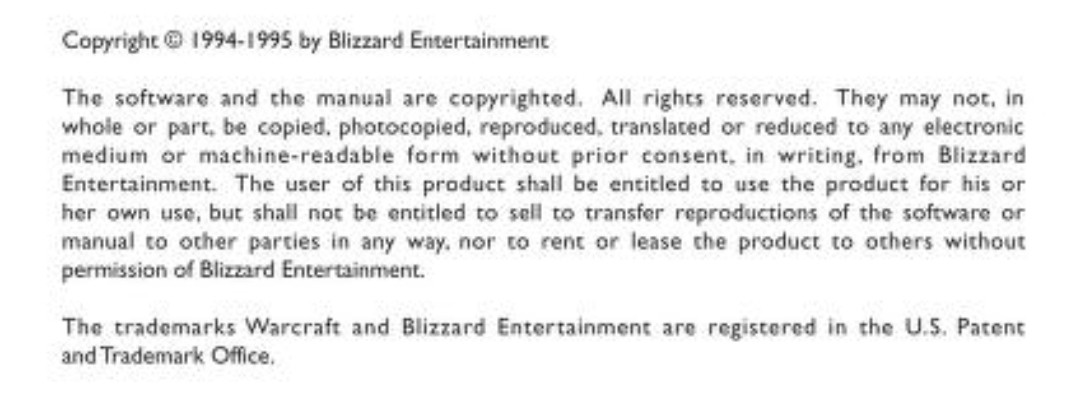
A) That was physical media and so by default falls into the ownership system wherein possession is nine-tenths of the law. Neither Blizzard nor anyone else particularly cares about your Warcraft CD these days.
B) There is zero indication in that document that Blizzard has any plans or designs to walk into your house and rummage through your drawers to take away the game you bought from them. Additionally, all you did was reinforce what I said in my first post - barring reproducing the product for personal profit, do whatever the fuck you want with it is what they effectively said in legalese.
You owned the licence for that physical copy of the game.
They just didn’t have a real way to revoke that license back then.
I completely agree it’s not a restrictive licence and people basically did whatever. The next page of the manual talks about the installation CD being used as a form of DRM. The game requires the installation CD be in your computer to launch the game. No-CD patches were very common at the time because of that and there was nothing Blizzard could really do about them. Licences and DRM have always existed, they just weren’t as restrictive in 1994.
The difference between “you used to own your games” and “games used to have less restrictive licences that were difficult to enforce” is trivial in everyday discussion. I only point it out because it explains the statements by Sony’s lawyers. Legally speaking, nobody has ever owned their games. Even SuperTuxKart has a licence.
It’s unfortunate that anything less than demanding CEOs be shot in the head gets downvoted, but that’s just online discussion today. I don’t like restrictive licences either. It’s why I use Linux and not Windows. Thankfully, people have a choice in the software they use and the games they play. I’m just not going to buy from Sony again. Problem solved.
Nobody is demanding Microsoft have a less restrictive licence for Windows. I don’t understand why the games Microsoft publishes are treated differently than the rest of their software.
When a company advertises a game for purchase, a reasonable person would expect to purchase a buy-once perpetual license to play the game as long as copyrights and online code of conduct are respected. Otherwise, it’s only a rental, not a purchase. Geez, if this is a class action, let me in on it! Sony is full of shit.
Exactly. I would only expect to lose the license if Sony went out of business and was no longer running the servers and did not make arrangements to let the software owners licenses continue after that, which a decent business would do.
Remember back in the day when any consoles and games you purchased worked regardless of whether the company behind either went bankrupt?
Pepperidge Farm remembers
If only one Person can own gta6, what follows would be that a Copy of gta6 would not be the one Product called gta6, since it would be unreasonable to assume, that this Copy was the one original Product. Since no Product was involved no theft has taken place. Sony still has its Product. No one Else is in Control of it. It would be unreasonable to assume the Copy was the Product.
They actually argued the opposite. They’re trying to claim that if they sell a copy of GTA6 that confers ownership, then they can only sell one copy ever.
The real battle here is about DRM and the ability of these games companies to stop people being able to play games, resell and do ownership things with their games. This is going to require government intervention that much has been clear for a long while.
And any reasonable jurist or judge knows you’re ripping off your customers.
Which is why the person suing should have a jury trial of reasonable people.
Seems like they’re saying if it was a disc, I’d have ownership of that disc. But since it’s digital, I have nothing.
You own the disc, you own the physical representation of its content. You don’t own the means to (indefinitely and irrevocably) use it’s contents. Or something along this line
If that’s their metric from reasonable, then there are no reasonable PlayStation players.
deleted by creator
deleted by creator