Imagine living in Lebanon and not being a millionaire…
Even normal people there live in houses worth billions of Lebanese Pounds.
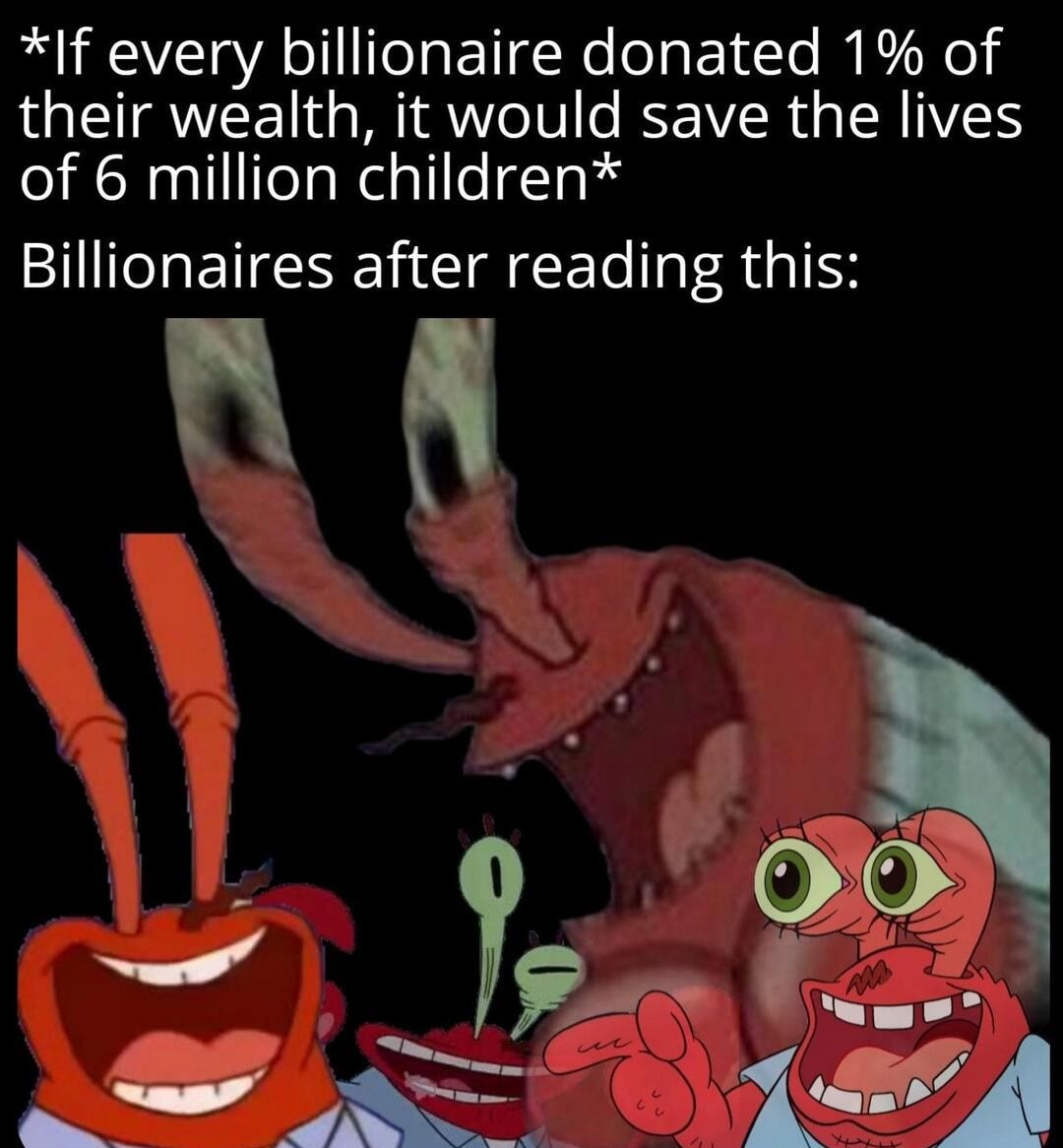
The net worth of the world’s billionaires is over $16 trillion in 2025¹. 1% being 160 billion. On average, around every 4000 USD send to the most effective charity saves someone’s life². So around 40 million children.
This doesn’t account, of course, for the difficulty of selling large amounts of stocks without them losing value and the fact that, as low-hanging dangers are depleting, each subsequent child would be more costly to save.
¹ Wikipedia contributors. (2026, August 3). The World’s Billionaires. In Wikipedia, The Free Encyclopedia. Retrieved 18:47, August 11, 2026, from https://en.wikipedia.org/w/index.php?title=The_World’s_Billionaires&oldid=1367525482
² GiveWell. (2026, February). How Much Does It Cost To Save a Life? https://www.givewell.org/how-much-does-it-cost-to-save-a-life
First and foremost, there’s no such thing as a “communist country”. Communism is a very late stage of socialist development when all class contradictions have been abolished. We don’t know what that might look like, but the consensus is that we can’t really talk about a country being communist but rather an overall state of the world.
Secondly, China has a fairly good grip over its billionaire class. They don’t have the class power their class has in the US, Europe, or the rest of the western capitalist world. The capitalist class in China is subject to the wishes of the working class represented by the party with its over 100 million members.
100% they have a class based system it’s just not talked about.
They do have a bourgeoisie class and a peasent class.
They have doctors, lawyers, construction workers, government employees, billionaires and unprecedented wealth within families.
Then they have the peasant class the rice paddy farmers, the package sorters, the food delivery drivers, the minimum income workers living in cramped apartments and the unemployed.
100% they have a class based system it’s just not talked about.
It’s literally on their flag though. Those stars aren’t just decoration, they stand for the peasants, workers, petite bourgeois and national bourgeois, unified and led by the big star: the communist party, and its allies.
China is a people’s republic, which historically would mean that those various class strata would be represented in government, by various parties and mass organizations. Not just a single communist party (see, East Germany, Socialist Poland, or the early DPRK). As China has developed its productive forces, however, a decision was made to allow the Bourgeoisie to be an element within the communist party itself, so they couldn’t form their own separate base of political power. While that brings contradictions, they’re far more manageable than they would be otherwise.
They’re pretty open about all of this.
Yes, that’s why it’s not communist. But it is socialist, because the working class controls the government and holds the reins of the economy.
The 200 million rural farmers control the country!
No wait, the 400 million service workers control the country!
No wait, it is the 500 million middle class that control the country!
No wait, it is the 130,000 of the wealthy class that controls the country!
No wait, it is the 320 billionaires that control the country!
No wait, it is the 2,878 Congressional members that control the country!
No wait, it is seven leaders who control the country!
No wait, it is Xi who controls the country!
wacky shit, aint it.
Yes, exactly like the working class in the US controls the government and holds the reins of the economy.
Except not. Tell me more about how ignorant you are about political economy theory and how China actually functions.
ohhhhhhhhhhh it’s evolved. I’m going off of an old system:
Class structure and earnings
In the last half century, China’s class structure has undergone a major transformation, evolving from a simple system of three socialist strata (cadres, workers, and peasants) in the pre-reform era to a hybrid class system mixing capitalist features with aspects of the previous socialist class system. The Chinese market-oriented reforms and the expansion of the private sector changed property relations and generated a class structure with striking similarities to that of other capitalist societies (Bian Citation2002). Previous research has adopted multiple approaches to understand the class dynamics and earnings in transitional China. Some research on urban China applies Goldthorpe’s neo-Weberian class theory to the Chinese context (Zou Citation2015) while others have adapted Wright’s neo-Marxist class framework to explain class-based earnings inequality (Li, Qin, and Chen Citation2012; Lin and Wu Citation2009). Lin and Wu (Citation2009) compared different class schema and concluded that a modified neo-Marxian class approach (albeit one that incorporated hukou) best captured the evolving class structure in transitional China. They also demonstrated that class has become the major source of earnings disparities among Chinese workers.
Source: https://www.tandfonline.com/doi/full/10.1080/21620555.2021.1878019#d1e358
Hukou: https://en.wikipedia.org/wiki/Hukou
Hukou is incorporated into almost every Chinese socioeconomic and political system
deleted by creator
deleted by creator
The capitalist class in China is subject to the wishes of the working class represented by the party with its over 100 million members.
LMAO. Do you actually believe that garbage yourself?
The simple truth is that China is the most efficient capitalist country in the world right now - they combine a totalitarian regime with a huge economy and an actual self-serving but smart understanding of capitalism. They are simply better at playing that game that the rest of the world.
What we don’t see from the outside is to what degree becoming rich enables you to take influence on the political system. What we do see is that the Chinese “communist” (muhaha) party has an iron grip on the country, but also that they are strongly intertwined with what you call “the capitalist class” (i.e. rich parasites).
an actual self-serving but smart understanding of capitalism
Welcome to marxism-leninism. Socialist state building is about achieving progress for the people. That can mean building up production forces and engaging in capitalism, as long as the capitalist class is subject to the peoples wishes.
as long as the capitalist class is subject to the peoples wishes.
Yeah I think that’s the part where you missed the news flash about the Chinese state.
Wordy and condescending but does absolutely nothing to prove them wrong, great job!
Cope
In what way? There’s nothing to cope about
You know exactly what way.
You’re losing and you know it
I’ve never won harder
Embarassing if true
China has maintained enough of a market system to avoid our usual direct efforts at overthrow or embargo, as long as our billionaire ruling class sees their markets as an opportunity outweighing the threat of their government they’ll block any push by our government to interfere with their access to those markets. Not only did that work perfectly but they actually managed to get their greatest global rival to voluntarily de-industrialize and hand the vast majority of our productive capacity over to them without a single shot fired. Every last bit of argument here and elsewhere about whether they’re communist or not is just cope from people whose civilizations have never pulled off anything half that slick in their entire worthless existences.
They do have famously good working conditions, high wages and quality of life. Their working class is in a meat grinder to an extent I haven’t seen anywhere else. Especially unskilled laborors.
Their working class is in a meat grinder to an extent I haven’t seen anywhere else.
Then you really haven’t looked. Chinese working people have paid vacation and sick leave, low-cost public housing in abundance with nearly 90% of the population owning a primary residence, and retirement in the 50s for women and 60s for men. Per-capita debt is about 10% of the American population. The adult literacy rate is 98%, 20-pts higher than their American peers. Life expectancy is eclipsing the US, as theirs rises and ours falls. Instances of suicide are much lower. Incarceration rates are lower. Yadda yadda yadda.
Now compare the Chinese working class to folks living in The Philippines or Pakistan or South Africa or Brazil. Nevermind Egypt or Russia or Qatar or - god forbid - Haiti or Palestine. It’s not even close.
Source?
Essential China Leave Policy Requirements
-
Annual Leave: 5-15 days based on years of service (5 days for 1-10 years, 10 days for 10-20 years, 15 days for 20+ years)
-
Sick Leave: 3-24 months depending on service length and local regulations
-
Maternity Leave: Minimum 98 days nationally, extended to 128-190 days by provincial regulations
-
Public Holidays: 7 statutory holidays with additional adjusted days totaling 11-16 non-working days annually
-
Critical Compliance: Provincial and municipal variations significantly impact leave entitlements
Edit:

Somethin ain’t addin up
That’s a great step you’re making towards the realization that you’ve been lied to for decades about how great the US (and a bench of other western countries) are really.
Idk life is pretty sweet for me and it started out pretty shitty.
Sounds like you don’t know how to use a calculator.
I don’t
-
Their working class is in a meat grinder to an extent I haven’t seen anywhere else
You’ve never been to a global south country I take it?
China has a lot further to go to reach parity with the first world, but its nowhere near as bad as it was 20 years ago when you could see videos of children working inside machine presses.
Meanwhile conditions remain similar to what they were 20 years ago in India, Bangladesh or El Salvador.
Rapid industrialization has a cost, which anyone in any western country could have told you 150 years ago. But China is continually improving, and I would expect them to be similar to US working conditions of 20 years ago within the next decade. And I say US conditions of 20 years ago, because our conditions have backtracked since then, and will likely continue to backtrack because capitalists own the government and good working conditions are a barrier to profit.
You ever see the packinging centers go what appears to be fast forward speed on YouTube but irl because of the 11.11 sales? Insane how quick they can get through sorting a dumpster full of products.
I’ve never seen it irl but I’ve seen how fast they can get though sorting in videos and it makes you wonder why people get so good at something if they’re gonna replace that with robots?
It’s gonna be such a spit in the face when the robots take over those jobs.
Cool story kiddo
Cope
Lol no u
If the United States is your favorite country say “your mother”.
Your mother
if they are aiming to be a communist country?
lol
that one study by jason hickel et al. in. 2022 has pretty much proveen that china does NOT ever aim to beccoming a communist country because those in power inchina are a-okay with screwing over chinese workers in unequal exchange trade deals.
Also deng xiaoping was a capitalistic rat : https://m.youtube.com/watch?v=GCf1obSZ334&pp=ygUMYnVyeWluZyBkZW5n
Don’t tell that to @amnesigenic@lemmy.ml
amnesigenic is spamming me cause theyre salty and they know Im correct.
Unless someone cames back at me with sources that prove Im wrong? Im correct. Done and done.
Lol stay mad loser
They suck big time and are completely ignorant of that verifiable fact. Super easy to fuck with though, which is pretty cool. Regardless of proof and information you provide, it will be inadequate. Literally the epitome of why .ml is so meme’d on and cringe. Bummer because they could be cool.
Im sorry what is an .ml?
Anything’s possible when you make shit up
Gang shit fr fr
that one study by jason hickel
Lol not helping your credibility kiddo
What’s your beef with Hickel? Isn’t he the exact type of qualified academic you’d want to cite? What about the video ?
Hickel is fine, especially when he completely disagrees with you about China. Picking one study and ignoring the entire rest of his work to support your dumbass argument is embarassing enough, failing to link that study as well makes it extremely clear that you’re completely full of shit
Wow wow wow I didn’t pick any studies or make any arguments, yank.
Try harder halfwit
We don’t need donations, we just need to tax them at the same level we’re taxing regular workers. And since their fortunes are growing at double digit rates, a small annual wealth tax wouldn’t hurt them either.
We need to bring back the tax brackets from the 1950’s
The community allows for the accumulation of wealth by providing services, security and labor. Therefore the community is entitled to a portion of the accumulated wealth in form of taxation.
No man is an island, and nobody becomes a billionaire from their own labor. Community matters.
Imo there should be a law that limits the sum of assets everyone is allowed to have, say 1M-10M
Again overvalued positions in society are an issue too. People fuckin hate when I say no one should be able to make over 500k$/annually and its like if you can do that you’re automatically going to be seeking to consistently enhance either your own riches, someone else’s riches or generational wealth w/estate properties paid off in full for 2 lifetimes in a trust that no one can touch and then because rich people involve themselves with politics, even at a local level (you’d be surprised how many people are, “generous donors,” to their mayors for favors), they’d get away with being able to probably make it so the property never leaves the city.
You wanna stop the rich make it so they can’t earn as much.
OH wait but that whole cost of living and capitalism thing… Money is just a flawed concept and another thing people hate on me for saying is that humans need incentives to get things done. Whether it’s an award with praise or a cash bonus; by now humans need something in return, we’re not a naturally do something for nothing in return species.
So you cannot inherit a 1.1M house or artwork? No one would be able to own property in New-York?
Also one needs to account for inflation. In 100 years 1000’000 would be equivalent of what is now 20’000.
Inheritance should be taxed if you really want equal chances lol but ig you dont want equal chances, one person can inherit millions the other inherits nothing, yeah thats fair /s
i have it on good authority from about half of lemmy that china is a wonderful place where everyone feels safe and actually there never were any uyghurs, since that’s just western propaganda
itt: people confirming the premise. ni hao baybeeee
After living and working in the US and now living and working in China (no not a teacher), I can say my life is definitely better in China than it was in the US. And no I’m not a bot or paid CCP stooge. Just a normal person lucky enough to have worked and lived in many places around the world.
There are too many things to mention why China is better besides the obvious like healthcare, social security, infrastructure, green energy, technology, cost of living.
I still don’t understand why western media portray China as a communist hell hole, worse than North Korea. Clearly no one bothers to really understand how China works.
And in regards to safety, yes it’s one of the safest countries in the world. Actually when you ask Chinese what is good about China, safety is one the core answers. No school shootings, no need for metal detectors at schools. I can leave my electric scooter unlocked with my phone on it, come back an hour later and everything is still there. If I tried that in my birth country, it would be gone by the time I turned around.
Thailand for example is much stricter and run by a military government. When I worked there, one morning we had tanks rolling down the street when the military overthrown the government. And don’t say anything about the playboy king or his family.
Anyway, I’ll get downvoted but if you are from any of the 62 visa free countries that can visit China, obviously not the US, I recommend you visit and have your eyes and awareness opened. Or just stay in your ‘China bad’ bubble.
China is a decent place to live, but just as capitalist as anywhere else, and is authoritian (again, like many other places, the US included in that to a decent extent).
And no doubt I’d prefer living there over the US. You couldn’t pay me to visit the US.
What drives me crazy though, is MLs and the Chinese state, claiming that they’re socialist.
I hecking wish they were… :(
ctrl-f uyghur
it’s so easy!
Ctrl-f western propaganda.
Keep your brain washed!
Xinjiang is open for tourism, you can literally just visit and ask them yourself dumbass
Being banned from .lm is a badge of honor.
Here is your Lemmy ban medal;

Aw Fuck yah, a chucky cheese token
Also North Korea is what all countries should strive to emulate.
No, seriously, I’ve seen a tankie on here say that.
Wdym? Haven’t you seen the citizens of the democratic people’s republic of Korea cheer and cry when they see their beloved leader Kim Jong Un?
Also, did you know that countless people defect from South Korea to the democratic people’s republic of Korea???
/s
The second point is legitimately what someone told me on lemmygrad. No, they explicitly said “today”. They were not just talking about the 50s-60s.
I wonder how many of them think they ally live like a North Korean peasant?
Also, any source that disagrees with you, biased sources like Wikipedia, are just Fake News!
Western media is verifiably corrupt, they’re right
Or so says the propaganda machine of China.
Lol no dumbass, verifiable facts. Our media has been untrustworthy for longer than either of us has been alive, the only people claiming otherwise are incurable morons or lying.
Which facts are verifiable and which are fake, how do you tell the difference?
In this case specifically, by living through Iraq+Afghanistan and not being completely braindead.
I’ve heard that too
Why people like china? They are trying to solve global warming problem. They are bringing innovations at scale and low cost. Their state is battling some capitalism schemes, like price inflation of goods and housing. Their billionares are little bitches of the party. Not the other way around. People there generally feel safe, better salaries compared to its neighbours, better medicine etc.
If usa or europe or russia rules the world, humanity is fuked. If china rules then everything will be fine.
You know other, better countrys exist outside of these 2, right?
better salaries compared to its neighbours, better medicine etc.
[CITATION NEEDED.]
i guess uyghurs aren’t human.
that tracks with chinese policy.
out of curiousity, how much do you get paid to post on lemmy? is it a decent gig?
How paranoid do you need to be to think anyone is paying to propagandize to a small collection of grumpy middle aged autists, tech geeks, and trekkies?
Like maybe you think someone’s understanding of the world is downstream of that propaganda from elsewhere, but do you really think we have anyone actually getting paid by China or the CIA on this deserted island of the internet?
must be morning in china
I mean, we all know you’re making more at Langley, but at what cost?
Oh, right, your soul.
China’s restrictions on free speech scare me… and I don’t like all their policies… at all…
but, in China’s defense…
Many countries that have tried to implement communism have been overthrown… and so if China is trying to position itself in a technologically dominant way to avoid being overthrown, embracing some limited capitalism to foster technological dominance may make sense. If you look at China, they make a lot of great tech and they are really excelling at robotics.
If someone is really good at making money, they sometimes use that capital to create more companies or push technological development further. So it may be a thought out policy choice to allow limited capitalism, even resulting in billionaires, so as to gain technological dominance, so as to not be overthrown?
China’s restrictions on free speech scare me…
I see people complain about free speech restrictions in China with this deep paranoid fervor. And then I see them dismiss free speech restrictions on Reddit or Facebook or YouTube or TikTok or Twitter as personal problems created by trolls and losers.
Three months after Tired_Thumb learned of the government investigation, a New York poll worker named Paigelynne Gonyea received a voicemail from a man identifying himself as an agent with Homeland Security.
“We were just calling you in reference to a post that we believe you made on Instagram where you doxxed an ICE agent back in January,” said the caller.
Shortly after, two agents from ICE OPR arrived at the voting site where she was working.
They held printed screenshots from her account, she said, including the post in question. The agents flipped by it quickly, she said, but she caught one thing: The post included a photo of Ross, the immigration officer who killed Good.
The file that agents were holding also contained Gonyea’s address, date of birth and what looked like a picture of her taken at airport security, she said. They told her to take down the post and asked her to sign a letter acknowledging she had been informed that she “may” have violated federal law with her social-media account.
Of cousre, I’m not living in China. So my fear of Chinese restrictions on free speech are minimal because the Chinese government isn’t the one I have to worry about.
It’s a great point and the anti-free speech climate in the USA is terrifying.
No political system can exist in its purest form. ALL successful governments are a mix of the best elements of multiple systems. America positions itself as the big democracy, but many of the best things about America are SOCIALIST.
Communist China ran into all sorts of problems when they tried to implement the purest form, but now that they’ve allowed capitalism into the mix, job quality and working conditions have increased greatly, and they have become the manufacturing capital of the world.
They will end up being the most influential country on the planet, without firing a shot.
Not only does it make sense from a global perspective, but it also makes sense economically. China would still be in the gutter if they didn’t have market engagement. The USSR, for example, failed dramatically at trying to have a strictly command-based economy.
Did it fail because of the command-economy? I seem to recall the worst days of the USSR following implementation of perestroika. And then the Shock Doctrine that followed Yeltsin’s tank-ride into parliament (literally) was even worse.
The amount of complaining under the command-economy was arguably much worse. But that stemmed more from the receptiveness of the government to complaints than under the modern system, where they just arrest you and shove you into a trench in Ukraine.
I believe so, yes. Other to a the well-documented issues that arose from the information problem, Vivek Chibber has done some recent work on the incentive problems that also plague Soviet-style command economies. https://confrontingcapitalism.substack.com/p/why-soviet-style-planning-fails
Vivek Chibber has done some recent work on the incentive problems that also plague Soviet-style command economies.
He comes at it empirically - “We ought to be skeptical, as any rational person ought to be, because when you see something failing over and over and over again” - and extends causality from there. And he goes running back to price signals as the proximate cause of the failure, because he conflates market signals with efficient consumption patterns.
Planning was consciously directing the flows of investment into the sectors that you deemed to be the priority sectors, discouraging investment from sectors that you deemed to be superfluous or unimportant. And then the key — the really hard part — was figuring out how to incentivize the managers of your factories, the managers of the agricultural cooperatives that you had to follow the dictates of the plan, because you cannot rely on price signals.
Which is all true, but not unique to communist economic planners. We have a bevy of capitalist planners that live all through the corporate world, fixated on directing the flow of investment. And once an industry becomes vertically integrated, it also can’t rely on market signals, because all the company is dealing with is raw material inputs and final product outputs.
What private industry in capitalist states have achieved that communists arguably lacked was the proverbial “Manufactured Consent” of the end consumer. You take a thing that’s incredibly cheap to produce and engineer at scale - plastic or particle board or ink/paper or data - and you upsell it through marketing. So you end up with a $600B/year budget in the United States that’s dedicated just to telling people that they need to buy stuff.
And that doesn’t include the budget for industry lobbying or legal wrangling. It doesn’t include the kind of bribery and kickbacks that avoid popular resistance to industry. Or the negative externalities of waste management that are displaced onto end consumers.
Normally in capitalism, what do managers do? They want to make profits. The way to make a profit is by trying to sell at the lowest price possible, the best quality good that you can.
That’s straight foward not true. You make a profit by selling at the highest price possible with the lowest quality of good that you can. You aim for higher margins per unit sold. And then you aim to maximize volume. McDonalds would not exist in its current state if it was in the business of undercutting people making sandwiches at home with superior products.
Everything he’s writing about is just the restatement of the old economic calculation problem posited by Ludwig von Mises in 1920. And it’s been pretty thoroughly debunked with the advent of modern computer technology. But even before the invention of the microprocessor, it was on shaking footing in countries like Allende’s Chile and Deng’s China.
In fact, the reactionary response to central planning as an institution wasn’t to outcompete it but to demolish the methods by which it was achieved. Most famously, when Pinochet’s troops stormed the Presidential offices and shot the computers.
Not only is central planning possible, but it is proven successful, as often within capitalism as within the socialist sphere.
The USSR, for example, failed dramatically at trying to have a strictly command-based economy.
So did East Germany.
embracing some limited capitalism
They were embracing some limited capitalism last century. They’re fully capitalist now, minting more brand new billionaires every year than any other country. Per capita the US still has more, but not for long. China’s working with some pretty bad inequality.
Worry about your own country, yank
I hate baseball.
They’re both bad. China is full of pollution issues (though admittedly making progress), global blackmail (well mostly Africa) and terrible (virtually non-existent?) privacy. And a totalitarian capitalist state.
USA is an Idiocracy also full of pollution issues, mind numbing idiocy, and a declining imperialist empire full of (and I really can’t emphasize how many) idiots that’s a cancer spreading fascism and oligarchy.
Finland is, well, here. The Prime Minister did some corruption with an ice hockey stadium, but that’s recent and we’re waiting to see if he’ll be jailed. If he isn’t, we’ll be joining the ranks of corrupt capitalistic oligarchies I suppose, but we’ve had an okayish track record so far. Never invaded other countries (USA and to a much lesser extent, China) or tried to annihilate others (Taiwan).
Not a chin defender typically but why is what China is doing in africa black mail? Especially in comparison to traditional banking loans used to leverage natural resources away from africa?
A better term is usury. Or simply exploitative loans. And the ideal is that NO ONE should be exploiting the resources of other countries. Not the US. Not China.
Lol, nope.
If China is a 10 on badness scale, then the US is at 10000000. I won’t tolerate people even talking about the two as equals.
Damn, you really bit the propaganda apple didn’t you?
Yes the US is worse, but not by much. Your hypothetical level would be closer to 12 or something. 13-14 because of Trump.
When 18-20 would be Nazi Germany
How many illegal wars of aggression has China started in the last 50 years? What about the US? How many civilians has China killed in the last 50 years? The US?
The US is worse than Nazi Germany lol. You literally dropped two nukes on Japan, created the terror state of Israel, fucked up the geopolitics of the entire world and are now sponsoring the rebirth on fascism world wide. Hitler was inspired by the US ffs. And that’s not to speak of the genocide of native Americans. So please stop being such a butthurt yank and do some self reflection. Trump is what the US always has been, without the pretense of being civilised.
In the last 50 years, US sanctions killed 38 million people.
Not to mention the Vietnam war, the American prison system, the treatment of refugees… God the list is so long this idiot above in the comments thinks it all began with le bad orange CHEETO man. But then again, what to expect from the dumbest population of all time
In a sufficiently capitalist society, it is impossible to distinguish the dumb from the propagandized.
Same reason the US has the most prisons even though it’s aiming to be the freest country.
even though it’s aiming to be the freest country.
lol
Systemic racism to control the marginalized and ensure the poor stay with very few viable options?
It was always from the very start meant to maximized the freedom of the Landed classes, nobody else.
gotta ensure that reserve army of labor, otherwise how the capitalists gonna keep profit?
Of course, think of the poor capitalists!
/s obviously
Don’t make me tap the sign.
The sign: “Whatabout the USA”
So much ignorance on display here in this thread. People talking out of their ass with no clue or care why and how China has implemented economic reforms and development policy. No clue what communists even are much less the details of how they manage the economy of a developing socialist state within a capitalist global economy. Just thought-terminating clichés about billionaires and so-called “state capitalism”.
Fun fact: you can actually read the justifications for why socialist countries managed by proletariat governments have implemented limited market systems in their economies in China, Vietnam, Cuba, USSR, even Korea. Their thoughts are public!
I somewhat echo you feelings on ignorance and “China bad!”, but definitely do not agree with the characterisation of China as a “proletariat government”.
The workers do not have meaningful democratic control over society in China, and to claim they do requires some next-level mental gymnastics.
If one believes in control of society by the workers, as socialists ought to by definition (at least, by my understanding), one really ought not tout China as a government to emulate…
I might go one further and suggest this is why the “Just tax the billionaires” line never actually delivers the goods. It’s a classic Belling-The-Cat problem, because its very easy to say “Tax the Billionaires” but its very difficult to move forward with a policy that does the actual thing, without billionaires pooling their resources to prevent you from accessing any of the levers of power.
You need a certain collectivist worldview to even attempt the problem of regulating and sanctioning a bourgeois class. And when you’re brainwashed by some combination of out-of-context Adam Smith quotes and reskinned Milton Friedman / Ayn Rand videos, good fucking luck.
Fun fact: you can actually read the justifications for why socialist countries managed by proletariat governments have implemented limited market systems in their economies in China, Vietnam, Cuba, USSR, even Korea. Their thoughts are public!
If you know where to look and you trust the source material and you’ve got the patience to work through the finer details, sure.
But that’s the sort of learning you typically need to tackle in grade school if you want it to stick. Open minds and lots of free time are necessary to get this kind of rigorous political education. By the time you’ve had your head crammed full of cable news fearmongering and employer-sponsored propaganda, you’ll be allergic to the very idea of taking a book like Fanshen or The Bolivian Diary at face value.
What do you mean? Are the Chinese billionaires a good thing?
China did not press a magical “make billionaires from clay” button. It enacted market reforms, after the failure in leaping directly from a largely feudal economy to a collectivist one, to progress the development of its economy within the global capitalist market system. Billionaires are an unfortunate symptom of the condradictions inherent to this system. Unlike most countries, however, the chinese government recognizes these billionaires as the threat to the public that they are, and tends to be much more cautious about them as a result, resisting their influence in state affairs.
Instead of using the term good, I think the standard here is asking, “Do the billionaires have more power than the some other group? In this cases CPC.” And if the CPC has more power, “What role does the CPC imagine using the billionaires to development of society and the party goals?”
“The ends justify the means.”
Surely that’s never caused any problems…
It depends if you think capital circulation is a necessary step along the way to a more just world. For Marxists, they see it as just another step in the process to socialism. There are reasons, and I’m happy to describe the theory if you’d like, but that’s what they believe. They see it as a process they can control verse a process in which they become exploited.
I’m not really asking about capital circulation. I’m interested specifically in the billionaires. So why the billionaires?
I can understand the logic of having a market-based economy. It’s a very effective means of achieving compound economic growth. But a market economy does not require billionaires. There are numerous more equitable models that China could have built its system around. For example, they could have built their market economy based entirely around worker-owned co-ops. Co-ops can compete just fine in markets. Or, they could have gone with the current structure, but put in place a wealth cap. That’s been proposed before even in the US.
Why couldn’t China build a market economy, but just have a hard rule of “no one is allowed to amass more than X amount?” Even if people couldn’t hoard more than say, $100 million, that still gives people plenty of incentive to start new businesses, get an education, work hard, etc.
There are numerous more equitable models that China could have built its system around. For example, they could have built their market economy based entirely around worker-owned co-ops. Co-ops can compete just fine in markets
Well, you’ll be quite pleased to know that a significant part of China’s market reforms, has been the development of worker co-ops as a significant part of its economy.
Why couldn’t China build a market economy, but just have a hard rule of “no one is allowed to amass more than X amount?” Even if people couldn’t hoard more than say, $100 million, that still gives people plenty of incentive to start new businesses, get an education, work hard, etc.
Because they established markets to bring in foreign capital investment. Foreign companies, wanting comparatively cheap labor, were encouraged to partner with Chinese (usually state owned) firms, to access said cheap labor. Over the decades, the Chinese have taken this foriegny capital, invested it in its own domestic economic development, and encouraged the establishment of worker co-ops, in place of foreign firms. Huawei, for instance, is a worker co-op, and came out of the capital generated from partnerships foreign telecom companies.
Now, a private, national bourgeoise does exist, and people have gotten very rich. But China also puts those people on an INCREDIBLY tight leash. The reason they don’t limit the wealth you can amass, is because they wouldn’t want to limit the generation of capital that could be spent on economic development goals. Instead, they use the slightest steps out of line to seize those rich people’s wealth for thepublic good.
I’m interested specifically in the billionaires. So why the billionaires?
Essentially, the TL;DR is that billionaires in China are a byproduct of market reforms designed to generate domestic capital, and development. While they’re there, and their presence creates contradictions, they don’t have the ability to impact politics the way they can in the west.
The Chinese state, being a socialist state, seeks to manage the contradictions of market reforms, and funnel the gains from them for socialist ends. Those ends being the development of the productive forces (domestic industry, ending poverty, etc.), while also developing the relations of production, via state ownership of major industries, and encouraging the growth of cooperatives in the consumer goods market, and workers Congresses and party committees in nominally private businesses, to give workers a greater say in firm management.
I can’t actually answer why they don’t set a hard limit of how much they will let some one accumulate or as for why they didn’t use coops. Both of these are counterfactuals that would be difficult even if I knew all the internal discussions. For example, you’d have to look closely at Deng’s policies and the subsequent three represents during the early 2000s to see what the discussion around coops was. Hard to say what the thinking was that precluded coops from the discussion.
It’s easier to say what they are doing and the policies they are enacting. I believe they have a goal of reducing inequality with a goal of a Gini index of .35 by 2035. They are focusing on a common prosperity goal. This has led to increased donations and contributions from the wealthy to social causes. With the common prosperity project, they hope to increase the middle class and reduce the rural-urban divide as well. I think there are several other goals.
I don’t see setting a hard limit on whether or not one is a billionaire contributing to these goals and then runs the risk of creating resentment of a particular class that the party needs to grow their level of prosperity.
Edit: Prior to the 90s, there government supported state-owned and collective enterprises. But they weren’t growing quick enough to meet the needs of the CPC.
Meanwhile, the growing number of entrepreneurs were gaining power, but no access to representation. So the CPC decided to bring them in to the party. This would reduce the likeliness of a counter revolution.
Theoretically, coops struggled with massive, capital-intensive investments. They can’t scale or absorb risk because their capital is in the form of worker’s equity.
When coops fail, it can be doubly devastating. Workers lose their jobs and equity when the firm goes bankrupt. Just as bad, though, there can be a prolonged declined as the coops would go under they would slash their pay to keep the dying firm alive.
Coops seem great when the economic engine is humming along, but if you are looking for rapid growth, you need large capital investments and the ability to fail quickly or massively succeed.
I think the billionaires are just a symptom of the capitalist global economy. China uses the wealth generated by the billionaires to further their goals of working towards communism.
Interesting, and I thought it was the workers who generated the wealth. Perhaps it should not belong to them after all then. Why tax the billionaires at all if they’re the ones generating the wealth?
Are you an actual child? Serious answers only please
What do you mean?
I mean that if you have a valid excuse for being this painfully naive then I would like to know in advance before I hurt your feelings about it
You’re why I do this. I’ve never seen an easier group to ragebait than .ml users/lemmy communists. I don’t care even a tiny bit about China or their billionaires. The fact you’re viewing a shitpost through the lense of winning and loosing is the best thing I could have hoped for making this post. Look through every comment I’ve made here, are any even slightly high effort? Its all the easiest bullshit talking points to keep people unable to discern context riled up. I’m having a fantastic time.
Not even a little believable, you’re either some sort of deeply incompetent fed or profoundly lonely, maybe both lol
If you love capitalism and are just being a silly goose say “your mother”.
deleted by creator
Funding the military so they can quash any rebellions from people having nothing left to lose deciding to rise up. Did you know that the founding fathers intended for there to be no standing army for this very reason? I just learned this the other day.
Jefferson said a central bank was more dangerous to our liberty than a standing army. They also basically told us to overthrow the government and rewrite the constitution in our situation
We hold these truths to be self-evident, that all men are created equal, that they are endowed by their Creator with certain unalienable Rights, that among these are Life, Liberty and the pursuit of Happiness.
That to secure these rights, Governments are instituted among Men, deriving their just powers from the consent of the governed, -That whenever any Form of Government becomes destructive of these ends, it is the Right of the People to alter or to abolish it, and to institute new Government, laying its foundation on such principles and organizing its powers in such form, as to them shall seem most likely to effect their Safety and Happiness.
Unfortunately the “no standing army” thing was a product of a certain age. When the fastest an army could move is via sail or a trotting horse, you can get away with not having a standing army. In the months it took your enemy to reach you, you could train and prepare. Standing armies always had some advantage, but it was actually possible to maintain a viable defense without one.
But today? The enemy army will be occupying your capital before you can even send all the draft notices out. Imagine if Ukraine had had no standing army when Russia invaded. And that’s just with how quick ground armies can move. We haven’t even mentioned aircraft and paratroopers!
Sure, there are a handful of countries with no standing army today, but they’re countries that simply don’t need a credible defense. Iceland has no army. But an Iceland without an army would perform in war only slightly worse than an Iceland that was as devoted to war as the historical Spartans. Iceland could tax themselves into oblivion and put every citizen they could in uniform, but they just don’t have the population to credibly deter an invasion by a major power. The only countries without standing armies today are very small countries that, due to their population, are completely dependent on outside allies for their defense.
They should’ve banned it in the Constitution then. Though given how bloodthirsty Americans turned out to be, we probably would’ve amended it anyway.
You don’t have a clue what the word capitalism means
Can you have oligarchs in a communist country?
Oligarchs definitionally have institutional power, if the billionaires were in charge in China corruption wouldn’t have a death sentence, simple as
definitionally
That’s not English. Maybe don’t go lecturing others about capitalism when you have to invent words for your (flawed) reasoning.
Yes it is, read a book dumbass
People will well paying jobs and money for fun stuff are less likely to start a civil war
Depends on what part of Mainland China, as there’s glaring class struggle within. Of course, anyone says otherwise will have Xi quietly sending in riot police.
China does not claim to be a fully communist society yet. Official ideology describes the country as being in a long-term developmental phase of socialism; communism is portrayed as a future goal. However, if they continue as they have been treating people like mere numbers, keeping them in poverty under total control, while billionaires amass wealth they will never achieve that anyway. In a society that ideologically advocates for overcoming class distinctions and capitalist exploitation, enormous private fortunes exist. Entrepreneurs like Jack Ma have at times amassed wealth running into the billions. At the same time, the Party controls key sectors of the economy and can exert massive pressure on companies. That transitional phase has gone spectacularly wrong. That is not how communism is defined. Private property is accepted only as long as it remains compatible with the Party’s political interests. This is very convenient for the government: it can harness the productivity and innovation of capitalism without adopting the political power structures of a liberal political system.
Their own brand of capitalism is one tied to a penultimate patriotic goal, where all enterprises are convinced by the Party they are working to achieve supremacy by 2049 where by that time, the Mainland topples and humiliates what they see as American hegemony and exceptionalism, while expecting the rest of the world – including developing countries who are now tied to the Mainland through heavy imports – to acknowledge its being figuratively the Middle Kingdom.
This is the China that can say “no”, and a book that once vigorously supported the idea of confronting American hegemony and was banned briefly, is now cashing in on the winnings as its authors are seen as prophetic.
Oh Jesus Christ. They’re as communist as you can humanly get currently. I hate this crap where people go “well xyz isn’t full communist”. No country can or will be 100% communist, socialist, or capitalist. It’s basically impossible. They can claim whatever they want. Half the shit they say is made up anyways.
But. they are at communist as possible.
No they aren’t. Try actually reading about how their economy works. The whole thing is a scam to keep their form of state capitalism.
The people who wanted to make China communist, as in people having collective ownership over the economy, were thrown out of power by the Dengists who ostensibly believed that they needed to use capitalism to build towards socialism. Except they’ve never done anything to actually implement socialism. In China everyone is still a wage cuck just like everywhere else.
Have you considered, although everyone is still a wage cuck, the government is popular and therefore “proletarian socialist”? (/s)
But. they are at communist as possible.
Educate yourself. China is de-facto the biggest and most successful capitalist economy on this planet, under a totalitarian regime that uses “communist” in their name like televangelists use “christian”.
Try harder
Poop fart and fart poop
They didn’t used to have billionaires, when Mao was in power. Strangely, a lot of Westerners seem to hate what China is now, but also hate what China was before, which seems very strange to me. “The reforms were bad and China should be more Maoist” that is a coherent position, “The reforms were good but should have gone further and become even more capitalist” that is also a coherent position. But “China is bad now because they allow billionaires but they were also bad when they didn’t allow billionaires” isn’t really coherent, it just seems like knee-jerk opposition to whatever they do or don’t do. Anyone who wants to offer critiques should be able to answer the simple question of whether the reforms were good or bad, whether they moved in the right or wrong direction.
On the off-chance that you actually want a serious answer to the question, let’s start with some history. Before the revolution, China’s average life expectancy was in the 30’s, it experienced frequent famines, had no access to medicine, and had had similarly awful conditions for literally thousands of years with no improvement for the average person. The revolution brought about huge improvements in life expectancy and the basic necessities of life (with the failure of the Great Leap Forward being an exception to this general trend).
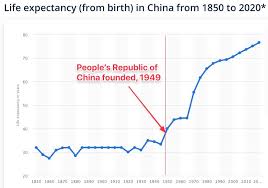
However, while central planning works for providing basic necessities because the demand for those necessities is very predictable, it is not the most efficient regarding consumer goods. This was one of the failures that caused the collapse of the USSR, the desire for consumer good and the inability to compete domestically. Furthermore, despite the increases in life expectancy, virtually everyone in China still lived in extreme poverty. The reforms in the 80s were intended to address this, and they were wildly successful at it:
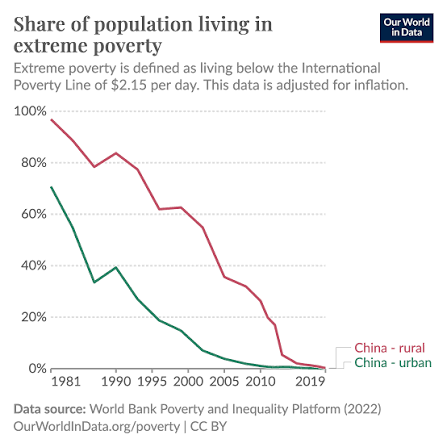
In the words of Deng, it doesn’t matter if the cat is white or black, so long as it catches mice. It doesn’t really matter if a policy is ideologically “pure,” so long as it provides clear material benefits for the common people.
Where I’m standing, the whole point of having any sort of political beliefs at all is to figure out which policies will improve people’s lives. And lifting 800 million people out of extreme poverty over the span of 40 years, can you name a more successful policy, ever, in all of history?
I think the position of those people is “Maoism was bad, the reforms were good, but they overcorrected”. Imho a perfectly coherent position as well. Quality of life in modern China is surely better than during the Mao era, and not only because if material wealth, but surely this current state is not perfect. Far from it, if you ask me.
You mean people don’t like that millions of people starved to death when Mao killed at the intellectuals? Yeah, I could see why people might have a bad view of that.
Precisely. Among massive corruption, a decadent ruling elite, and some less than ideal foreign politics, if I remember correctly.
Just because one thing is bad, it doesn’t mean that the other extreme is good. Maoism had massive flaws, but it transformed a practically medieval country ruled by warlords into a single, somewhat industrialised nation. The reforms by Deng and others, including Xi, turned it into a country with a half-decent standard of living and competitive economy. But they introduced other problems, such as massive wealth inequality and environmental issues.
Youre actually completely wrong about extreme poverty AND extreme poverty in China.
Thw World Bank’s definitions of ‘extreme poverty’ are completelt stupid. Thhe World Bank has stated that they consider 1.25USD/day to be ‘extreme poverty’ … who here could live off of 1.25USD /day? Could you live off of that? Even in China? Even in Nigeria you cant live off of that.
ALSO deng’s reforms increased the people in China living beneath the BASICS NEEDS POVERTY LINE which is a much better measure of extreme poverty since the BASIC NEEDS POVERTY LINE or BNPL measures rhe BASIC NEEDS that a person needs
Citations here and in the description of the video : https://m.youtube.com/watch?v=RStKklOC-Z4&t=926s&pp=ygUqYWxsIHlvdXIgcHJvYmxlbXMgaGF2ZSBzb21ldGhpbmcgaW4gY29tbW9u
Be better.
You’re losing
PROVE that Im losing.
You’re doing that for me, thank you!
And lifting 800 million people out of extreme poverty over the span of 40 years, can you name a more successful policy, ever, in all of history?
Democracy. I really hate this untestable argument as if we could go back in time and do A|B test to see which framework would have lifted people out of poverty the fastest. Taiwan is richer and more free than China despite being democratic, so is Japan, South Korea - what now? Which dicks do we measure and do we start at the balls or just the shaft?
I really hate this untestable argument as if we could go back in time and do A|B test to see which framework would have lifted people out of poverty the fastest.
What?? Then why even discuss anything about anything?
If you’re criticizing China’s policies, surely the point of that criticism is that you think different policies would have been more effective.
It’s also not entirely an untestable counterfactual because we can examine every other political faction that had a reasonable chance of controlling China, and see what their leadership looked like in practice, and make reasonable extrapolations based on that.
-
The Nationalists did absolutely nothing to help the rural poor, embezzled foreign aid, and were more preoccupied with hunting down their domestic enemies than repelling the genocidal fascist invaders. Chiang Kai-Shek literally had to be captured by his own bodyguards to be pressured into defending the country. Life expectancy remained completely flat during his rule.
-
The fascist, genocidal Japanese invaders weren’t a good option for obvious reasons.
-
How about having no centralized authority at all? That’s what they had during the warlord period, a time of chaos and conflict that left the country vulnerable and did nothing to improve things for anyone.
-
Before that, there was the Qing dynasty, an authoritarian monarchy which was so assured of its superiority that they completely failed to adapt to foreign innovations and technologies, out of pride, even when it was clear that those technologies were superior.
-
Then you have the various European powers, carving the country up to divy up the resources between each other, while getting half the country addicted to opium.
-
And, returning to how things played out historically, we have the one and only faction that had any intention whatsoever of helping the hundreds of millions of starving farmers, which doubled life expectancy within a generation and then adapted to changing conditions and enacted policies which, again, brought 800 million people out of extreme poverty. And the whole reason they won the revolution was because the starving Chinese peasants could tell that they were the only ones who gave two shits about helping them.
Which dicks do we measure and do we start at the balls or just the shaft?
I’m the one trying to avoid this pointless dick-measuring contest between countries with vastly different conditions, despite everyone else trying to draw me into it. I’ve said repeatedly that I don’t know why we’re comparing countries. Why don’t you ask WoodScientist whose dicks we measure, since he’s the one trying to measure dicks?
What?? Then why even discuss anything about anything?
I’m confused by your reply here. This is entirely limited to this scenario of false attribution. As we can’t verify this in any meaningful extend due to - as you yourself pointed out - every country and culture being invredibly different. So why are you OK with attributing success to chinese policy but not failure?
At the end of the day the historic justification magic doesn’t matter. I see today how unjust and miserable China is despite what tiktok might paint you. Not having internet is my litmus test and China fails this, I don’t understand how can people justify this. And please don’t try to diminish the great firewall of China - it’s really fucking bad.
As we can’t verify this in any meaningful extend due to - as you yourself pointed out - every country and culture being invredibly different. So why are you OK with attributing success to chinese policy but not failure?
I’m so confused by this conversation. Let’s recap.
Originally, OP asked why China has billionaires if it’s aiming to be socialist. I replied that the reforms that allowed billionaires also resulted in 800 million people escaping extreme poverty. WoodScientist randomly started drawing comparisons between the PRC and Taiwan, and I said that it’s apples and oranges, and that I didn’t see the relevance to what I had said. Then you started providing even more reasons why the comparison isn’t really valid, acting as if that contradicted my position in some way, which was even more confusing. You added that you didn’t like looking at other possible routes China could have gone, because it’s untestable.
Now, having established that you don’t like comparing China to other countries (calling it “dick measuring”), and also that you don’t like comparing other historical possibilities (calling them “untestable”) you’re now accusing me of being unwilling to attribute failure to Chinese policy.
First of all, which failure are you talking about? There are plenty which I’m willing to acknowledge. But also, on what basis could you call any policy a success or failure? You’ve thrown away all your epistemology. If we discount comparisons to other places, and also discount comparisons to other possibilities, then what can we look at to determine if a given policy was a success or failure?
I see today how unjust and miserable China is despite what tiktok might paint you.
Do you? What’s your point of reference for that? Some hypothetical ideal that exists only in your mind?
All I did is call you out that you can’t draw conclusions from n=1 of a policy so you can’t attribute chinese authoritarian policy for “getting people out of poverty”. So your glazing of Chinese autocrats is exactly that - glazing.
That’s completely absurd. This is the dumbest thing anyone’s said this conversation.
The sample size isn’t “n=1” it’s n=800,000,000. It’s clearly visible from the graph that I posted that the reduction in poverty began immediately after the reforms, and then continued extremely consistently on an extremely large scale.
In case you need a refresher on what the data looks like:
You’re just so committed to shitting on every single thing that China does that you’re willing to throw out all reason and logic, completely ignore obvious facts, and throw out any means of evaluating any policy just to avoid the conclusion that China may have done a single thing right.
What other possible explanation even is there? You’re just very objectively wrong.
Lol keep moving the goal post boot licker
-
And yet, China has delivered substantially lower average incomes than its peers. It’s not even close. The people of Taiwan, despite sharing a common cultural and ethnic history as mainland China, enjoy a substantially higher standard of living than their mainland peers.
Yes, they’ve raised hundreds of millions out of poverty, but that’s been the case throughout East Asia. The whole region saw its standard of living dramatically rise as it industrialized. And the capitalist countries have enjoyed far greater economic success than the communist ones.
The absolute number of people is a red herring. Obviously big countries have more people.
I’m hoping you’re not one of those .ml folks that acts like a Republican and calls every source they don’t like “Fake News.” But in case you are, can you provide your own sources? I would be curious on your thoughts of the per-capita incomes of China vs the capitalist East Asian countries. Can you show that China has performed better than them on a per-capita basis?
The people of Taiwan, despite sharing a common cultural and ethnic history as mainland China, enjoy a substantially higher standard of living than their mainland peers.
This is a ridiculous comparison. Taiwan received substantial foreign aid from the US because of it’s strategic value against the mainland, while the PRC was subject to a massive economic embargo.
Yes, they’ve raised hundreds of millions out of poverty, but that’s been the case throughout East Asia. The whole region saw its standard of living dramatically rise as it industrialized. And the capitalist countries have enjoyed far greater economic success than the communist ones.
Sorry, which countries are we talking about again? There’s not that many countries in East Asia. Taiwan, South Korea, and Japan all benefited from foreign investment and trade, and again, with much smaller populations.
If you’re going to argue that the embargo on China was an inevitable result of its communist policies, well, that’s a big part of why they did the reforms in the 80’s.
The absolute number of people is a red herring. Obviously big countries have more people.
That… what? I don’t follow what you’re saying here at all.
It’s much easier for a small country to modernize in a short period of time, especially with outside help. It’s very difficult to reach all the people in all the rural areas of China, it means more infrastructure has to be built, more people have to be educated, etc.
I’m hoping you’re not one of those .ml folks that acts like a Republican and calls every source they don’t like “Fake News.” But in case you are, can you provide your own sources?
My source is the extremely biased communist newsletter known as The World Bank. Hopefully that’s not too far-left for you.
I would be curious on your thoughts of the per-capita incomes of China vs the capitalist East Asian countries. Can you show that China has performed better than them on a per-capita basis?
I don’t agree that per-capita is the relevant statistic for the above reasons.
I’m also not entirely sure why we’re comparing China to capitalist countries in the first place.
You linked a source repeating your earlier claim about the raw number of people lifted out of poverty. Again, I ask, what about per-capita income?
This is a ridiculous comparison. Taiwan received substantial foreign aid from the US because of it’s strategic value against the mainland, while the PRC was subject to a massive economic embargo.
China received extensive aid from the USSR.
That… what? I don’t follow what you’re saying here at all.
Do you understand what “per capita” means? It would be far more impressive for a country of one million people to lift 950,000 people out of poverty than for a nation of 1 billion people to lift 800 million people out of poverty.
It’s much easier for a small country to modernize in a short period of time, especially with outside help. It’s very difficult to reach all the people in all the rural areas of China, it means more infrastructure has to be built, more people have to be educated, etc.
Why? I see no reason for this. Larger countries have more resources. Everything you need to lift people out of poverty scales with population. If anything, it’s actually EASIER for large countries to lift themselves out of poverty. A tiny micro-nation with a population of 10,000 isn’t going to be building an aircraft factory. There’s a lot of minimum-size requirements on certain national infrastructure. If anything, the bigger, the easier it is to modernize. Yes, the larger population creates greater needs, but you also have more people to address those needs.
And China was not unique in having disconnected rural populations. Small countries and big countries both have isolated rural areas.
I don’t agree that per-capita is the relevent statistic for the above reasons.
It’s the only meaningful way to compare countries. Otherwise you just end up making brain-dead conclusions like, “the big country has the big number. Therefore it’s better.”
You linked a source repeating your earlier claim about the raw number of people lifted out of poverty. Again, I ask, what about per-capita income?
Yeah, because I didn’t make any claims about per-capita income. That’s how sources work. I’m not going to provide sources for claims I didn’t make, if you’re just curious about some random fact, you can look it up yourself.
China received extensive aid from the USSR.
Lol? That’s a joke right?
You never heard about a little thing called the Sino-Soviet split? Even before that, the Soviets had plenty of their own problems, they were nowhere near as wealthy as the US and were struggling to survive and rebuild from WWII, and again, that much smaller aid for a much shorter period of time was distributed to a much larger population.
Also worth noting that the USSR initially supported the KMT over the CPC, seeing the CPC as too small and weak to be viable and the KMT as a lesser evil to the Japanese and expecting China to go through a capitalist stage of development.
Also, I thought we were discussing the Dengist reforms, which happened in the 80’s? The USSR wasn’t even around for much longer, even if they had been aiding them, which they very famously weren’t.
Do you understand what “per capita” means?
Yes I know what per capita means.
It would be far more impressive for a country of one million people to lift 950,000 people out of poverty than for a nation of 1 billion people to lift 800 million people out of poverty.
Not really, no.
Why? I see no reason for this.
Because, for one thing, modernization in developing countries is dependent on foreign technologies that have to spread to a much wider area, and that takes time and resources (resources that China lacked, because so many people were on the brink of starvation). If a big rich superpower says, “Hey, I’m gonna plop a semiconductor factory on your little island” it’s going to have a pretty significant impact on the average income of said island.
It’s the only meaningful way to compare countries.
I don’t really understand why we’re comparing countries.
Otherwise you just end up making brain-dead conclusions like, “the big country has the big number. Therefore it’s better.”
That is not remotely close to anything I’ve said or believe.
I said things about the success of the policy of the reforms and opening up in the 80’s, and you’re bring up all these other countries that I said nothing about and trying to compare them on absolute terms for some reason. I’m not saying one country is better than another country, I’m just looking at the effects of a particular policy. If you want to argue whether your dad could beat up my dad, you’ll have to find someone else to do that with.
Taiwan received substantial foreign aid from the US because of it’s strategic value against the mainland
And? China literally owns the 4th largest land mass in the world. So which variables are allowed in this math and which aren’t? Maybe if you give us a list we can defeat your delusion more swiftly.
Which variables are allowed in the math depends on what the point of the comparison is. And as I said, I’m not really sure what the point of comparing these countries is. It’s pretty apples to oranges and doesn’t really tell us anything about the efficacy of China’s reforms in the context of their specific conditions.
The fact that there’s such a difference in landmass is just another reason why it doesn’t make sense to compare the two. If you want to compare China to another country for some reason, it would probably make sense to compare it to a country with more similar conditions, like India perhaps.
You’re making a false dichotomy fallacy…
Like, the problem is that we don’t like neither because both are shit, just as USA, Russia and Ukraine are.
There are more than these two options, and is reasonably to want one of these.
Like, why aren’t they more like Iceland, Finland, Switzerland or Norway?
Honestly, these are the only countries I do like in the world, specially Switzerland and Norway.
Like, why aren’t they more like Iceland, Finland, Switzerland or Norway?
Honestly, these are the only countries I do like in the world, specially Switzerland and Norway.
That’s probably because you’re only looking at the surface level and not understanding the history of why countries and cultures make the decisions they do. Because all around the world, you can find countless examples of people trying to enact moderate social democratic policies, and being labelled as communists anyway and getting exterminated by far-right militias funded by the US. You generally don’t hear about them because they’re long dead, but the people of those countries remember their examples.
European countries generally haven’t had to worry about that as much, being essentially vassals of the US instead of colonies, they are granted much longer leashes. But those countries outside of the West who recognize this and take necessary measures to survive are generally denounced as “authoritarian,” justifying more open acts of aggression against them. The harsh truth is that when you look at examples of existing socialism and wonder why they’re not more open, it’s survivorship bias.
Take the example of Mohammad Mossadegh, a peaceful, progressive, democratically elected prime minister of Iran. After generations of struggling to convince the British to negotiate and abide by agreements regarding the oil they were stealing, Mossadegh nationalized the oil industry, in order that the profits from it would help lift ordinary Iranians, who were some of the poorest people in the world. He was faced with a devastating embargo, and was ousted in a coup led by the CIA.
What makes Mossadegh a particularly poignant example is that he did everything “the right way.” When all then newspapers in the country were taken over by the CIA and started printing constant criticism of him, he respected the freedom of the press and did nothing about it. When the CIA hired protesters to march in the streets, he respected the freedom of assembly. He never shut down the US embassy which the CIA was operating out of, and in fact, when a diplomat called him, days before the coup, feeding a false story about the embassy getting death threats from his supporters, he put out a public radio message urging his supporters to stand down and stay off the streets. When the coup happened shortly afterward, there was no one to come to his aid.
Mossadegh was replaced by a literal monarch who used secret police to hunt down and exterminate the Iranian left. When the shah fell, the left was too weak to step into power, and that’s how they got the government they have now. Generations of Iranians suffered from political repression and economic exploitation under the shah, only for it to be replaced by the repressive government they have now. It could very well be a hundred years until the Iranians get another chance at a leftist government.
With those stakes, with the ever-present threat from the US, is it actually so commendable to do things the “right” way, like Mossadegh did? To fall on your sword, knowing that you didn’t commit the sin of authoritarianism, but that millions of people will suffer generations of oppression because you failed to protect your country from the colonizers?
When you understand that this is the reality of every country outside of the imperial core, you start to have more sympathy for those countries and projects that have actually succeeded and survived, even if they have done so through ideologically impure means.
I very much appreciate the extensive response, and the time and effort you probably printed on it. Actually, the reading was very interesting.
Even so, I must say that while I do not believe that a disproportionate purity like Mossadegh is correct, as it ends up being rather naive, I do not think that reaching the extremes of China, Russia and Ukraine is correct at all. Citing one of my favorite philosophers, Aristotle, and the one that is my favorite book of ethics, Nicomacus Ethics, virtue is the just (or point) half between two vices, one by excess and one by default. Yes, Mossadegh sinned by default, for being too soft, but Jinping, Putin and Zelenski, for just putting a few examples, sin by excess, are too authoritarian and, above all, repressive.
If the objective is to guarantee the best possible conditions for its population, which I do not understand why they do exactly the opposite: to suppress, to increase the gaps of equity, to censor, to make cults to the image and personality, to destroy the freedom of the press, to enrich the country (and its own pockets, as we are) at the cost of the poorly paid (and often even unpaid) work of millions of poor working-class people (the absolute majority of the population), to destroy the right to privacy, to punish dissidences and freedom of thought, etc.
That’s where the point is, I think.
Citing one of my favorite philosophers, Aristotle, and the one that is my favorite book of ethics, Nicomacus Ethics, virtue is the just (or point) half between two vices, one by excess and one by default.
What defines the standards of what is considered excess? Go back a thousand years, and nearly any modern government would be considered “excessively” democratic. Or, look at the debates over slavery in early America. The idea of immediate abolition of slavery was the most extreme position then, yet it’s considered a given today. Looking back at all the compromises made to “keep the peace,” it seems like they only served to prolong the institution of slavery, and that conflict was necessary and unavoidable.
If we really want to play with the idea, I wonder if the Golden Mean implies that nonbinary people are better than everyone, because ideally you want to be balanced between masculinity and femininity. It’s pretty clear that we cannot apply the Golden Mean uncritically to all possible qualities.
If the objective is to guarantee the best possible conditions for its population, which I do not understand why they do exactly the opposite
They don’t. You’re painting a one-sided picture that only looks at the negative. They have eradicated extreme poverty, they invest in massive high speed rail projects and develop green energy. The average Chinese person has seen massive improvements in their material conditions in their lifetime.
Much of what you’re discussing are political freedoms. It’s true that I have more freedom to talk shit about my government than people in China do about theirs. But all I can really do is talk shit. The politicians aren’t going to care how much I criticize them, they’re bought out by corporate interests, and many of them are in safely gerrymandered districts. At the same time, economic conditions can restrain one’s freedom as well. My right to shit-talk my boss doesn’t mean much if my boss can fire me on a whim and I need the job to survive. Is being able to whine impotently about politics really worth having to follow whatever rules a landlord sets for you because you can’t afford your own home? Meanwhile, home ownership in China is over 90%.
With all that being said, China’s system is not my ideal. However, I do believe that China’s existence is necessary for more ideal systems to emerge around the world. Without China, the US’s status as global hegemon would be completely unchallenged, and it would be all the more free to ruthlessly suppress any remotely left-leaning political projects, anyone on the globe, through sanctions and coups. But, the more ruthless and aggressive they are, the more countries turn to China, because it exists as an alternative. Even if China were as bad as the US, it would still be preferable to have power divided between two superpowers than one.
However, I do believe that China’s existence is necessary for more ideal systems to emerge around the world.
That is an important point, and it could be applied to some more radical political figures in general. I don’t want to live under a radical communist government, but a radical communist politician is needed to make a moderate socialist look like a sensible alternative to “the center”. Unfortunately this works the other way around as well, as we see absolutely lunatic fashists emerge who make otherwise far-right populists look sane.
Norway? Massive oil reserves and natural resources in a country with a small population. Imagine Quatar with a more sane government and much more sane (and richer) neighbours. Plus self-sufficiency in terms of agriculture.
Switzerland? It was the one neutral country where everyone parked their emergency money. They played all sides in ww2 and won. Everyone needs a neutral ground to negotiate and put their fuck-off money.
Both very exceptional cases.
Yeah, and that’s very unfortunate, I wish it was the rule. Unfortunately, utopia are almost impossible to achieve.