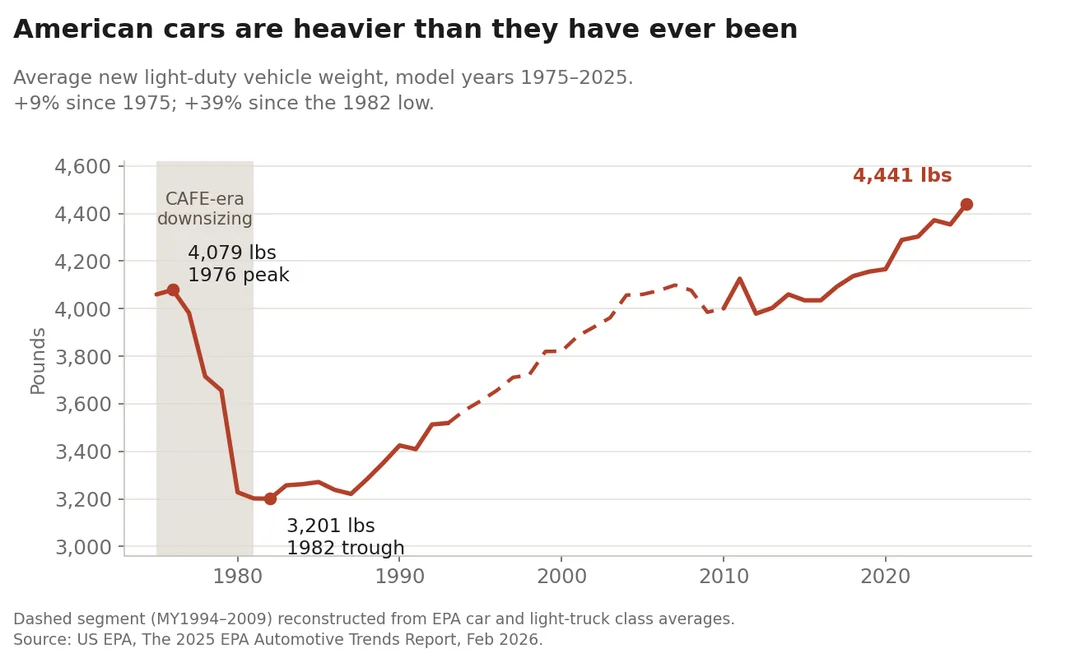
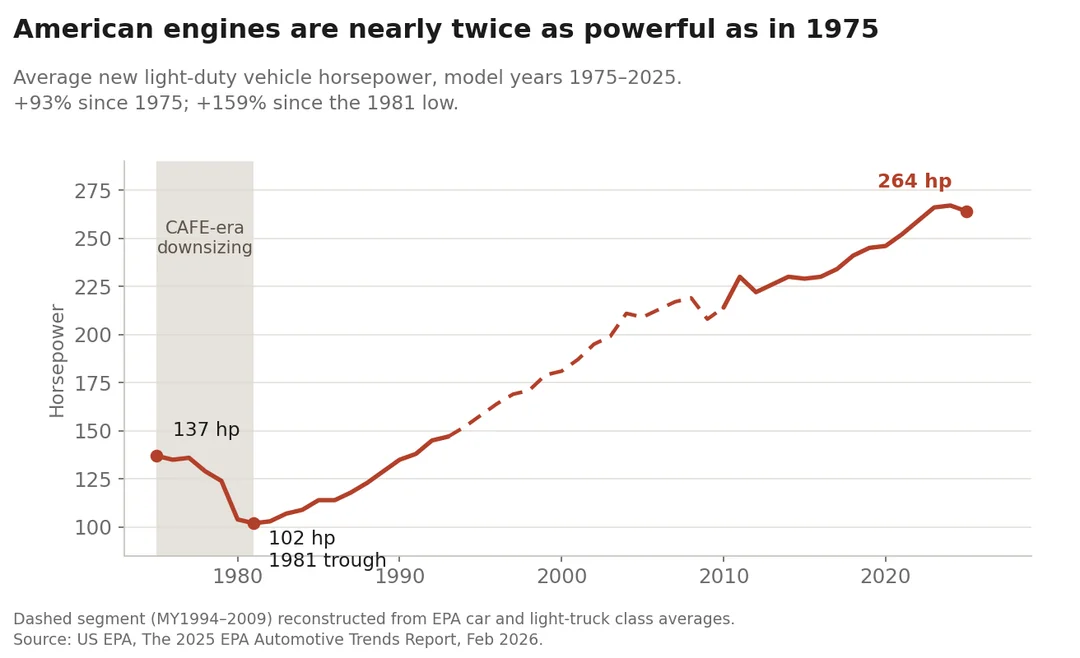
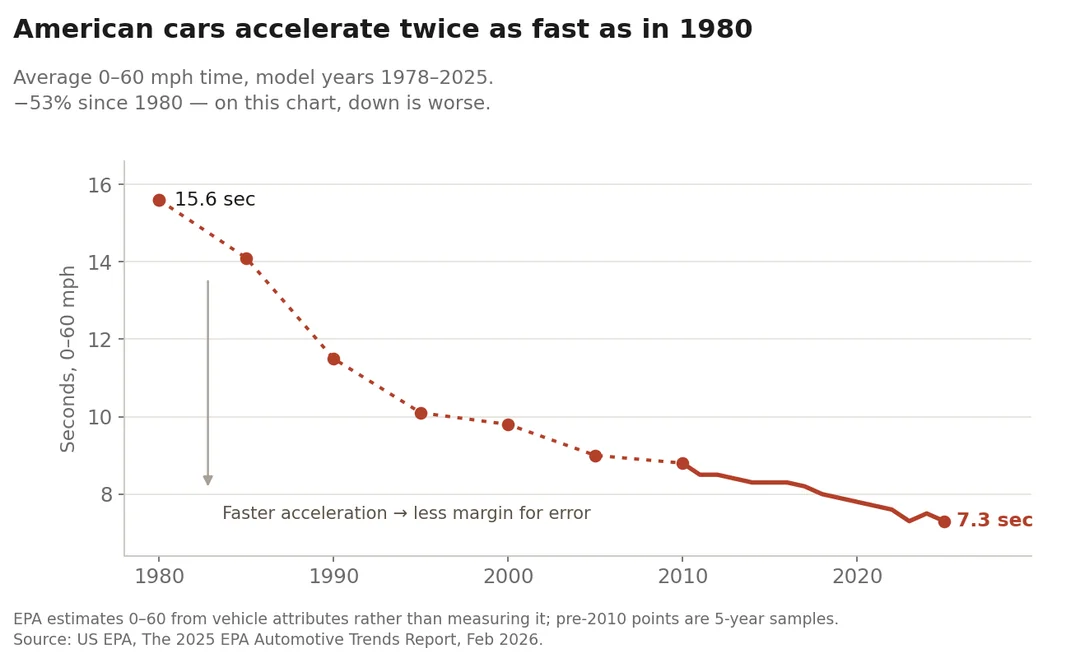
That’s vehicles classified as “light duty” — pickup trucks.
All other vehicle classes are down in curb weight over that same period.
Yeah, show us the average numbers for all vehicles used for private personal transport then.
https://www.consumeraffairs.com/automotive/average-car-weight.html
The average weight of passenger and commercial vehicles has varied over time. The pickup truck, which is America’s best-selling vehicle style, has bulked up considerably since the mid-1970s. As of 2024, the pickup truck has an average weight increase of 30% from 1975. Other vehicle styles, such as sedans and wagons, have slimmed down by 10%.
You know, eventually you’ll need to learn how to use a search provider on your own.
You know, eventually you’ll need to learn how to use a search provider on your own.
Watch it. The only reason your comment didn’t get removed is that @Jiral found your link useful.
soft
Removed by mod
Ah, ad hominem. Always nice.
Your quote does not answer my question, but the source you linked to actually did.
Average vehicle weight by year
2014: 4060 pounds
2024: 4419 pounds
deleted by creator
But those searches don’t tell me what I want to hear!
Another issue is that more people are buying “light duty” vehicles…
It’s infuriating. The number of trucks with their ass hanging out of driveways and parking spots is a legitimate public safety emergency.
And it’s probably worse than that graph seems to show… Since people are moving to a larger vehicle class mostly due to marketing rather than use case…
square metres
US-americans will get a stroke
I guess that will lessen the number of insanely sized cars and drivers then…
12 yards long, 2 lanes wide, 65 tons of American pride!
Can you name the truck with four wheel drive?
Smells like a steak and seats thirty-five.12 yards long, 2 lanes wide,
65 tons of American Pride!
She blinds everybody with her super high beams,
She’s a squirrel crushing, deer smacking, driving machine!
Top of the line in utility sports!
Unexplained fires are a matter for the courts!
Fat people want big cars. You can overlay these graphs.
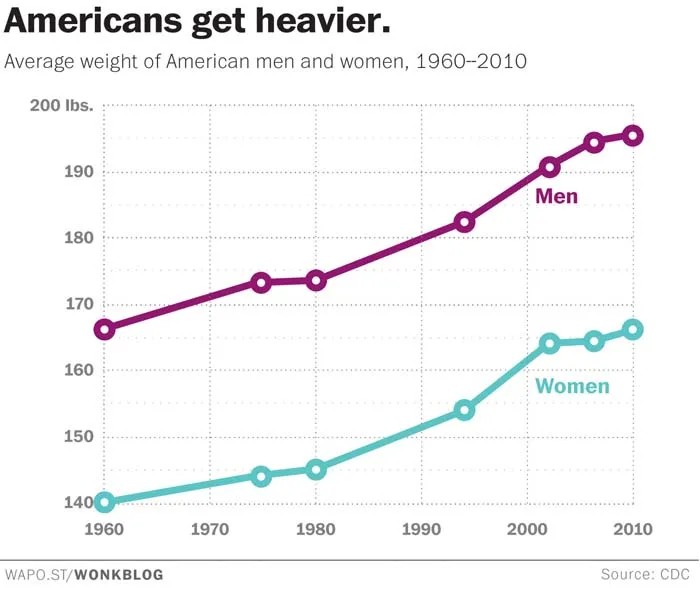
This would be interesting to see with height as well.
Anecdotal but I’m 6’1", vehicles like the Miata or BRZ or Tacomas sometimes make me wish I was shorter… and didn’t have chronic nerve issues in my legs that make small cars painful to sit in
I’m 6’3" and only drive small cars. The form fit the industry uses is the same from trucks to hatchbacks, but fat people prefer taller SUVs and trucks for entry/exit.
No, there is significantly less leg room in lower vehicles, which always have higher floors. I can go from comfy in a Tundra to knees in my chest in a Tacoma.
Ride height? Or height of the people?
If the former, that tracks. If you’re heavy-set, getting in an out of a sedan (for example) is just plain uncomfortable. Meanwhile, having a seat you can just swing your hips into, or even climb up into, probably works a lot better.
Yeah, meant people’s height.
There is a plausible causal relationship between these two measurements, though. Not proven (at least, not by anything @SaveTheTuaHawk wrote), but plausible.
Fat people are more comfortable in taller/wider vehicles. Ever watch a fat dude get out of a sports car? hilarious.
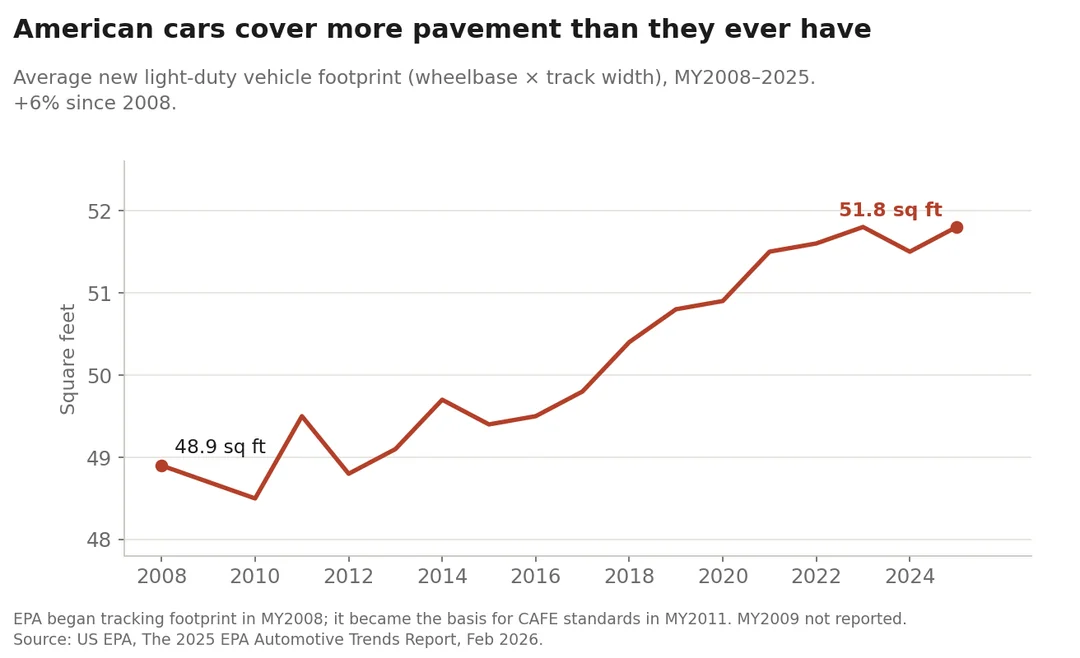
American cars cover more pavement than they ever have
Then goes ahead and shows a change from 48.9 to 51.8
Whoever made those charts wanted to make the change look bad, no matter what.
Where is the chart of the average heavy injuries per passenger? Or the average energy efficiency of engines?
injuries per passenger
The fact that you phrased this so specifically to not mention the corresponding increased danger to other road users and pedestrians, suggests you’re a shill pushing industry talking points.
Maybe I am just Mr. Ford
to be somewhat fair to the auto industry pedestrian habbits probably changed, but they probably changed to be more afraid of cars.
The graphs are terrible but come on, a 10% increase in weight in 10 years, doesn’t sound bad to you? Especially when the base value was anything but low to begin with? And an increased space consumption of 6% is a huge additional space consumption in absolute numbers, given the huge numbers of cars.
The weight gain could theoretically be explained by the simple fact that electric vehicles are heavier than their combustion counterpart.
Though I’m well aware these are american cars so probably just means more bigger pickup trucks that will never ever be used to actually pick things up.
Hardly, the EV adoption rate in the US is pretty poor and even if we ignore that, the share of EVs among existing vehicles on the road is way to small to be the dominating factor for the increase in weight. That said, yes, EVs will lead to an increase in weight, a necessary evil. However, that can be compensated by downscaling vehicles to actual needs. People are currently buying cars far larger than what they actually need for partly irrational and partly egoistic reasons (increasing threats to life and well being towards others in the hope to slightly decrease it towards oneself).
The graphs doesnt say “cars on the road” it says “new vehicles”. As in, new vehicles sold. Today. Are heavier than new vehicles sold, 5 years ago.
Yeah, electric versions of American monstrosities are part of the same problem and completely offsets any EV benefit. They just shouldn’t exist.
Or plug in hybrids. Even a 20kwh battery is quite hefty.
When it comes to covering pavement, it also starts at like 2008. Which is funny because I can guarantee you just from being around them that cars from the 70s were gigantic. Long hoods, big old protruding trunks.
I imagine the reason why the change is so small and why it’s not quite a linear progression. There is that initial decrease again immediately post recession is just the shift in what’s available for stock in the US.
The height of the SUV boom pre-recession, those cars were big. Like, we have CUVs now. Those are built on car chassis, which means they are about as long as a car is, about as wide as the car that they’re based off of. For example, a Mazda CX6 is just a Mazda 6, but like, fatter. The popular SUVs of the late 2000s were like actually full-on SUVs built on heavy truck platforms. So we had things like the Hummer and of course the Escalade of the day which were gargantuan. At the same time, because those vehicles got like single digit miles per gallon, people tended to also have commuter cars, which were also a lot cheaper back then. We’re talking like low 10,000s or less.
Post-recession though, like we did start seeing a lot more small cars again. For example Chevy brought in the Aveo and eventually the beat in the spark, Honda Fitts became bigger in terms of popularity, Ford brought over the Fiesta. And then gas went down again and because Americans have memories like a goldfish when it comes to gas, car sizes started growing again. When it happened again a few times during the 2010s and of course the big one during the pandemic and now cars had gotten more efficient in terms of their engine engineering and in terms of the prevalence of things like electric cars and hybrid units.
So that mid-sized CUV Is able to get better mile per gallon age or similar mile per gallon age to what someone driving around in a compact in 2007 might have gotten.
There’s also a lot of unintended consequences from safety and computer designed aerodynamic models that have led to cars being shaped a very specific way with very thick A, B and C pillars which make the car door openings smaller which make the taller CUV options a little more appealing as well.
Also, just as an aside, I’m sure full-sized trucks wreck the curve because those have been getting bigger and bigger and bigger and it’s kind of nuts how big they are and how, despite that, they’re also less practical as work vehicles than ever before. Genuinely kind of stupid.
Yea this looks misleading as fuck. Weight graph starts at 3000lbs too. Also no mention of the cars polluting the nearby environment a lot less despite getting heavier. And why measure acceleration instead of measuring brake distance, or pedestrian survivability, or crashes per million miles etc.
“A lot less” is something I’d like to have a source for, especially as the switch to SUVs and trucks is done to a large part to evade the much stricter emission norms for officially classified “cars”. Emissions could be a lot lower if the SUV loophole for many of the car norms had not been invented.
i think this is about toxic gases emissions vs CO2 emissions. while CO2 emissions have probably gone up somewhat (my guesstimate is +30% since 1970), the toxic gas emissions have almost completely gone to zero. there was a whole lot more toxic gases around in the 20th century industry and machinery, you had to cough constantly, we just don’t remember it because it’s comparatively clean now.
Toxic emissions have absolutely not gone down to zero. High respiration activities next to a highway still get you a solid dose of toxic stuff. Yes, it would be much worse with 1970s vehicles but it would be much better if the majority of vehicles sold today would not be able to use the regulatory SUV/truck loophole to be able to pollute more. This loophole is not just about CO2.
I witnessed myself what a huge impact on air quality it had on a street to see heavy two lane traffic gone and that had nothing to do with CO2 and it was even without that loophole you have in the US.
do you have any numbers how much toxic emission there is today compared to 1970?
No but I have a nose and lungs and I can smell the difference next to roads with jammed heavy traffic, it ain’t the CO2 and I am not simply imagining pollutants.
“almost completely zero toxic emissions” is a fairy tale. Respiratory issues remain to be a bigger issue in cities for a reason.
Toxic emissions from road traffic remain as major health problem in the US: https://www.pnas.org/doi/10.1073/pnas.2107402118 (not the newest data but you are not claiming that in the 10 years since, everything has changed ro the beeter,are you?), even if progress has been made. I can’t wait to see those dirty combudtion engines (no matter how much you purify the exhaust) vanish from the streets. In Europe we are on the way at least even if China will ve likely faster
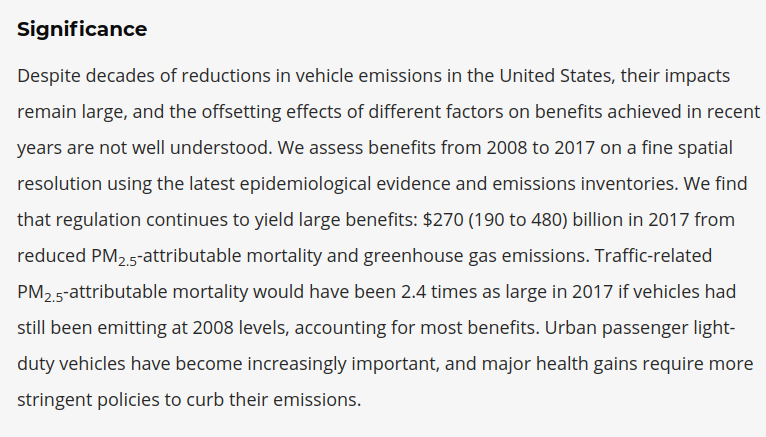
well sounds to me like deaths from toxic emissions sank by roughly 60% from 2008 to 2017. it’s not “almost down to zero” in that time frame but a lot has happened between 1960 and 2008 too.
SUVs are still popular and large trucks are just awful. It’s a big problem in this country. But most of the cars sold aren’t actual SUVs. They’re CUVs. They’re built on car chassis. They are heavier, which means they get worse fuel economy than their car equivalent. And they’re less aerodynamic, which means they get less fuel economy than their car equivalent. And that weight means they also erode their tires faster, which of course is just worse for the environment as well as well as their brakes and other components.
That said, the difference in size compared to their sedan equivalent, or even hatchback, five-door equivalent, is not tremendous. Even efficiency, the loss is usually maybe like a couple of miles per gallon on the tests. Though I imagine if you try to hyper mile and you know baby is a throttle you can get more out of the car-shaped vehicle than you can the fake SUV/CUV shaped vehicle.
Pedestrian safety, especially for children, is however much worse, luckily no one cares about that in safety tests in the US. In Europe you get downgraded for it.
yeah axes should start at zero.
I’m not sure it’s reasonable to directly complain about fast 0-60 times. Slower acceleration removes options and makes merging more difficult; not all high speed roads have onramps of adequate length.
Definitely agreed on weight.
The Y scale on the third graph is a joke; that’s like a 4% change over 20 years. Wheelbase is not the same as vehicle length.
I’m not sure it’s reasonable to directly complain about fast 0-60 times
It is certainly cause for concern when heavier and larger moving objects that are able to reach high speeds quicker are being controlled by increasingly more irresponsible people.
This is why there is an increase in SUVs crashing through shops when grandpa hits the wrong pedal.
0-20 times and 0-60 times are not necessarily closely correlated.
Could argue that’s due to a reduction in manual vehicles, or a reduction in driver competence / medical status.
Something that’s twice the weight with twice the horsepower only accelerates the same speed. Double the weight and keep the horsepower and you’ll go half as fast.
The graphs aren’t entirely 100% related to each other. The twice as fast acceleration average isn’t because of the double horsepower, that only works if the weight also isn’t doubles.
EVs have massive torque from zero speed. Horsepower is just a fake number derived from torque. A Model Y is both heavy and makes 500ftlbs torque immediately.
Horsepower is just a fake number derived from torque.
I don’t really disagree with your earlier comment, and I agree that the shape of the torque curve matters a lot when it comes to the practicalities and experience of driving a vehicle, but, uhh, what you said here is just completely wrong.
Force and speed (torque and RPM) are both components of power (horsepower is torque * RPM / 5253). Saying that the RPM, or time component, of that equation doesn’t matter is the same as saying it wouldn’t matter if it takes 10 seconds or 10 years for a crane to lift a load at a construction site, since its lifting the same weight either way.
To put it another way, with a long enough lever I can exert enough force to start a passenger train rolling down the tracks with just my own arms (and in fact, people do something similar using compound levers). But what that doesn’t let me do is move a passenger train at 200 MPH like high speed rail lines do. There is no arrangement of gears or mechanical linkages that will let a single human being power a high speed rail line like that, the human body does not have enough power output.
Both are very limited comparability especially between drive types.
Torque was normally measured ahead of the gearbox and that introduces a whole pile of extra messiness.
Power is relevant once you’re into higher-speed regimes e.g. merging onto a fast road, overtaking, and climbing hills (especially if towing).
Force-speed or acceleration-speed curves would be nice.
The acceleration of Teslas is one reason they have the highest crash rate of any brand. Fucking stupid to give the public more horsepower than a 70s formula one car.
The Y scale on the third graph is a joke; that’s like a 4% change over 20 years. Wheelbase is not the same as vehicle length.
I want to see that chart (a) starting at 0 sq. ft., and (b) going all the way back to the '50s.
Yeah, American cars have had a reputation as ‘land yachts’ for a long time.
For most cars, higher acceleration I don’t think is an issue. However things like the Hummer EV weigh 9,000 pounds and goes from 0-60mph in a smidge over 3 seconds. The amount of damage that can do is insane
I don’t know if these graphs, again, I don’t know what the source is, it’s not really provided, but I don’t think they’re meant to make a specific judgment one way or another.
Well, except the note that cars have gotten bigger while also becoming more efficient.
It explicitly says “on this chart, down is worse”.
The 5 square meters are no accurate display of the pavement covered by those cars, because they’re much longer than just their wheelbase.
About double. American cars tend to be bigger so 5m long and 2m wide is probably a fair approximation. Hell, even in Europe the average car is probably something like 4,5m by 1,7m
Has the average ratio changed over time?
I would’ve expected the ratio to actually shift the other way, where the wheelbase represents a larger percentage of the overall length/width of the vehicle, because American fuel economy regulations actually rewarded vehicles for having larger wheelbases. This killed small cars like the Honda Fit and small trucks like the Ford Ranger.
Also, it seems to be much easier to park vehicles whose front wheels are as far forward as possible. The greater the ratio of wheelbase to overall dimensions, the easier it is to maneuver, and anecdotally it seems easier to maneuver modern cars than cars from 25 years ago.
The true measure is dick to floor.
After swimming or before?
Just the empty cars and not with an average American inside, right?
There are a few different stories going on here.
One story is engineering success. The engineers squeeze out so much more performance per amount of gasoline burned, that the cost of extra weight from a fuel economy standard is significantly less than 25 or 50 years ago. If you chart the fuel efficiency over the same time period, the fleet average fuel economy went from 20 to 34 mpg, even as vehicles were getting more powerful and heavier. A 2026 Camry Hybrid has a 232 hp drivetrain (184 hp from the gasoline engine) that manages to push 3700 lbs 0-60 in 6.8 seconds. Those are sports car stats from the 80’s, and yet the modern Camry manages to get 44 miles per gallon in fuel economy. Charting emissions shows an even more pronounced improvement.
Similarly, the rise of electric vehicles has increased the average vehicle weight. Batteries are heavy, and the whole chassis needs to accommodate that.
Another story is unintended consequences from dumb regulations. The fuel economy standards were updated for the 2011 model year to allow a sliding scale where vehicles with larger footprints were allowed to be less fuel efficient. Naturally, smaller vehicles were disincentivized, and compact trucks and compact cars all but disappeared. These regs need to be updated, and we’ll see the return of smaller vehicles for those of us who prefer them.
And another story is shifting consumer preferences. For a whole bunch of reasons, Americans have expressed a preference for taller and taller vehicles, where crossover SUVs are much more common than the old wagons, the relative balance of sedans versus SUVs has shifted entirely in favor of SUVs.
Is there a metric version?
I can convert it to bananas for you if that helps
It’s 'Merica, so…no
'Merica is more metric than even USians are ready to admit.
America needs to make its own KEI car standard. at least they wouldnt be as dangerous for pedestrians, or as disastrous for the environment as the fucking rolling city blocks we have now.
Especially since we’re never gonna get a functional public transit system.
I’d settle for at least legalizing Kei trucks across the country
It’s beyond frustrating that I can’t even drive my own Kei truck on public roads where I live
legalizing Kei
No can do. That would be one letter away from legalizing DEI.
I thought kei cars/trucks/etc were legal if they were over 25years old due to antique car laws?
deleted by creator
I wonder if also legalizing 4 wheelers on public roads would improve the odds of it passing
I live in Japan and drive a kei van. It’s already scary going 100 on the expressway with the lightness of the vehicle and the wind. The acceleration time is also quite slow compared to many vehicles (the limit is 660cc engine size iirc). I don’t think it would sell without first making the US highway system safer in general. The highest speed limit in Japan is 120 and many us states are much higher
One of the sad bits of this is that the move to EVs, while a positive in many ways, also makes our cars even heavier for the battery.
It’s an arms race. I prefer a bicycle, but am I really insane enough to ride it in between these tanks? My wife is afraid in traffic, she would never want to get a small car, just because of her safety concerns.
The only thing stopping this madness is regulations.
My wife and I purchased a new Japanese car last year. Nobody makes small cars anymore, except maybe Suzuki with the Swift? Our small cheap car is bigger than we had anticipated. Good car though.
When I get in some of the newer SUVs it feels like driving a boat.
No they do make small cars (maybe just a bit bigger than 30 years ago for saftey). They might just not be sold in the country where you live.
Relevant watch : https://www.youtube.com/watch?v=JPm4de6-eTg