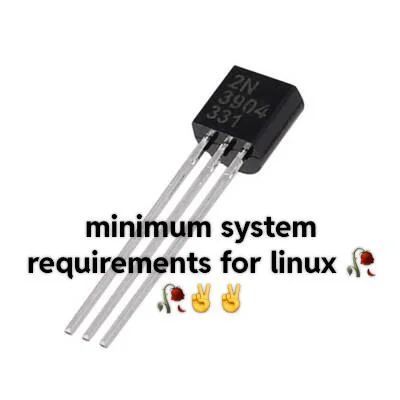

I know a guy who got Linux running on a diode.
Some joker will get it to run on a 1N34A.
Requirements are one resistor. Gold band for optimal performance.
I code by laying out gravel patterns for crickets to run through.
I don’t mean to brag, but I have two of those.
I will probably be hated for this.
NetBSD’s slogan is “Of course it runs NetBSD”, and with good cause.
I will probably be hated for this
Why?
BSD isn’t Linux.
GNU’s not UNIX
GNU/Linux Copypasta
I’d just like to interject for a moment. What you’re refering to as Linux, is in fact, GNU/Linux, or as I’ve recently taken to calling it, GNU plus Linux. Linux is not an operating system unto itself, but rather another free component of a fully functioning GNU system made useful by the GNU corelibs, shell utilities and vital system components comprising a full OS as defined by POSIX.
Many computer users run a modified version of the GNU system every day, without realizing it. Through a peculiar turn of events, the version of GNU which is widely used today is often called Linux, and many of its users are not aware that it is basically the GNU system, developed by the GNU Project.
There really is a Linux, and these people are using it, but it is just a part of the system they use. Linux is the kernel: the program in the system that allocates the machine’s resources to the other programs that you run. The kernel is an essential part of an operating system, but useless by itself; it can only function in the context of a complete operating system. Linux is normally used in combination with the GNU operating system: the whole system is basically GNU with Linux added, or GNU/Linux. All the so-called Linux distributions are really distributions of GNU/Linux!
Oh man you got there before me hahaha
GNU isn’t UNIX
GNU: Not Unix
GNU != UNIX
G!=U
You may not like it, but if your distro can’t run on this, it’s bloated.
This made me look up if you could somehow run it on vacuum tubes, sadly not
9 day boot time on a 4004!
He eventually got it down to under 5 days!
OMG!
I booted Debian Linux on a 4-bit intel microprocessor from 1971 - the first microprocessor in the world - the 4004. It is not fast, but it is a real Linux kernel with a Debian rootfs on a real board whose only CPU is a real intel 4004 from the 1970s. The video is sped up at variable rates to demonstrate this without boring you. The clock and calendar in the video are accurate. A constant-rate video is linked below.
I’m sure someone could figure out how to boot Linux on a vacuum tube computer. The problem is there just aren’t that many around that are still operational.
Of course you can run it on tubes, in principal, since they do the same as transistors at the end of the day
I guess I more wondered if some madlad had actually done it
Someone has done it this with relays so I don’t blame you for asking.
Don’t get it twisted
Not quite just a transistor but maybe something like this (an SOC with 32MB ram which costs about $5 in bulk) though it does require quite a bit of additional electronics to work.
Also somebody also made an embedded Linux for the ESP32-S3 (which is even cheaper and doesn’t require anywhere as much auxiliary electronics).
PS: Yeah, I got the joke. Just pointing out that the reality itself is quite impressive.
Some crazy fucker got the OG Tomb Raider to run on an ESP chip.
Although the ESP is significantly more powerful than the original console.
Tomb Raider… not Doom, I’m shocked
I think someone already did that one
figures
https://dmitry.gr/?r=05.Projects&proj=07.+Linux+on+8bit
This guy ran linux on 8-bit microcontroller by emulating a hogher end processor on an 8 bit computer. He also emulated the ram on an SD card.
Slow as heck, but can be done.
funny thing - the SDRAM used provides 300kb/sec, while the SDcard used as storage provides 200kb/sec. Performancewise they could just skip most of the ram outside of booting and use the SDcard without losing much performance, especially since the SDRAM needs to be refreshed every 62ms for a duration of 3ms regardless of use.
Edit: I LOVE this part:
It takes about 2 hours to boot to bash prompt (“init=/bin/bash” kernel command line). Then 4 more hours to boot up the entire Ubuntu (“exec init” and then login). Starting X takes a lot longer. The effective emulated CPU speed is about 6.5KHz, which is on par with what you’d expect emulating a 32-bit CPU & MMU on a measly 8-bit micro. Curiously enough, once booted, the system is somewhat usable. You can type a command and get a reply within a minute. That is to say that you can, in fact, use it. I used it to day to format an SD card, for example. This is definitely not the fastest, but I think it may be the cheapest, slowest, simplest to hand assemble, lowest part count, and lowest-end Linux PC. The board is hand-soldered using wires, there is not even a requirement for a printed circuit board.
6 hours to get into X is ridiculous- and i misread - it takes 6 hours to boot , and then hours more to get an X server running lol
Ok, but with emulation and enough time, you can run any software on as much as a light switch.
>Not quite
>has about 1.5 million gates in the CPU alone
>each gate is multiple transistorsThere are some not practical, but workable as proof of concept examples that go even lower:
https://hackaday.com/2012/03/28/building-the-worst-linux-pc-ever/
88 pins, that’s way too many!
Is there a 32 pin DIP-32 chip that can run Linux?
Well, as two people already pointed out, turns out somebody got Linux to run on the 8-bit ATMega1284p microcontroller which comes in a DIP package, though it’s 44 pin rather than 32.
It’s funny but it’s not true
Well, not with 1. But collect a few million transistors,

Gosh, his character as ‘himself’ on Arrested Development was so damn good. It gets me every time. I think I’m way past due for another rewatch; thanks for reminding me! This was also a wonderful usage of the reference and gif! :)
Plot twist: it’s actually a whole SoC packaged to look like a single transistor, with the pins being for +V, ground, and a 1-Wire data bus.
I don’t know that such a thing exists, but these days I bet it could.
You’re right. A lightbulb plugged into a potato is the real minimum system requirement.
But could it run doom?!
Not with that attitude!
looks at the community name
reads at the comment
SmhJust set the gate to high
Linux requires at least 32 bit machine words, and it always has. Linux was originally written for Intel 80386.
Linux requires a hardware MMU to support virtual memory. There are patches that can make a no-MMU kernel, but it drastically changes the experience to do so.
There’s an ESP32 with MMU running Linux now
Well it is kinda cheating but Linux does “run” on a intel 4004 running a MIPS emulator
I think you could cook something like a 4-bit turing complete computer with around 100 transistors or so. And i guess turing completeness basically means “it will run with enough elbow grease” in this case
(if we exclude memory from the transistor count…)
Shows image of a common NPN bipolar low power transistor
You’re telling me that a Japanese (Nippon) person with wild mood swings and low self esteem who identifies as a trans sister, also runs Linux? How is this news.
wait till you hear about igbt trans sisters
I run arch btw
(Optional)
Install directly into the base of the brainstem
Every time I woke up would be like
GRUB RESCUE> _
[Optional]
This meme made me wonder what’s the minimum number of transistors needed to run linux